Peruvian artist Yerko Zlatar’s repositioning of the Inca sacramental figure of the huaca is interesting in many aspects and for several reasons. In the first place, because it uses its architectural structure to create an unquestionably contemporary work, and secondly because it points to the vast amount of research and exploration needed for the artist to redefine our intercontinental culture without losing conceptual rigor or falling into simplifications or political literalism.
Anthropologists and historians dispute the scope and meaning of the term huaca. The discussion—oscillating between early Hispanic interpretations and more recent and local readings—recognizes topics and signs common to the different Andean regions. Beyond conceptual controversies, a huaca is a sacred and sacrificial stone edifice that brings together past lives and the memory of death. The primordial architecture of the huacas were Zlatar’s main source for developing the pieces that filled the Fleisch gallery with artistic and sociohistorical modulations.
Fleisch is a singular exhibition venue. Clearly inscribed in an alternative or lateral dimension outside of traditional circuits, it proposes a different space in a different context. This allows the gallery to imagine creative and risky exhibition designs that are not subjected to the rhythm and rigors of more conventional galleries.
The team—formed by Nicolás Sfeir, Manuela Barreiro, and Carlos García Montero—offers a mix of nationalities, traditions, and disciplines; a quality that lends Fleisch its hybrid and contemporary aura, strongly marked by an architecture that can adapt very well to the versatility needed in these times.
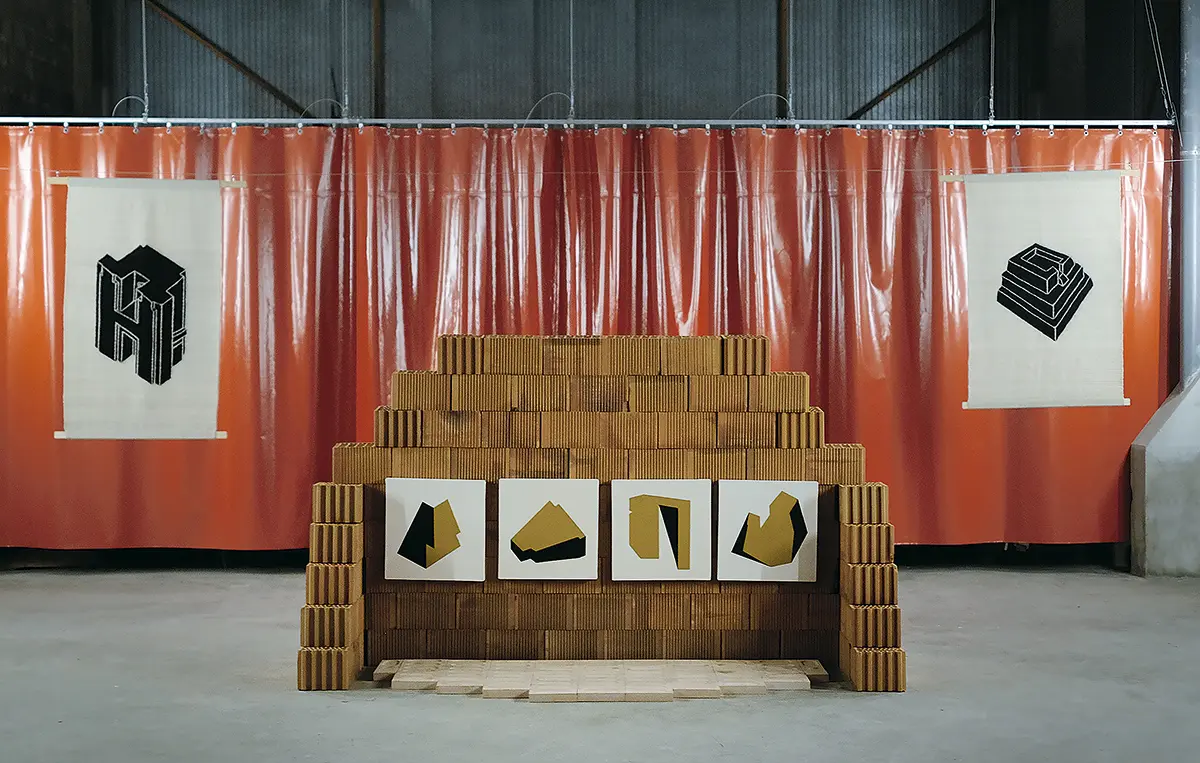
Seen in its entirety, the work presented by Yerko Zlatar at Fleisch qualified as an installation. At the center of the large room was a brick structure that reproduced the forms of a huaca on a smaller scale. The tiered arrangement and the altar-like shape recreated a sacred atmosphere. This simulated Inca ruin had, at the same time, a clear projection towards other forms in the history of architecture, resulting in an amalgam of times, material elements, and symbolic meanings.
Arranged on the brick wall were four acrylics on canvas measuring 50 centimeters on each side, in a palette of ochers and blacks, and very simple geometric shapes reminiscent of Argentinian and Brazilian Concrete Art of the 1940s and 1950s, but also with a very modern temperament, recalling above all the contemporary interventions of artist architects like Luciana Levinton, for example.
Behind this sacred monument and against the backdrop of an imposing red mantle—the gallery’s hallmark—two black-and-white wool tapestries completed the installation. The apparent simplicity of these works hides layers of conceptual and practical complexity that are worth explaining. The black shapes and white background were not dyed, but come from the natural color of black and white sheep. They were woven, moreover, with an ancient loom technique by a master craftswoman from Peru.
The black silhouettes, reproducing two dilapidated huaca monuments from Lima and Tiahuanaco respectively, were fitted in an isometric composition and incorporated to the tapestries. In the process, they became slightly deformed, adding yet another aesthetic and symbolic layer.
When standing in front of the work, the sensation of sacredness is all-embracing. This austere and wide space could not have been more appropriate to generate the distinct and intimate vibrations inherent to holy places.
Architectural Synthesis gave the viewers a great deal of information without overpowering them. The aesthetic resolution reached by Zlatar condensed, with a few gestures, a long and rich history. This was possible after much research and exploration, combining a respect for form and content with the determination to give history and words a new meaning.
GABRIEL PALUMBO