As a spectator, I could fathom all the difficulties involved in the production. Colombian philosopher Amparo Vega, in an article called “On the Materiality of the Image,” stated that the image is an experience and an attempt at meaning represented in thought, but when one decides to give it a material life, there are no easy solutions. This exhibition could not help being excessive, fabulous, expansive, immaterial, ghostly, difficult.
The Luis Caballero Award allows or encourages a difficult materialization from its conception: created in 1996 to promote mid-career artists over 35, it looks for projects to be presented in situ. In other words, artists are mentally prepared to intervene and even to invade spaces that may be historical, challenging, or neutral; the latter spaces were chosen by the majority on this occasion. Perhaps to intervene in historical spaces requires a budget that artists cannot afford; I don’t know. This exhibition was characterized by white cubes: geometric, without nooks and crannies, virgin and waiting to embrace all kinds of interventions.
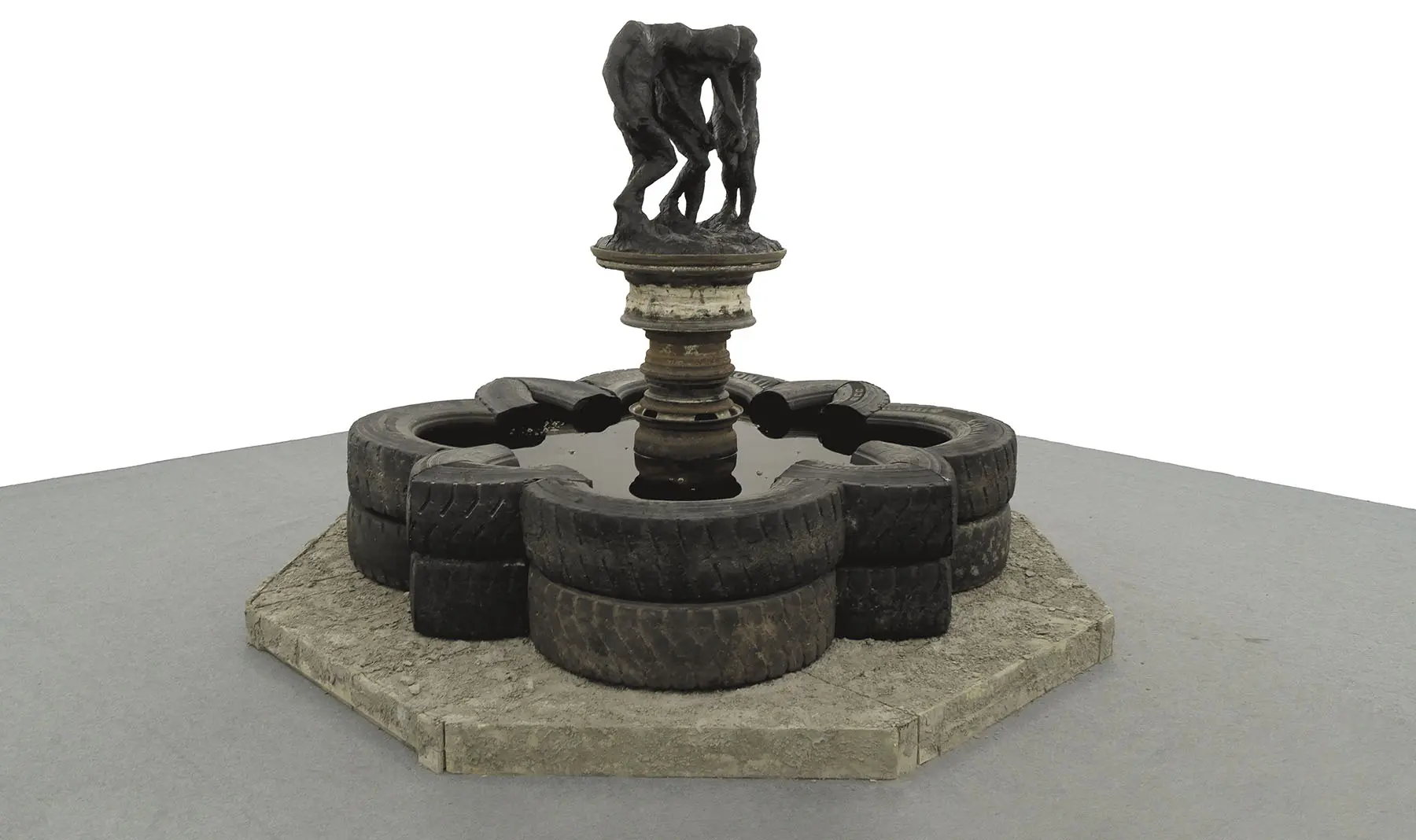
Artists wrap and unfold embodied ideas and that is why I find this exhibition to be essential for Colombian art. It’s a space for experimentation that demands attention. It’s not just about ideas. For example, museums are financed with contributions from large oil multinationals; said this way, it makes for headline news. But Adrián Gaitán turned his chosen space into a warehouse; an archive of detritus, tires, truck rims, and calabash planks precariously lit with plastic bottles and oil, reminiscent of Christian Boltanski’s stagings of dark archives in the basements of museums. The central piece was a fountain—the papal and bourgeois ornament par excellence–which here became a fountain of tires, burnt oil, and, at the top, a simulacrum of Rodin’s Three Graces, goddesses of beauty and love. This fountain reminds us that in these times we must open our eyes in the midst of so much garbage and art institutions with double standards. The planks were also used as support for burnt-oil paintings of Saint Sebastian, underlined by shipping slips to museums where the sexy baroque-art pictures of this holy martyr are exhibited. Gaitan sent these museums a letter offering to give one of his paintings for their collection; a yes for an answer may only be possible in fables.
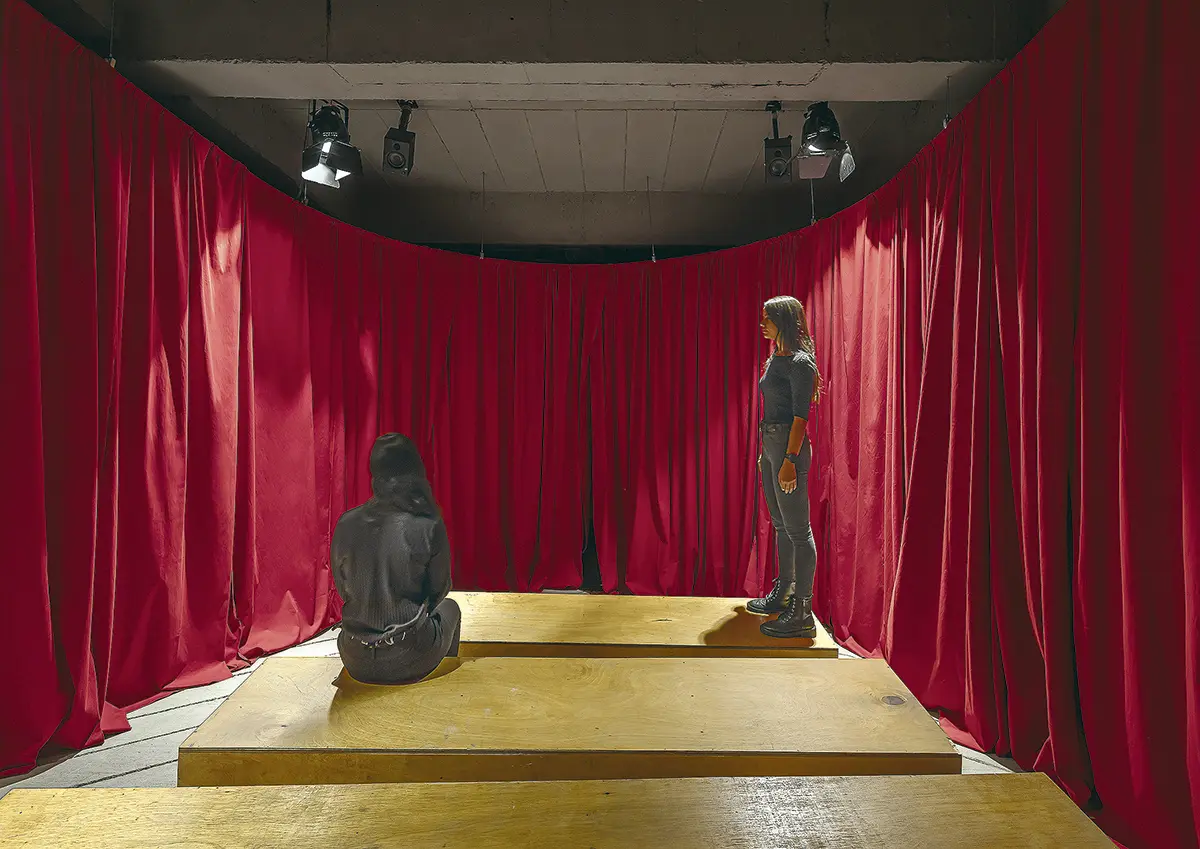
Between science and fiction, reality and simulacrum, these works explored truths expressed by folds enveloping the viewer. One theme was violence in Colombia: a phrase that defines our history. María Isabel Arango hung meters and meters of red curtains in her space to build a welcoming, ominous, and sonorous labyrinth. The walker was guided by a feminine voice—alive, intimate, understated—which pronounced single words and avoided obvious syntaxes: long-winded, my voice, lies, parity, hidden word, technique, indifference, your exile, expressionless, fairness, dignified in our words, cruelty... As a professor, I end my classes with a phrase stolen from systemic therapy, in order to break the silence and explore what just happened. I ask my students: “What are you leaving with? Give me one word.” Well, María Isabel Arango’s Incalculable Instability enveloped our bodies and changed the syntax of the language that we Colombians are used to hearing, as a means to turn reality into pure resonance.
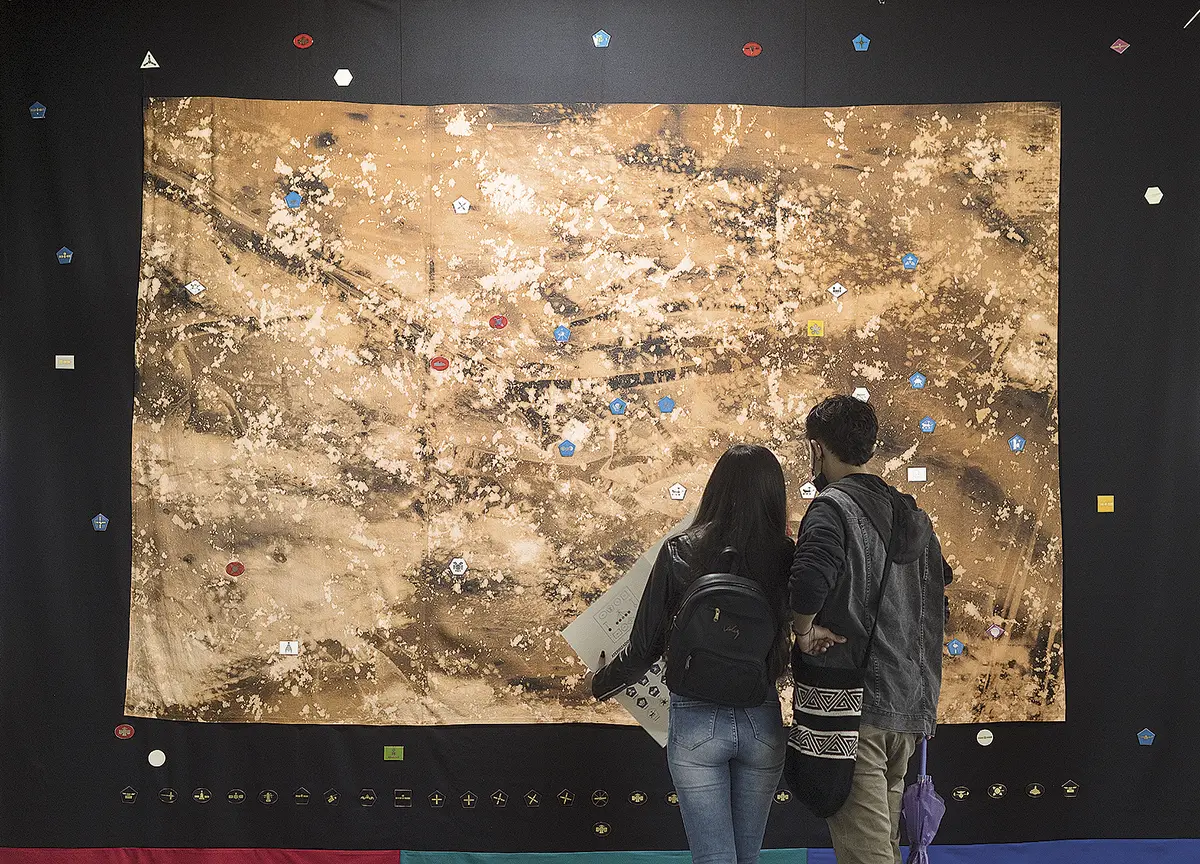
News from planet Mars navigate between science and fiction. This is Giovanni Vargas’ theme in Red. Upon entering, I felt at the doors of an urgent but distant laboratory or an impersonal airport; a space I recall in films, with its clean, terrifying design. Vargas invited several artists to explore new ways to breach long distances with graphics and typography—which interested me a lot—as well as assemblages and videos: signs, stains, programmed simulations, archives, quotes… And, in the end, one leaves with a deep sense of unrest; faced with a planet planted with flags, like so many other distant spaces with fragmented and hidden histories that we are unable to understand even though they’re already colonized and about to be exploited to the point of devastating that which we haven’t seen yet; not only in this show’s fable, but also in our harsh reality.
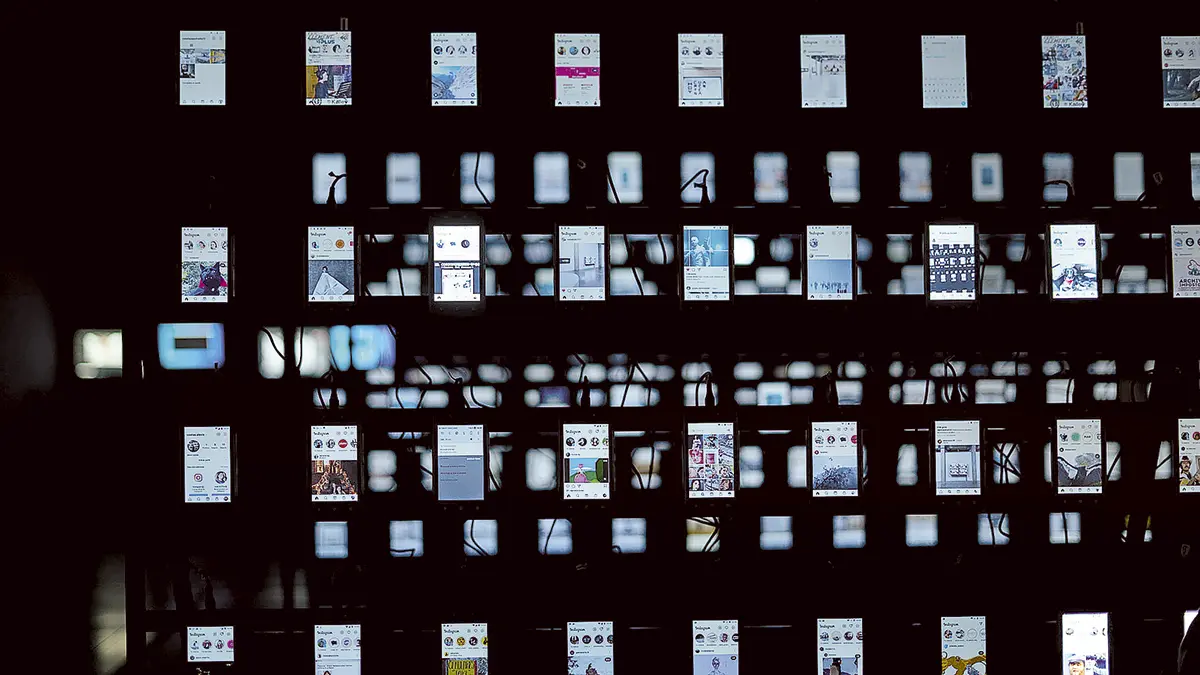
Between virtuality and reality, the long-awaited “likes” that artists long to receive became phantasmatic and robotic in La Concordia Click Farm. Juan Obando installed 300 cell phones that showed his own works on their screens, turning the gallery space into a virtual exhibition. The cell phones were connected to social networks with a system of malicious and viral robots, which, upon receiving the information, responded with a “like”. These bots—the final syllable of robots—got emancipated during the pandemic by enshrining a second reality: the screen, with its seductions and orders. How perverse for the artist to build a device in which “likes” mean everything in the real and virtual worlds, without realizing that they may mean nothing in both worlds as well.
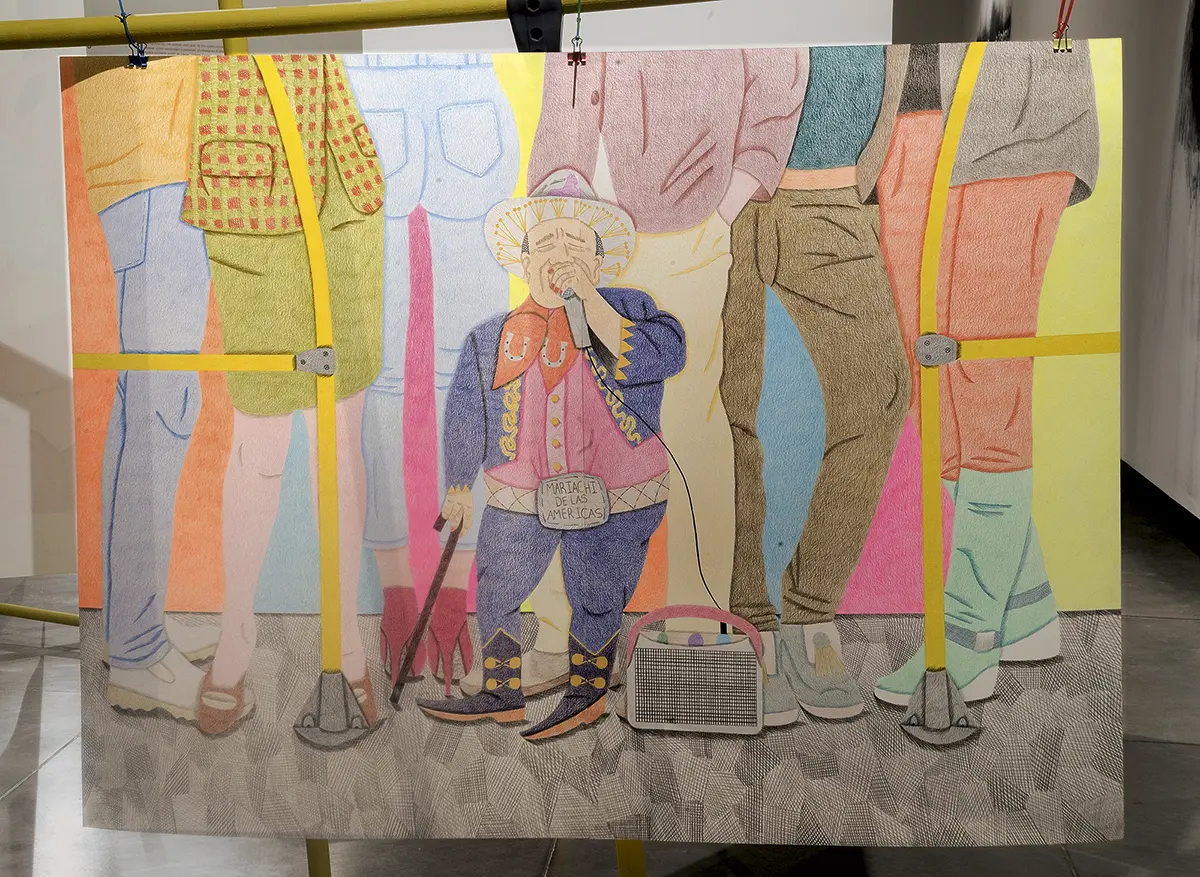
“Truth: the more difficult it gets, the more pleasant it is, and knowledge that is harder to gain is more esteemed,” says Baltasar Gracián in relation to fabulists. I don’t know if I completely agree with this statement, because stories are not always told in complex ways to make them enjoyable. What is certain is that materials tend to muddle what happens, and end up culturally inscribing lives that no one is interested in, such as those of the users of the Transmilenio, the red public transport system in Bogotá: The Red Stain, as urban maps call it, and also the title of Iván Navarro’s installation, which allowed me to enter one of those buses. The gallery space became a large rendering of tense rods about to collapse, emulating the passengers’ bodily movements (a sad man on a train comes to mind). The structure held tacky drawings, much like bad language that insults “good” taste. Leaning against the wall, I was moved by the story of a character adapted to an ecosystem that doesn’t look at him, that erases him. Language and drawing; gossips spread and exaggerated. How else can one talk about, and experience, in one same space—the bus—thefts, harassments, daily victims, intrusions into the body’s territory, and estranged illusions?
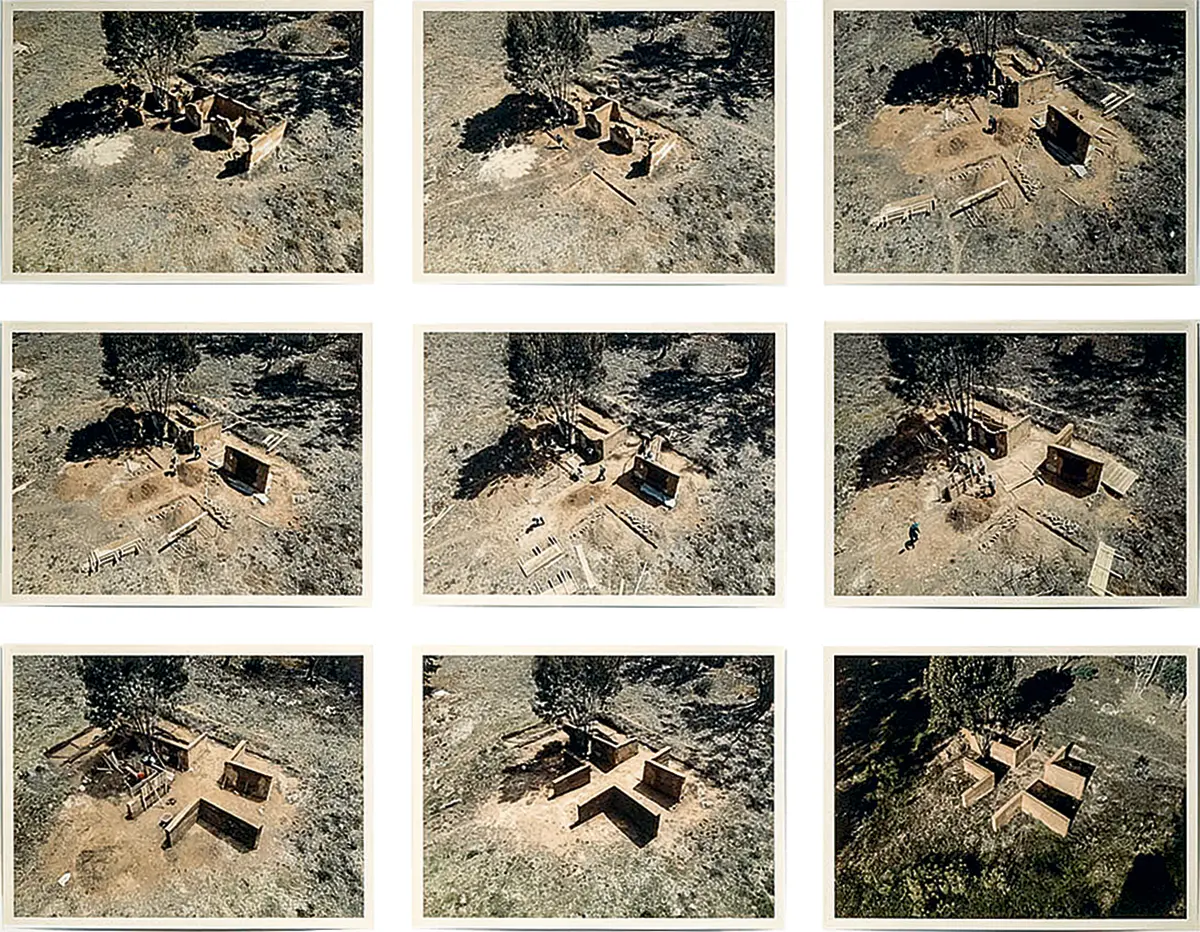
I’ll make a parenthesis here to say that good taste is definitely a bad counselor for contemporary art and for understanding culture. Good taste instructed those modernist architects attentive to forms and tea rooms. A bad counselor, I insist, who decides to cover up experiences, histories, ruins, and matter. I’m referring to Barro (Mud), an inconceivable show in these times. Jaime Franco decided to intervene a mud house in ruins, which was made by peasant artisans at the beginning of the 20th century; he also covered it with mud, but a fresh and smooth mud. It is not a modern construction next to the ruin, but a concealing of a ruin full of mishaps, shrubs, adobe, and stones. The exhibition included proud photos of this new construction from a bird’s eye view, as modernity would want it—or from a drone, which is the same thing in this case—full of nostalgia for Malevich’s compositions. I left with questions. Who gives an artist the right to silence—on a whim—the accumulated marks of time? Doesn’t the theme of the smooth and the striated, so frequently discussed in classrooms, say anything to Jaime Franco? Is he not interested in honestly arguing and disagreeing with the critics of modernity who find ruins in the future? I do hope that he’s interested; but, if so, the installation lacked eloquence.
After this parenthesis, let’s go back to the fabulists. María Isabel Rueda—an artist with a wandering, independent imagination, detached from trends—presented At the End of the World. A Speculation about the Possibilities of Life among the Ruins of a World that Seems Dead. This work was the only one that shunned a gallery space. It was installed in two houses in downtown Bogotá: one from the 1920s with art nouveau accents and the other from the 1930s in the so-called “Bogotan English” style. These two homes inspired encounters with stories that, rather than told, had to be summoned with a Ouija table or a game of mirrors. A great assembly of texts based on science-fiction books was a brilliant idea that expanded the imagination. There was also a cabaret theater with conversations on wonderful chairs and sofas, and women meticulously dressed for the streets and the theater; bodies of all kinds; archives inciting a great fissure with immaterial vibrations. María Isabel Rueda compiled and expanded this project step by step on her page http://alfinaldelmundo.xyz/, which I cite because it constitutes an autobiography, a manifesto of her art and of her way of seeing, which breaks with the notion of mirror and replaces it with speculum, the name that ancient astronomers gave to the sparkles they saw through telescopes, obliging them to speculate and debate in order to propose a new world.
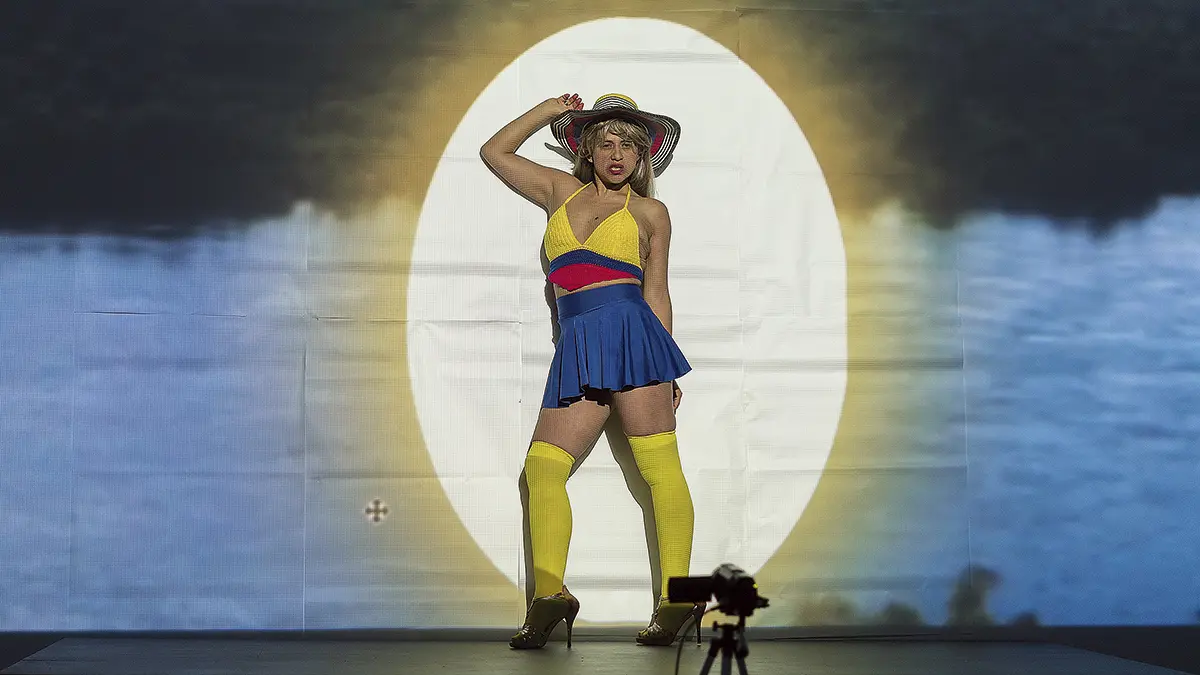
The winner of this version of the Luis Caballero Award was Nadia Granados, with her work Colombianization. Nothing happens in Colombia. “No one dies in Macondo.” Colombian culture piles layers upon layers of information of all kinds: there is talk of the dollar, oil production, coffee (not so much anymore), consumption, and, above all, ecstatic bodies in colorful parties that bury a horror story. These layers make us skeptical of horror, and so we tend to think that cultural practices of cruelty with bodies both dead and alive don’t happen, have never happened. Some call this process of denial foreclosure, and it consists of exiling the horror from our worldview; it is unthinkable and, above all, impossible to visualize. Nadia Granados has long undertaken a tireless struggle to build an explicit porn language with her own body and with images, which slips into fiction so that the viewer can realize that misery, alienation, massacres, false positives, murders, ritualization of corpses, and drug trafficking do happen. Her body—standing in front of us, just like those bodies for sale on the streets—would shift from simulacrum to performance, and at times to its collapse, here and now, painted, smeared, and effaced, in order to expose our Colombianization, the “wussup?” that has become the mark of our refusal to reveal anything. Pornography is the writing of those bodies that are right there, in the streets, exposed. I adhere to an award, given to someone who has built a porno-fiction that allows us to see reality head-on.
* Photo: Mónica Torregrosa Gallo. Galería Santa Fe Archive, Instituto Distrital de las Artes - Idartes
NATALIA GUTIÉRREZ ECHEVERRI
Anthropologist with a PhD in Art Theory, and professor at the Universidad Nacional.