Our way of life depends on the use of natural resources, which we transform to make them more suitable to the satisfaction of our desires. The history of technology is on a feedback loop: in response to a given need, we develop procedures and tools that give rise to new needs, which give rise to new technologies. In essence, the stuff we use has existed in the planet since long before humanity made its appearance; what has changed is our capacity for transforming those materials, a capacity that becomes ever greater as technology itself evolves. Our definition of needs expands to encompass not only that which is required for shelter, nourishment, and warmth, but also that which satisfies our vanity and identifies us socially.
In the past, both utilitarian and sumptuary objects were produced by hand, following traditions that were passed on to family members, friends, or people in geographical proximity. As a result of relentless industrialization, almost everything we use today is produced by mechanical means, appropriating artisanal knowledge and the sphere of small-scale transactions, connected to folklore and the world of emotions. A complex world governed by the logic of infinite accumulation, compulsive consumption, and programmed obsolescence, promotes the jettisoning of materials at ever-growing speeds.
In his solo show Desconhecido para o mundo (Unknown to the World), Tonico Lemus Auad explores the contrast between manual and industrial processes, in works of art that denote his preference for the former but leave room for a certain degree of noncompliance with their patterns. He makes use of repurposed materials, especially wood; he adds textiles and embroideries, and intervenes the objects with notches, grooves, and knots. Many of his works dialog with the architecture of the gallery, which ends up functioning as an element in the composition. This operation takes advantage of the octagonal shape of the floors, walls, and ceilings, which, incorporated as hollow shapes, direct our gaze towards a more careful consideration of the characteristics of the materials in the “sculptures”; that last word is in quotes because nothing here submits to the canons of any established artistic language. These works are subtle. Nothing in them is superfluous, neither in terms of the elements they include nor of their colors or textures, but this does detract from their intriguing appeal to the eye or the intellect. They are, in fact, sophisticatedly synthetic compositions.
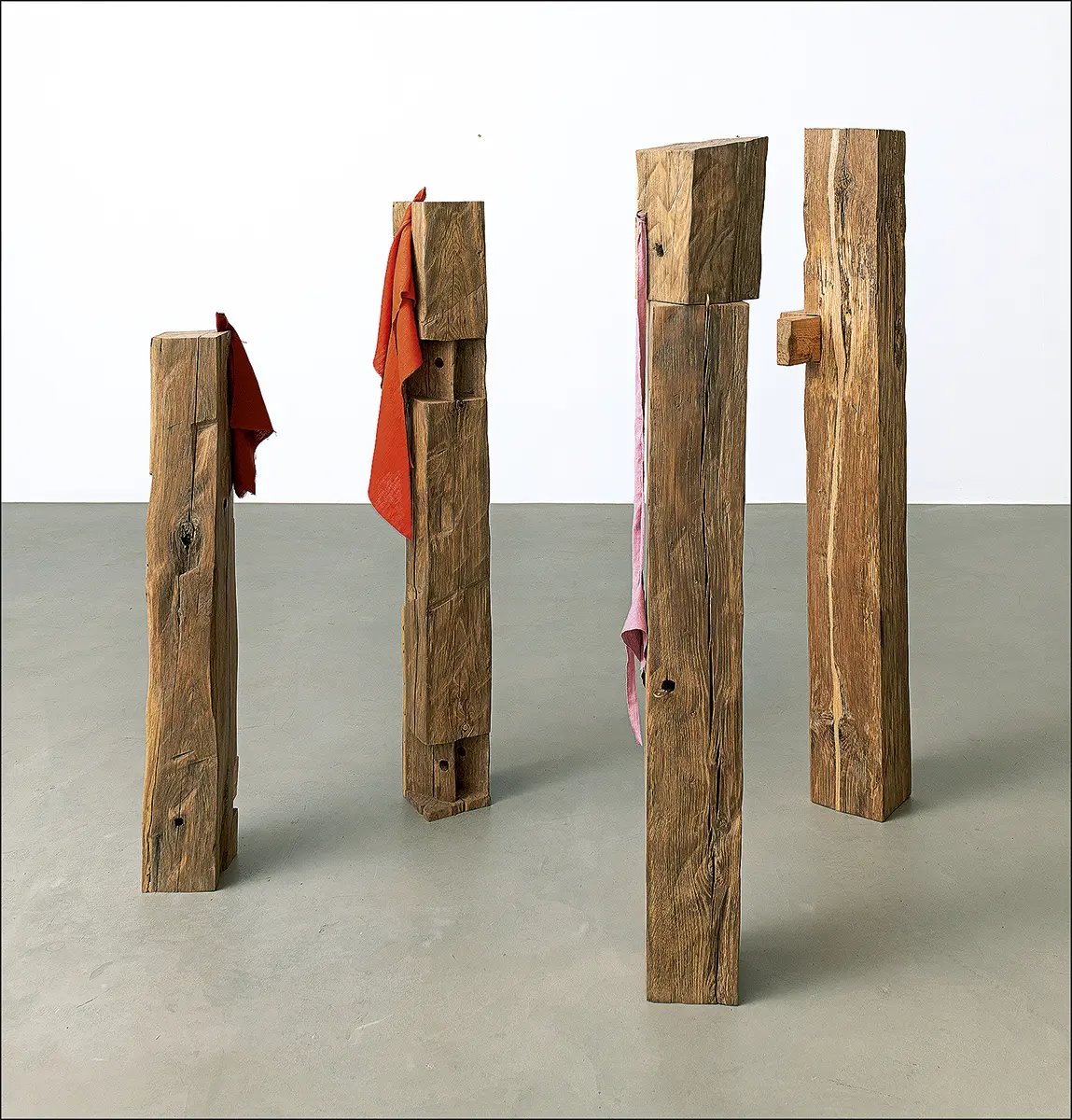
The installation from which the show takes its title, Desconhecido para o mundo (2021), is comprised of wooden beams standing vertically in an arrangement that has a certain animated quality, as they seem to be in conversation with one another; this impression is reinforced by the variations in their features (height, wear by time and use, etc.) and by the elements that are added, such as pieces of weaving, to lend each item a degree of individualization. In some of his textile works, the artist drops the horizontal/vertical axis to build organic forms, always maintaining a chromatic restraint that eschews big contrasts and complementary colors, preferring instead predominantly earthen, warm, closely related hues.
Were it not by the titles, the entire selection of works could be said to escape all temporal and geographic specificity. Selected and repurposed, the materials are freighted with stories, but the works do not reflect visually a concrete time period. They inhabit a time of their own, perhaps not susceptible to measure. The artist employs techniques perfected by artisans over generations, but he does it in unconventional ways, shirking the norms that determine which results are and aren’t good. As he experiments as much as possible with each material, he adopts a foundation of traditional knowledge only as long as it does not become a limitation.
In earlier works, the content was closely related to a specifically Brazilian material and immaterial repertoire, including bananas, sweet potatoes, figas (amulets), and carrancas (scowling figureheads). There were also European elements from Auad’s everyday experience (he’s lived in London since the late 1990s.) In this exhibition, however, the titles of the works may guide us in the direction of the places and situations they refer to, but the observation of the artworks themselves provides no such reference, either to the artist’s native land or to any specific culture. By the manner in which they are built, these works are not circumscribed to any one time or place; their character is universal. In their elegant experiments with matter and their occupation of space, they go beyond narrative and chronology.
SYLVIA WERNECK