What is seen is not only expressed in the gestures that sustain a degree of discomfort in the three video installations presented by Silvia Rivas (Buenos Aires, 1957) with the title of El revés de la armadura (The Reverse of the Armature), after an invitation by the Andreani Foundation, headquartered in the neighborhood of La Boca. Because, if to talk about the reverse of an armature is to talk about that which is not seen, it bears noting what Enrique Lynch writes in Ensayo sobre lo que no se ve (Essay on What Isn’t Seen): “any attempt to represent falls within the framework of a basic dialectic between what is seen and what is not seen.” To a certain degree, that foundational line of thinking is what Rivas is after when she wonders how to use language, the image, materiality and its resources, to represent the vulnerabilities of an experience of time and a state of being. And she is able to achieve this in part thanks to the actions of the women she records in various delegated performances, in the term used by the Italian critic Eugenio Viola, Chief Curator at the Museo de Arte Moderno de Bogotá (MAMBO), who traveled to Buenos Aires for the show. Wearing clothes that neither cover nor protect, these women reveal themselves unstable, vulnerable; they carry pained expressions on their faces as they seek to retain that which has been lost. The scope of Rivas’ resources broadens when the work is installed in space, because what takes place on the screens finds ample correlative in the way in which the screens themselves operate, forcing us to experience them in a manner that is pointedly not the usual frontal approach to a video plane.
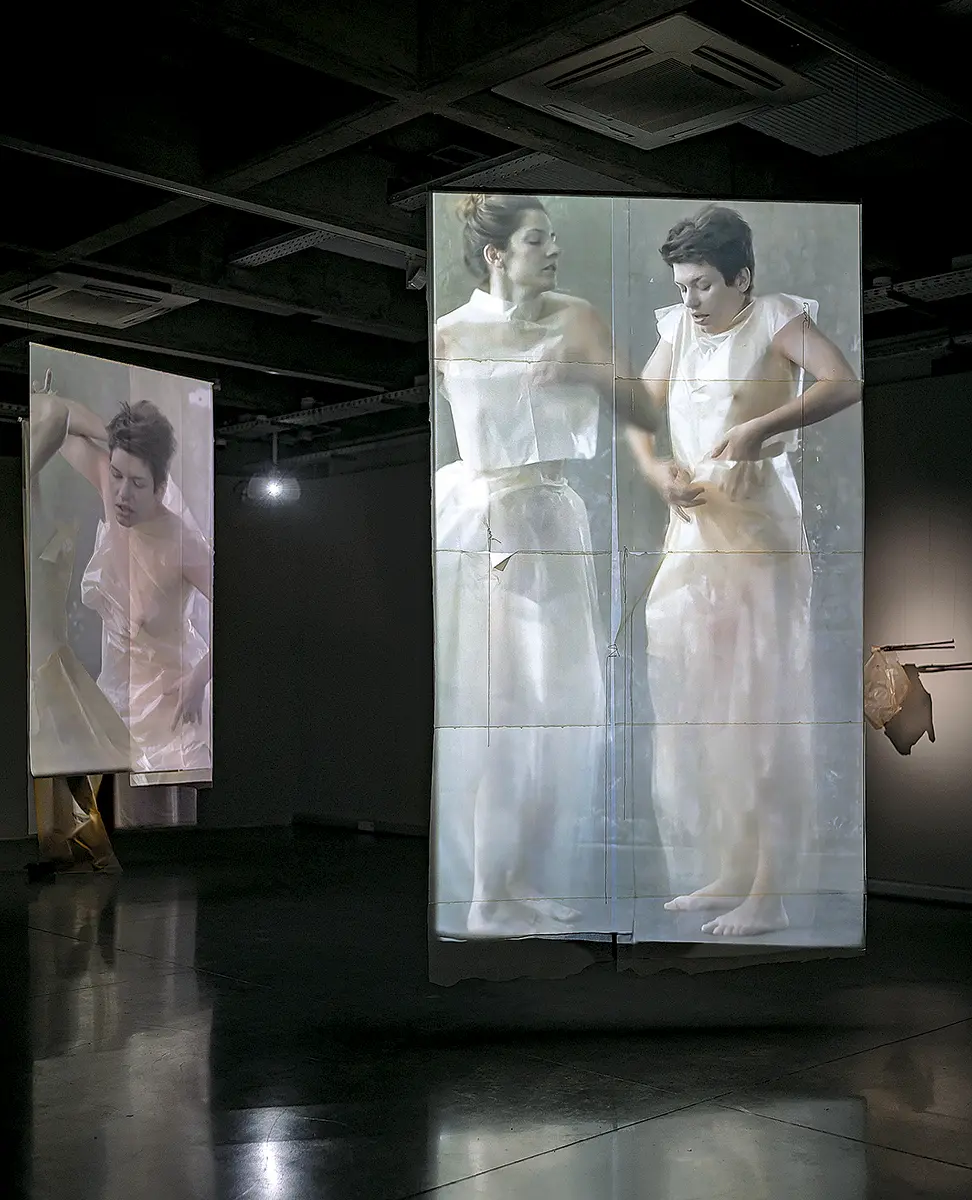
El revés de la armadura signals a step forward with regards to certain ways of representing the collective that were already present in previous installations, where Rivas also deployed the recourse of exerting pressure against the architecture of the exhibition space by setting up the screens in unstable ways, as if everything she uses served to drive the gaze towards what is not seen. Indeed, this is an artist who leaves nothing to chance and always considers who will execute the actions required as she thinks her projects through. Sometimes it’s trained dancers, but here she decided to use untrained women in order for their movements to make no gesture towards professional practice. Rivas sets up a color palette not only for the performers’ outfits, but also for the lighting in the space where the video is recorded and for the gallery; the element of subtlety in which the scene is bathed as a result lightens the tension that emanates from the faces’ expressions of disgust. This time, leaning towards the fragility of paper treated with oils that render it transparent, Rivas tailored a type of garment that does not cover the body, but appears to bother it greatly. She also used latex to create something resembling a dress, but in all instances what the voice in the soundtrack adds to the crackling sound of the paper enshrouding the bodies in motion are indecipherable words complemented by moans, growls, cries, fear.
At the entrance to the exhibition, visitors encounter a penetrating question: To what degree do we coincide with the forms we invent? Set up next to that panel was the video titled El revés (The Reverse), where the slow advance of a woman walking is made unstable by porcelain tiles covering the floor, which produce sound. In a contiguous space, the video installation Exuvia offers a staging of loss and fragility; in the words of the artist, “the trigger for the action are those garments that are ours and represent us and display what we do: to cover ourselves, to project an image that, for a variety of reasons, begins to feel alien. It is us and not us at the same time.” Meanwhile, in Asilo propio (An Asylum of One’s Own), the third video installation, tension rises notably not only because the screens almost touch the floor, demarcating divergent diagonal lines, but also because an iron beam hangs menacingly over the core of that nucleus of three moments in a performance where the garment has become latex, which makes it stickier, “almost as having one’s innards exposed.” Rivas says that she sought to illuminate the conflict between one’s self-image and a confrontation with the self, where one perhaps discovers what has become alien and feels the desire to strip it away, like those remainders of latex that, as part of the exhibition, also hung from the walls.
PILAR ALTILIO