Celebrating an artist’s centennial always brings to the fore a number of different circumstances.
Naturally, any commemoration recapitulates the trajectory of a creative career and highlights the directions followed by an artistic investigation that retains its relevance and has achieved expansive significance in the contemporary scene, influencing later generations and shaping future perspectives.
Those are precisely the circumstances that motivated a reengagement with the work of Rubem Valentim in 2022, gesturing towards the celebration and recognition of his eloquent legacy, a visual project that remains alive and active in many scenes.
In a panoramic celebration of the memory of Brazil’s master of “scratching”, São Paulo’s Almeida&Dale and Pinakotheke galleries launched the centennial tributes.
With his unique visual vocabulary, marked by a sacred understanding of geometry that was always reinterpreted by a conscious engagement with the symbolism of his Afro-Brazilian culture, Rubem Valentim (1922-1991) played an indisputable role in the contemporary scene.
A restless creator, Valentim fulfilled his destiny by creating a committed visual syntax, with the powerful visual constructive medium of geometry as its core characteristic.
The exhibition Ilê Funfun: uma homenagem ao centenário de Rubem Valentim (Ilê Funfun: An Homage to Ruben Valentim’s Centennial) was a potent start to the year of celebration. It established the itinerant character and the spirit of a project that includes a variety of other initiatives by cultural centers, individual artists, art critics, and collectors of the Bahia-born artist’s oeuvre, which circulated in Brazil, Europe and Africa.
Ilê Funfun resulted from the collaboration between several institutions. It brought together Almeida&Dale gallery, the Museu de Arte de Brasília, the Museu de Arte Moderna da Bahia and the Rubem Valentim Institute for a year-long itinerary, with a project of research and special immersion into one of Valentim’s most notable works: his Templo de Oxalá (Oxalá’s Temple).
After its São Paulo run, the show moved to the country’s central plateau, to the Museu de Arte de Brasília; it will close the year in November at the Museu de Arte Moderna da Bahia.
Solidly curated for the entire multi-site run by Daniel Rangel, curator at the Museu de Arte Moderna da Bahia, Ilê Funfun begins with a decision to emphasize the religiosity that infused the artist’s entire body of work.
Ilê, a Yoruba term, refers to the home and the terreiro, a sacred space celebrated in Afro-Brazilian belief systems as signaling ancestral power and the dominion of the orixás (African deities) over everyday life.
Já Funfun, also a Yoruba term, refers to the color white and connects directly with the white-clad orixás, the entities who, in the African mythology of candomblé, govern life in its multifarious manifestations.
Within the white-hued, orixá-helmed universe of Valentim’s artistic explorations, the panoramic view presented in this exhibition was organized in three nodes.
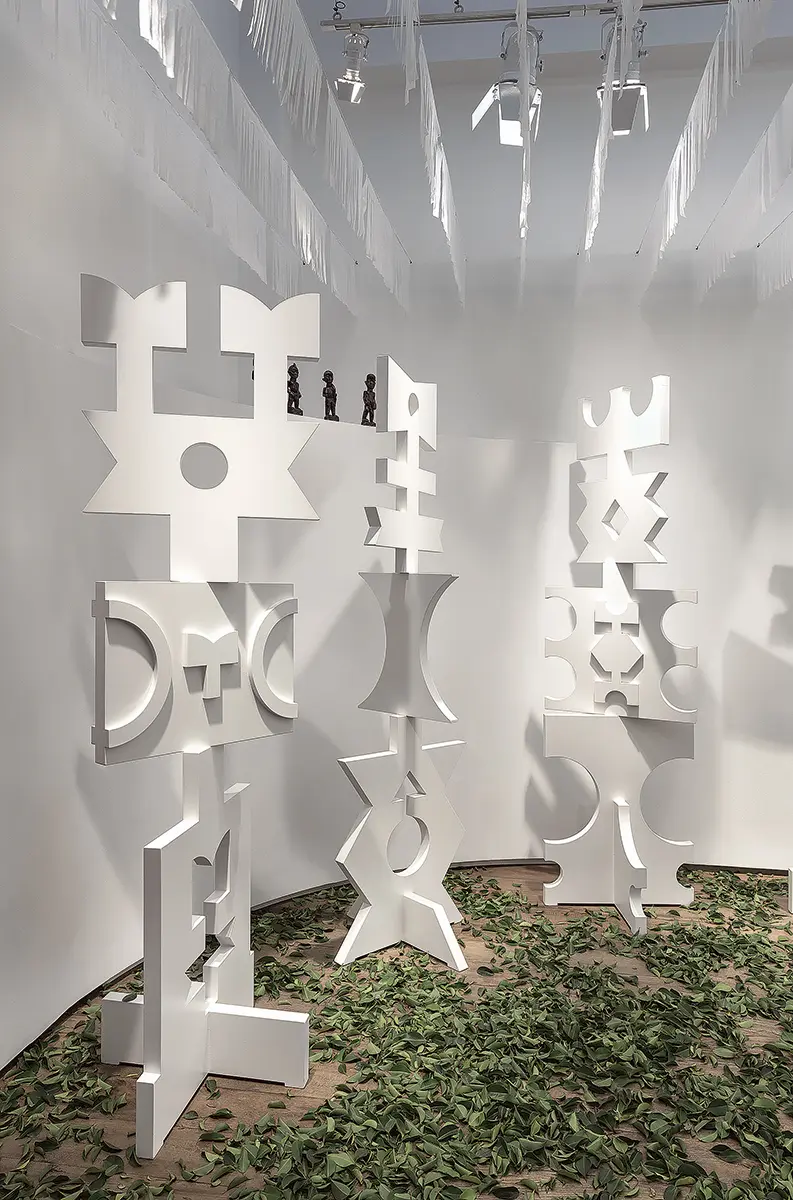
The first node highlighted the Templo de Oxalá, first exhibited at the 14th São Paulo Biennial in 1977 and now in the Museu de Arte Moderna da Bahia collection. This group of ten reliefs and twenty wood sculptures discloses the general tone of the curatorial proposal, as a living space for the new installation.
The second node presented Valentim’s working space, his atelier, in its dimension of everyday practice, featuring studies, partially completed canvases, and many work tools.
Lastly, the third node, titled “Chronology”, offered an incisive investigation into the artist’s life and work carefully arranged on a timeline, in dialog with the archival documents in a display cabinet containing folders, photographs and placards.
This striking reactivation of the Oxalá temple as the installation of a candomblé ceremonial terreiro inside the exhibition gallery, embodied the ritualistic dimension of Valentim’s art, in a space occupied by his various formal and spiritual investigations.
We read its logic in the words of the curator: “Ilê Funfun condenses together all that is essential to the artist’s project: a powerful artistic-sacred group and the reference to his singular universe, which is to say, the Oxalá temple and objects that inhabited the space around him, from the collections of the the Museu de Arte Moderna da Bahia, the Instituto Rubem Valentim, which is headquartered in São Paulo, and the Museu de Arte de Brasília, places that were his homes, spaces that were his ilês (candomblé houses, terreiros).”
Also as part of the project’s itinerancy, a detailed bilingual catalog accompanied the exhibition in its journey through São Paulo, Brasilia and Salvador. The luminous white-centered design of its graphic project connected with Valentim’s catalog concept for the Oxalá temple’s 1977 debut at the 14th São Paulo Biennial.
Expanding the range of his centennial celebrations in São Paulo, the sequence of homages also included a separate exhibition of Valentim’s works, conceived by Max Perlingeiro at Pinakotheke Galeria. This was the panoramic Rubem Valentim – Sagrada Geometría (Rubem Valentim – Sacred Geometry), organized in three fronts of commemorative action.
The art exhibit as such, derived from a book of the same title organized by the visual artist Bené Fonteles, featuring a previously unpublished photo essay by Christian Cravo about the Oxalá temple, created in the spaces of the Museu de Arte Moderna da Bahia, brought to life a new audiovisual made specifically for he occassion, with testimonies about the Bahiano artist’s visual poetics.
In the context described above, then, Pinakotheke’s bilingual publication was the first commemorative front, framing the oeuvre, according to Perlingeiro, in the perspective of its spirituality: “Valentim sought that sacred connection in aesthetic complementarity. (…) The development of the editorial project started in 2017, to be presented in 2020.”
The third element in the commemorative triad launched with the publication of the anthology book and immediately doubled by the centennial exhibition was the audiovisual Rubem Valentim 1922-1991 Sagrada Geometría, an original production for TV Pinakotheque, a very important third front of action and a veritable contribution in and of itself to the memory of the artist.
One single current of Afro-Brazilian consciousness can be detected in both publications, and it is the same consciousness revealed as one of Valentim’s firmest convictions in Manifesto Ainda que Tardio (Manifesto Although It’s Late) of 1976, where the artist reflects on his practice and his commitments. “There is an intrinsic monumental sense to my art. It comes from rituals, from festivals. It seeks out what’s at the root, and it may encounter them anew in space, as a kind of resocialization of art, which belongs to the people.”
It was certainly a different kind of energy that circulated through both exhibitions, finding in the Templo de Oxalá the place of Brazilian scratchings in the celebration of the artist’s centennial.
Dedicated to Oxalá, the deity of creation that is so intensely present in Yoruba communities, Valentim’s temple gave new meaning to the color white that governs the presentation of the orixá in ancestral African mythology.
Through the Bahiano artist’s aesthetics, the same color white reinvented in the temple created the environment of a constructive terreiro, a place for always pluralistic interactions and conviviality.
Valentim created the Brazilian scratching based on his own critical consciousness, an alphabet of “meta-signic” variations as a legitimate repertoire for his sacred formal investigations.
It is a fact that Rubem Valentim always deserved the attention he is consistently receiving nowadays, with critical studies of his oeuvre and a significant number of collections expanding their holdings in recent decades, in the understanding that Latin America’s constructive avocation was never homogeneous or limited to a single mode of expression.
To the exactingness of a calculated geometry, measured by the precision of the line, Rubem Valentin brought the dimension of a visual project that extrapolates the fields of rationality and ventures consciously into the symbolic realm of our ancestral cultures.
CLAUDIA FAZZOLARI