Labriego (Landless Peasant), Rosemberg Sandoval’s exhibition in Poland, was an important recognition of the quality and value of his work as an artist. Opening on April 29 at Laznia, Gdansk’s Center for Contemporary Art, it was not, however, the first such recognition Sandoval has received. He garnered similar ones in Argentina, Venezuela and Spain.
Exhibiting in Eastern Europe, at an art center that has hosted figures as relevant as Gerhard Richter or Gilbert and George, has, nevertheless, a special significance. All the more so given that Sandoval’s work, with its sharp rawness, is not for sensitive stomachs or for easy digestion by foreign audiences, deeply rooted as it is in Colombia and its lived experiences.
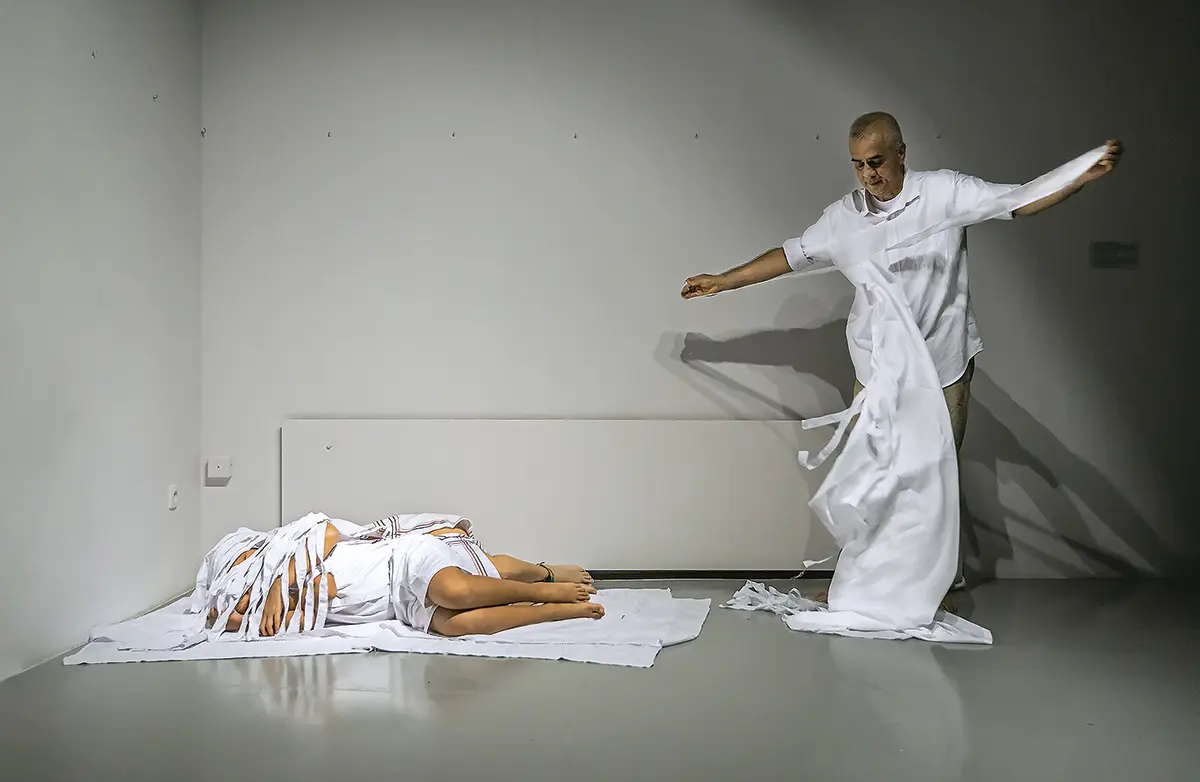
The Cali artist was able to overcome these obstacles and establish a connection with his Polish audience by invoking shared concerns. Labriego opened with a new version of Sandoval’s performance EU-ROPA, which consists of having someone selected by him lay down on a platform and be wrapped, in view of the audience, in fabric straps ripped from pieces of clothing, an operation resembling the shrouding of a corpse. In an earlier version in Cali, the person selected was an older refugee who’d fled the violence of Colombia’s internal armed conflict. In Gdansk, it was Paola and Tomás, Sandoval’s spouse and son, and the action was performed in front of an audience that included Ukrainian refugees fleeing the war currently ravaging their country.
The installation Puñado de tierra (A Handful of Earth), included in the exhibition, also promoted an awareness of shared ills across distances and differences. It consisted of 160 recycled-plastic bags nailed to the wall, each holding a handful of dirt. On each bag, Sandoval had written the name of a family member. It is, he explained, “a family tree of sorts.” Carrying with them a handful of dirt from their native land was a common practice among European migrants in the nineteenth and twentieth centuries, who left their countries with little or no hope of return. Among them were many Poles from territories that belonged to the country before the redrawing of its borders in 1945 left them out, forcing them to leave their land forever.
The motivation for Puñado de tierra is rooted on Sandoval’s own biography. He became who he is because in the 1950s his parents, peasants from Cartago (Valle), were forced to leave their land under threat from thugs in the service of large landowners. They resettled in Cali and never returned, and their son’s installation memorializes their irredeemable uprooting. The same does the general title chosen for the show, Labriego, the meaning of which Sandoval explains in a text in the gallery.
Five large-format stills from videos documenting the same number of actions by Sandoval were also included in the exhibition, and three videos were projected: Mugre (Filth), Rose-Rose and Acciones políticas (Political Actions).
Mugre records a version of one of Sandoval’s most striking performances in his four-decade career. First, Sandoval contacts a homeless person to negotiate their participation. The following day, the artist, dressed in white, finds the person in the street, picks them up and walks to the gallery carrying them over his shoulder. There, Sandoval uses the grime and filth coating their clothes as a paintbrush or roller to paint the white walls and, lastly, an equally white riser on the floor. Then, they both leave.
Mugre’s aggressive irreverence is also rooted in Sandoval’s biography. In the gallery text mentioned before, the artist explains: “At home as a child, the closest thing to painting and performance was what my dad did as a wildcat construction worker for whom I used to prepare colors for the jobs he got from neighbors. Seeing him paint in that obsessive, gestural, frenzied way, dripping everywhere, clinging to his ramshackle bamboo-and-wire ladder, was very moving.”
The video Rose-Rose documents an action of the same title performed by Sandoval in a number of occasions. In it, once again dressed in white, Sandoval sits down and tears a series of red rose bouquets to pieces, letting the thorns pierce his hands and make them bleed. Meanwhile, the 26-minute video Acciones políticas displays the 22 actions he performed, all in one go, in the course of a single day. These are visual poems that range from the tenderness of seeing the artist pack small toys into a crack on the asphalt in a highway, to the violence of a street person hanging upside down from the doorframe of one of his siblings’ bedroom, in their family home, and in the middle of this seeing Sandoval, dressed entirely in black, with a baby’s corpse hanging from his neck, near a tank filled with formaldehyde on which, among other corpses, the corpse of the baby’s mother floats, having died, like him, in complete squalor.
Anna Róg was the curator.