No knowledge is possible without geography. I found this phrase enlightening and wanted to share it. When geography is included in oral stories, the written word, films, sculptures, or drawings, we as spectators and readers are imbued with coordinates of time and space, and places are constructed, allowing us to learn what inhabiting means.
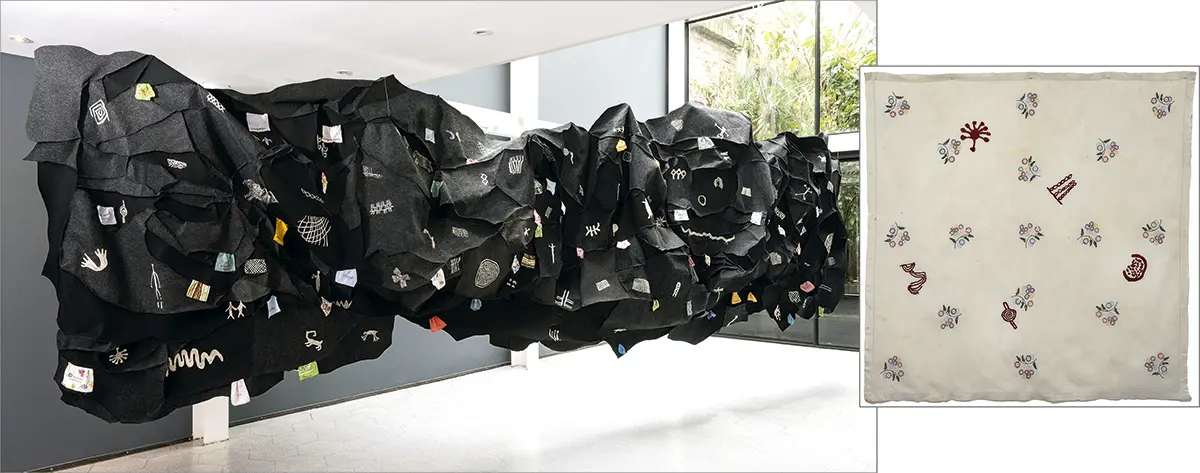
The exhibition placed a mountain of felt in front of the viewer: the result of Rosario López’s journey in La Lindosa Mountain Range, which is the gateway to the Chiribiquete National Park, “the center of the world.” Both are located in the Guaviare Department, which is part of Colombia’s Amazon Basin. Chiribiquete is a 300-kilometer-long mountain range on the equatorial line and has abrupt and steep plateaus—tepuis—comprising vertical stone walls and more than fifty rock shelters where fifteen, eighteen, and twenty-thousand-year-old cave paintings have been documented.
In Chiribiquete—which in the language of the Karijuna means “a hill where one draws”—pre-Hispanic artisans prepared the walls to draw red outlines with sensitive contours; drawings as direct as phrases, depicting the exuberant vegetation, boas, hammocks, backpacks, and, above all, human figures with able and moving arms; figures in the heat of the dance; sometimes elongated and dressed in ritual costumes amidst bonfires and jaguars. Colombian anthropologists such as trailblazer Gerardo Reichel-Dolmatoff and Carlos Castaño Uribe, who around 1991 discovered these paintings (still in the process of analysis and conservation), have recognized in these pre-Hispanic representations the figure of the shaman: someone who unites communities around the knowledge of the jungle and of healing.
Jacques Lacan’s oft-cited article “The Mirror Stage as Formative of the I Function” refers to shamans as characters who thoroughly investigate their context; they listen, console, and sing. Shamans are psychic mediators who help to understand everyday experience and our place in the world. They are in charge of inventing and promoting rituals of knowledge within the community, for which they lend their bodies to imaginarily transform themselves into anacondas and birds, but above all, into felines that dominate the secrets of the jungle. Therefore, community members must observe and understand their movements and stealth. This self-transformation allows shamans to learn how to live in their habitat, sharing their knowledge with whoever needs it.
The shamanic worldview, found all throughout pre-Hispanic Colombia and with current indigenous people, can also be seen in Bogotá: shamans from the different sub-Andean chiefdoms are dressed in gold and enclosed in showcases at the Gold Museum, with their singing lips, feathered or basketry headdresses, and in transformation: feline mouths, arms like bats, birds on their heads, in a trance. In Chiribiquete, shamans and the entire community are painted in front of the jungle.
Rosario López, born in Bogotá in 1970, is an artist with an immense curiosity for materials; she questions them and gives them the possibility to speak in terms of her own experience, rather than in terms of abstraction. I can avow that Rosario López was the pioneer of soft sculpture and formlessness in Colombia: in her exhibitions since the late 1990s, uneven latex bojotes (bundles) were installed in the exhibition space; but also, sand-filled fabrics that look like the peaks of a glacier, rags sewn and hung like the walls of Cusco, frayed hemp hanging from the ceiling like clouds. All of her work fulfills several functions in the broadening of sensibility: on the one hand, it invites the spectator to consider art as an expedition to different territories, and, on the other, it reveals the possibilities of materials, which sometimes seem strange and even Dadaist, given the ease and audacity of the formless to do whatever it pleases. The soft sculptures of Rosario Lopez represent nothing; they open to a material’s particular struggle to exist. For her, the map—that is, representation as a place of arrival—is not the territory: experience is needed to unsettle representation. Even photography, which has played a key role in her work—perverse and humorous maps as it where—is way more detached from a more complex and untimely experience.
The mountain, more than six meters long and made of felt, hung in the exhibition space. Experimentation with embroidery allowed her to interpret some pictograms. Small cloths displayed the names of the indigenous craftswomen of the region. The exhibition also showed Rosario López’s will to inscribe the pre-Hispanic drawings onto our western and urban culture; to achieve this, she obtained embroidered tablecloths and covers cross-stitched with baskets and roses, as we were taught in school—Marie Antoinette-inspired bourgeois needlework—and on them she embroidered some of the red pre-Columbian figures she had discovered on her trip. To inscribe is to include in our thoughts that which has been forgotten.
The felt mountain returned to La Lindosa. She told me: “I traveled to the rock with the artisans of La Fuga reservation and we enjoyed the whole trip. We installed the fabric in the reservation, and then came the Carrizo dance and a sancocho that I still feel in my body.” The non-form, the form behind-the-scenes, that which is vital. Sculpture, then, as geography, but also as the act of listening, as an experience that lets itself be affected and in permanent self-transformation.
NATALIA GUTIÉRREZ ECHEVERRI