In January 2022, I had the opportunity to visit the Museo Marte. I traveled to El Salvador with the intention of seeing, first-hand, the latest proposal by artist Ronald Morán (1), “Above the Garden.” The photographs of the exhibition that the artist had sent me were amazing, but I needed to be in that space to be able to grasp the magnitude of the project and its conceptual unity.
I felt I was facing a strange paradox: how can these sharp and highly dangerous objects made with razor wire be beautiful? Their function is to protect, with their steel hooks, public or private property, be it well or ill-gotten.
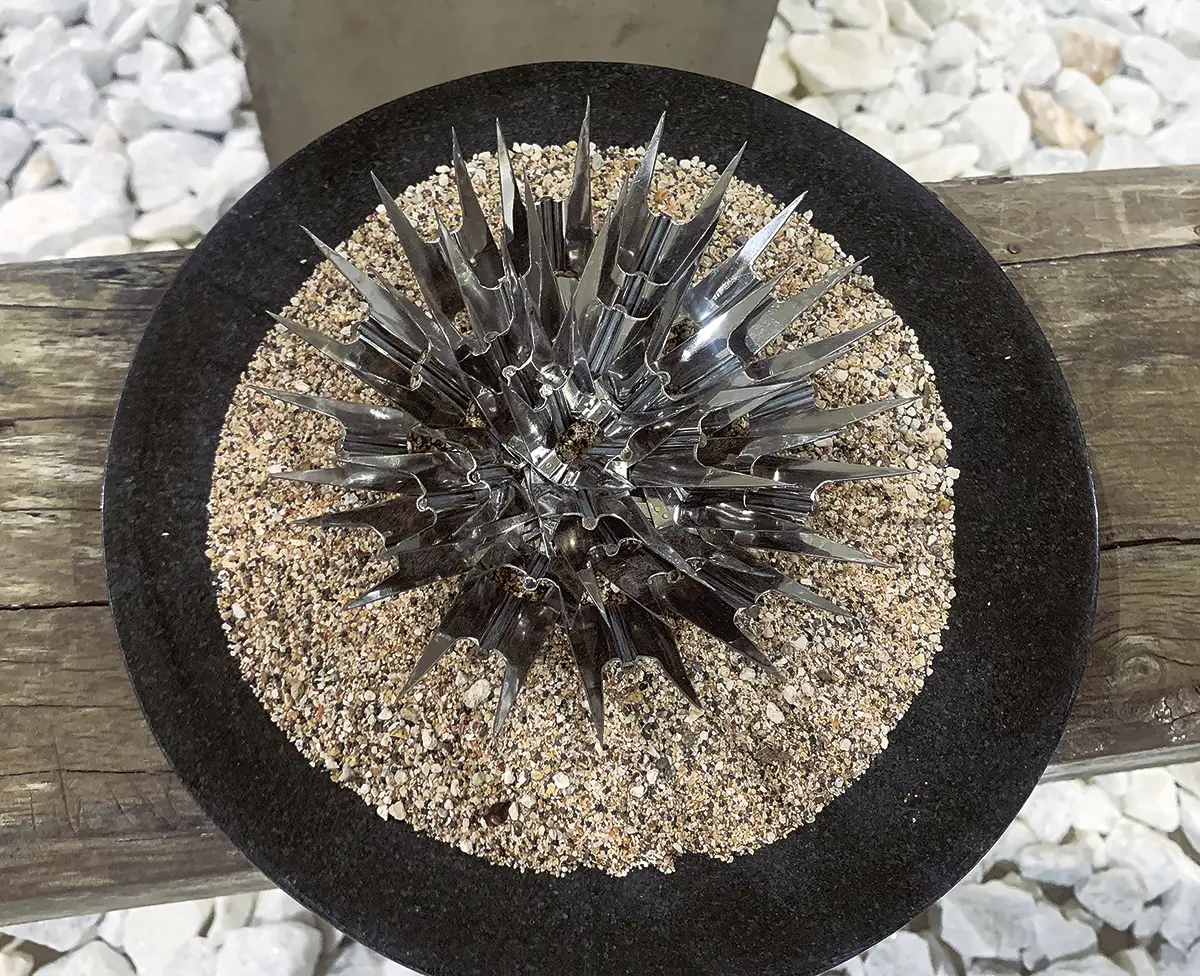
It is ironic to describe as beautiful what I experienced when I saw the work of Ronald Morán. In an interview (2), the artist reaffirmed this perfectly programmed contradiction: “Social discontent and insecurity go hand in hand. I want to produce irony from something so grotesque, tough, and dangerous, and make something as truly beautiful as the shape of a flower, as well as an entire garden.” The artist had already warned that his method in “Above the Garden” would be to establish a critical angle that envisions the relations between the beautiful and the grotesque. Morán proposed a strange metaphor whereby the edge of a knife is placed in dialogue with the smoothness of a flower.
It’s not a matter of hiding the dreadfulness of human existence; that would be tantamount to a crass “embellishment of reality” or what is known as the “aestheticization of reality.” What dissolves this knot between beauty and tragedy, between beauty and grief, and their different antitheses, are the irony and the conceptual relevance that Arthur Danto spoke of (beauty is inherent to the work’s significance). This is precisely what makes it possible for the razor wire to transform its grotesque appearance into the beautiful ritual of a garden, or, to put it another way, for the beauty of the flower to be contained in the piercing edge of the razor. Curator Adriana Herrera’s epigraph for the text she wrote about the artist’s project is a haiku by Kobayashi Issa: “Never forget: we walk above Hell, gazing at flowers.”
“Above the Garden” confirms a general characteristic of Morán’s artistic production: his ironic conception of beauty. In his different projects we can perceive this contradiction: the transferring of a chaotic and painful reality to formal models that, by internalizing their dissident and controversial contents, immediately discourage the aura of beauty with which he delicately covers his objects. Adriana Herrera calls this operation the “aesthetics of paradox,” through which Morán designs “a subtle poetics that confronts the weight of reality with the lightness of the imagination, but without taking his eyes off the latter. This poetic operation sustains, like the rest of his work, a precise reference to the real, which asks us to observe and, at the same time, move to another place” (3). Move to another place? This is what art theory has called “displacement”; the term has several meanings, but here it functions as the process that allows for the meaning of an image to be transferred psychically. In this case, the transference is not only visual or perceptive; it is also cognitive and therefore modifies our state of consciousness about reality. In the end, this is the search that Morán suggests we carry on when traversing his perilous garden, which begins with pages of notebooks filled with his drawings during the pandemic shutdown. Inspired by barbed wire, these drawings triggered the creative process for the rest of his multimedia works: translucent hanging papers that project their forms on the wall, thorny wall-bushes, sharp metal gardens, a huge installation in the shape of a barricade that invades the projection of barbed-wire fences, and a video that elevates the image of the spikes up to the very sky, creating a friction between the open immensity and the enclosed space.
In this project, the object is de-alienated and, thanks to its ironic force, is translated into something provocative that acquires a powerful human energy, thus expelling all fetishizing action from the work. This strategy allows the artist to avoid “exhausting the potential” of those organic forms that constitute his garden. We are not facing objects that neutralize or anesthetize our critical experience; rather, the use of highly dangerous materials to represent these flowers, plants, butterflies, and birds, among others, translates their brilliance into an opaque contrast that tears apart every existing thing, like a knife being sharpened in dark blood.
Morán does not evade the aesthetic resources inherited from tradition; on the contrary, he emphasizes them in order to dissolve them in a biting critique that addresses existential problems beyond the pandemic. His artistic practice does not aspire to show beauty; it aspires to complicate it; in other words, to turn enchantment into a garden where light agonizes. Morán confronts us with an apparent beauty that tries to erase, without succeeding, the density of life, which demands to recover its human dimension.
NOTES
1. Ronald Morán was born in Chalchuapa, Santa Ana, El Salvador.
Arteturismo 503, November 9, 2021.
2. Adriana Herrera, Above the Garden, text for the exhibition catalogue.
CARLOS A. LANZA