How can contemporary art be my own mirror? To what extent do stories activated by the works invite me to look at myself? Or is it I who activates them as my own reflection? And how is it possible to establish mirror-like convergences between authors?
The title of Rodrigo Hernández’s exhibition, produced by Museo Jumex in Mexico City and Museo de Arte Moderno de Medellín, prompts all these questions as we go back and forth between the pieces and the installation containing them.
The project simultaneously activates different sensitive and reflexive aspects: on the one hand, stemming from the will to rescue the contributions of modern art in different latitudes, the exhibition pays tribute to Danish architect and designer Verner Panton (1926-1998) and to Colombian artist Antonio Grass (1937) as mirrors of each other. The former is linked to research with new materials, bright colors, and shapes for the design of furniture, interiors, and lighting fixtures. And the latter to the reworking, revitalizing, and resignifying of pre-Columbian motifs in artistic scenes during the 20th century.
Furthermore, a fictional link between the two is established by the display of letters written with creative skill by Rodrigo Ortiz Monasterio. A purported letter from Grass launches their exchange, followed by three letters from Panton, which include the remembrance of an encounter; and then, silences that seem to be metaphors of the convergences between European and Latin American art, and then of the latter possibly pursuing its own course with total autonomy.
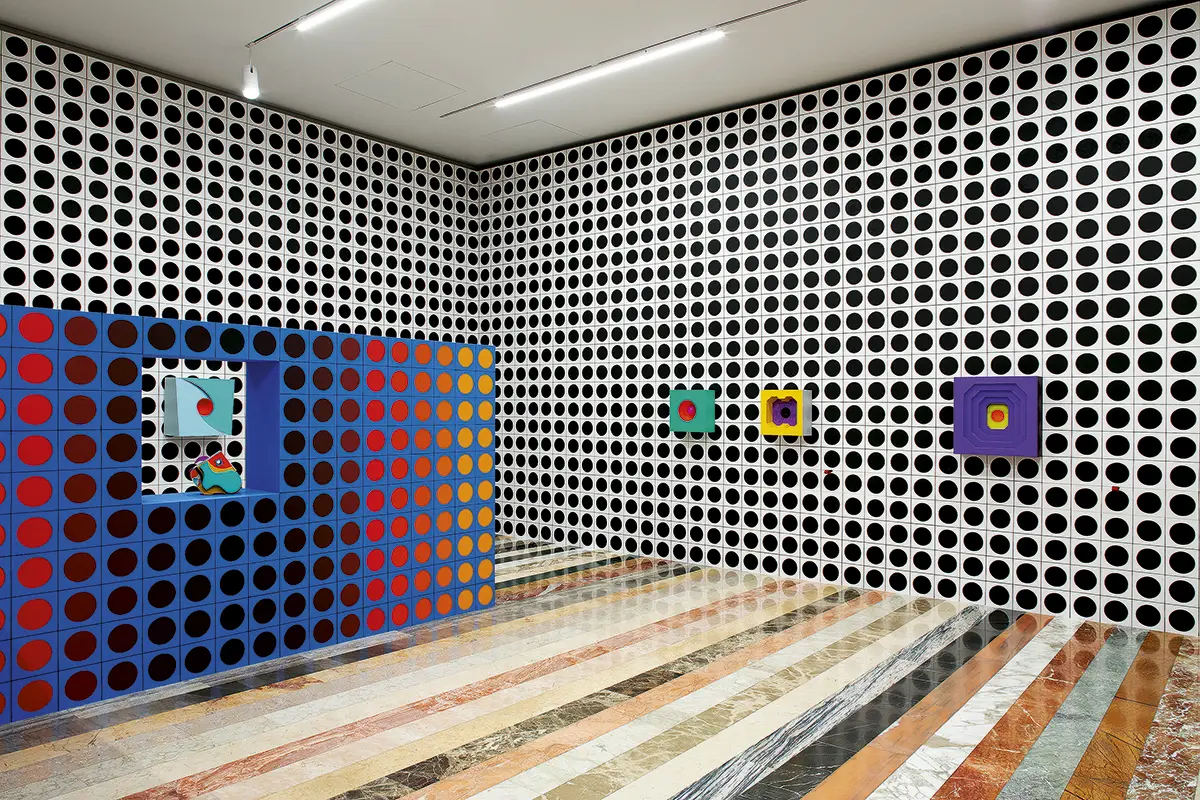
Letters and drawings are placed in folding display cases that are camouflaged with the walls and works affixed to them, and housed in the installation with perimeter walls topped with a series of black circles arranged in a white grid. The blue walls at the center of the space have another grid housing circles that lighten or darken in a sequential range between bright orange and dark earth colors.
The circles and their repetition function as reminders that our reflection is everywhere. Incessant, repetitive, in black and white, or in a variety of color ranges. And by this tapping of our inner lives, the assemblages 1 to 7 of the series “The Mirror”—made with cardboard, papier-mâché, acrylic, and oil—sparkle, as do four drawings on paper made with acrylic, graphite and ink, from the “Milk of Fear” series.
The drawings accompany and diversify the meanings of the imaginary relation between Panton and Grass, delving into artistic and human imbrications.
The mirrors whisper to us from combinations of shapes, volumes, and colors, so as to touch us from their red or orange cavities with pink protuberances and contrasting spirals in aqueous or celestial tones. Or else, they suddenly mutate to an inexorable black void that contrasts with yellow hues and violet rungs, bitonal stripes, and territories that can be lattices for the soul, with small orange or purple plots. We travel the circularity of the concentric, as disparate cycles in opposing colors.
A special emphasis should be made on other mirrors: a small pencil drawing on wood and acrylic, and the assemblage The Mutant Mirror. Both are reminders that contrasts of scale are indispensable elements of any life experience:
the part in relation to the whole, as its metonymy (the small drawing of a man made up of patterns of squares and stripes on a background evoking the chromaticity of the installation’s central wall);
and the bidimensional volume in relation to the real mass of an object, as what happens with The Mutant Mirror, which recalls children’s wooden toys and suggest a fusion of explorations with simultaneous references to the works of Grass and Panton.
This exhibition has been organized by Museo Jumex in Mexico City, and curators Marielsa Castro Vizcarra and Cindy Peña, as well as by Museo de Arte Moderno in Medellin and their chief and junior curators Emiliano Valdés and Guim Camps, respectively.
In the exhibition, we can interact with different viewpoints and superimpositions between bichromatic or polychromatic structures and peepholes to generate our own compositions. We are able to play—from within ourselves—with heights, scales, volumes, and colors, thanks to this new phase of Rodrigo Hernández’s trajectory, produced in 2022 and based on artistic inquiries that come from an array of sources belonging to our visual culture.
It is an invitation to look at ourselves from the reflections that we project in all the sensitive and reflexive devices of this project, and to reassess—from the lens of a speculative link between Grass and Panton—Latin America’s relationship with the artistic processes of other latitudes.