
In the Aymara language, the word Ch’ixi means something like the color grey. This is only an approximate translation; the word refers to a nondescript color present in Aymara textiles, which weavers obtain by superimposing threads of different hues. River Claure (Cochabamba, Bolivia, 1997) sees it as a good simile for identity and its complexities: the superposition of practices and cultures results in a mixed identity that is difficult to define. Warawar Wawa (Child of the Stars), Claure’s recent photographic project, explores Bolivian identity by means of a reinterpretation of Antoine de Saint-Exupéry’s novel The Little Prince.
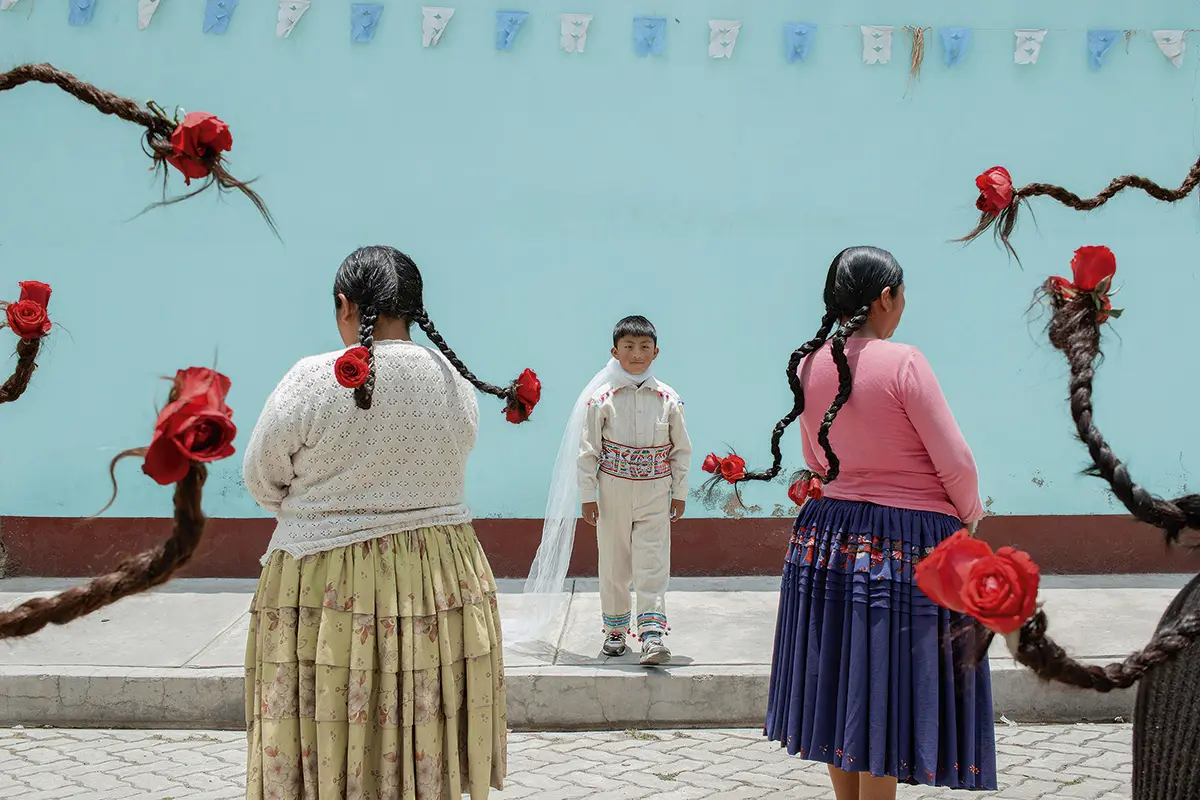
Evoking the universe of The Little Prince in the Andes results in a fantastic imagery that interacts with the legacy of Latin American indigenismo. With their pastel-like hues and their soft, nuanced light, River Claure’s colorful and disconcerting photographs bring to mind a kitsch aesthetic. This series, which recreates Saint-Exupéry’s illustrations and adapts them to the Bolivian desert, is part of a larger project that includes the translation of the novel into Aymara.
Saint-Exupéry’s Poetic and philosophical narrative, written and published during World War II, extends a critical gaze over the world system that produced the horrors of the concentration camps and the atom bomb. Adult-centrism and the fact that its protagonist is a child have resulted in the novel’s pigeonholing as children’s literature, when in fact it is a metaphor of modernity and industrial civilization that uses childhood as a symbol of goodness and wisdom. What would this story look like in an Aymara context? What would happen if it were transported to the Bolivian Andes? Is Claure’s approach a vestige of the paternalistic view of indigenous peoples, which tends to infantilize them? A change in perspective could be a good starting point for the debate.
Transporting the novel to the Aymara context involves a readjustment of its symbolic reach. The little prince is no longer a child; his semantic terrain expands into the entire epistemic-ontological universe of an indigenous people, which differs significantly from a European cosmogony. No longer is that penetrating, wise gaze to be deemed child-like; it belongs to a different civilization. The Eurocentric tradition of infantilizing otherness, idealizing it, can be traced back at least to the myth of the Noble Savage. It is a power move by means of which, as postcolonial critique has pointed out, the “other” is always the non-European, and the child-like takes a position of inferiority with respect to hegemonic modes of knowledge.
A new appraisal of childhood would necessitate a profound shift in paradigm, and in that process, debates about the infantilizing of indigenous peoples would touch on new critical territories. As long as that doesn’t occur, the idea of an Aymara Little Prince (or of Aymara civilization as a saccharine counterweight to the vices of the West) will remain the result of the exoticization of the indigenous by an external gaze. In that context, Claure’s approach seeks to distance itself from the visuality of ethnic exploitation; his photographs are painstaking and aesthetically pleasing, but they eschew the anthropological gaze and instead move into the domains of the uncanny, mystery, and fantasy.
Clouds in the middle of the Uyuni Salt Flats, in Potosí, the world’s largest salt desert; a man in Aymara garb wearing augmented-reality goggles; the famous image of the little prince surrounded by roses, which in this case issue from the braids of cholitas luchadoras, female Aymara wrestlers, as a metaphor of the defensive function of thorns —all are presented here as images of the offbeat and unique. Claure’s project is the result of three years of work and exploration, carried out during a stay in Madrid.
The demystification of a literary classic by means of its adaptation to new environments is, at the same time, a demystification of the latter. Indigenous universes, previously relegated to anthropological visuals, open themselves up to a new semiosis. In Claure’s own words: “I sought to have the fantastic burst into the indigenous imaginary, creating its own logics and demystifications.”