
Curated by Betty Alice McGhee, the exhibition Revealing brought together Richard Garet (Montevideo, Uruguay, 1972) and Andrés Michelena (Caracas, Venezuela, 1963) in an immersive space where the extreme subtlety of the sensorial stimuli provided by the works on exhibit invited viewers to reflect about what is implied in seeing and hearing within the deeply alienated framework forced by the complex existential dynamics of the contemporary world.
Both artists have lived in the United States for about twenty years and have been friends for more than fifteen. Their connection is based on personal sympathies and on the affinities between their explorations. The grammar in which emptiness—such as that of silence or of absence—expresses itself has been a persistent subject for both. Garet’s inquiry has included the incorporation of sound, and in particular a study of the “background noise” omnipresent in all cities. Garet brings technological obsolescence into the fold of his work as a way of highlighting the sound mechanisms of the contemporary world and the traces they leave on modes of perceiving, living, and being. In turn, Michelena is considered one of Venezuela’s most solvent conceptual artists. His work signals the ontologically intimate spaces of someone who deeply considers his being in the world, unfolding from the interstices of language but also from the honest precariousness of materials such as paper or a bare wall, and of media such as drawing or installation.
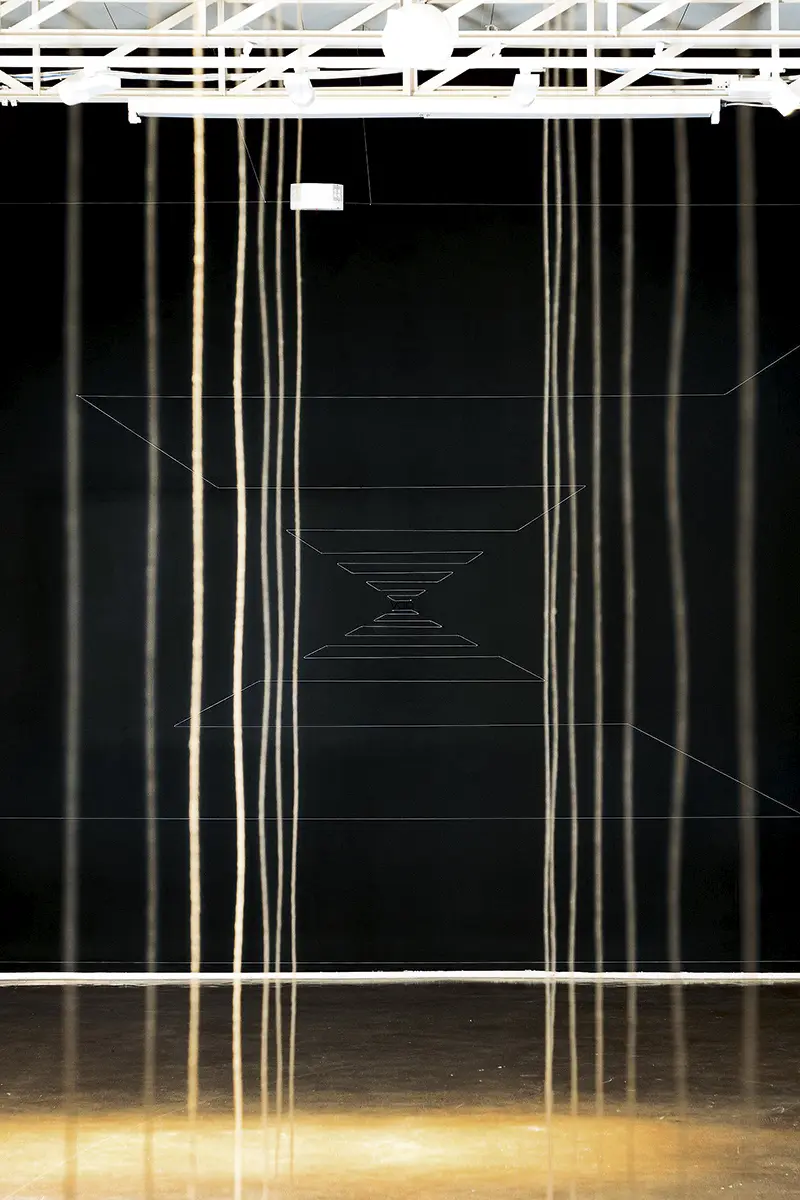
As we enter the gallery, the minimal presence of the materials and the austerity of the installations overwhelm us. Words written by perforation, empty planes, silence, subtle vibrations, lines made of rope: it all calls for us to sharpen our senses as we attempt to see what invisible and hear the inaudible.
We are received into the exhibition by Andrés Michelena’s somber installations in the Loop Whole group. Most consist of an orthogonal segment of white wall demarcated by lines made with rope, affixed and braced throughout their trajectory. Each of these wall segments displays a small phrase written in perforations left behind by nails: An End to Begin, Misplaced Space, Reserved, and Residual Space. There is also Void, the only installation covering an entire wall, painted black. Suddenly, something begins to unnerve us. The limpidity of the wall segments and the precision of their boundaries are broken by “small accidents” of space: an exit sign, on acrylic and in large green letters, in Misplaced Space; an electric power jack cover in Reserved, an emergency lighting device in Void. All but unacceptable to the perfectionist logic of today’s museography but statutorily required in contemporary architectural spaces, these elements, highlighted within Michelena’s spotless grammar, impel us to regard the simple and pure reality of our everyday surroundings, offering an impromptu detour from an aestheticizing discourse that seeks to abstract itself from them. In that way, the area of Loop Whole functions as a large “meditational” device pushing us towards attentive observation, bringing to the fore of our consciousness the real-reality of space, in that alternative kind of breathing that is to see the world and ourselves.
Occupying a small area between walls, towards the back of the gallery, is 30 Cycles of Flux, an audio installation by Richard Garet. Contrary to what could be expected, it produces no sound. The audio file reproduced by the amplifier in 30 Cycles of Flux is in 30 Hz, a frequency that the human auditory system does not register. Fourteen speakers mounted on a single panel and hanging from the ceiling blast out the recording, but we can only see it and feel it in the form of subtle vibrations coursing through the ropes attached to the contraption. In a way, this silent sound magnifies the act of hearing, moving us to weigh not only exterior noises and sounds, but also our inner, organic or mental pulses. This forceful work of art confronts us also with our own limits. It compels us, human beings subconsciously made arrogant by a sense of technological omnipotence, to disbelieve the boundaries of the audible; for a moment, we insist on trying to hear. Something recondite rebels within us before we, confronted with an incontestable yet seldom experienced reality, are able to accept our condition.
Revealing was indeed like a small, quiet revelation, perhaps one—with its quiet and restraint—particularly needed in a world so oversaturated with images, sounds, and words that it seems designed to distract us from ourselves.
KATHERINE CHACÓN