“We who use the process of destruction understand above all the desperate need to retain unconscious integrity ….” From “Destructivism, a manifesto” by Rafael Montañez Ortiz.
Authenticity, agency, and action have been foundational touchstones for interdisciplinary artist Rafael Montañez Ortiz for over a half century. Profoundly prescient, Ortiz has been a pioneer on several fronts including as an advocacy artist working with the community. In 1969 Ortiz helped East Harlem residents to launch El Museo del Barrio to raise awareness about Latin art.
This exhibition is organized into four thematic sections, the first and most visceral is “Destruction.” Ortiz was a key player in the “Destructivism” movement of the ‘50s and ‘60s. His signature act was to take an axe to a piano, ritualistically debasing it as a colonial shibboleth while reinterpreting its function.
The remnants of the instruments on display can be seen as healing relics. Their original purpose has been subsumed by a subsequent manifestation. Incorporating indigenous, shamanistic practices into his performances, Ortiz intended to induce a trance in audiences and restore autonomy to people removed from their oneiric insights by cultural stasis.
In addition to the pianos done from 1961 to 1965, wrecked furniture from Ortiz’s home is mounted on the wall. Visually, these “Archeological Finds” have aged well. Their exposed interiors are remarkably animated. Protruding springs and ripped batting possess uncanny abstract expressionist flair. They appear as anachronisms, evoking a past from which we are permanently exiled while extending an aura of self-destiny so central to Ortiz.
Ancestry and a framework of personal identity have always been a critical focus for Ortiz.
An interest in psychoanalysis and anthropology also informed his goal of reaching people in multiple ways using multiple materials. He has embodied the concept of an artist as a conduit, relaying a jumble of sensations in a codified manner capable of evoking a meaningful emotional response.
The second gallery, “Decolonization and Guerrilla Tactics,” emphasizes his involvement with the community. Posters of resistance, magazine covers and demonstration fliers attest to his collaboration with the community, including the Bronx-based gang The Latin Kings.
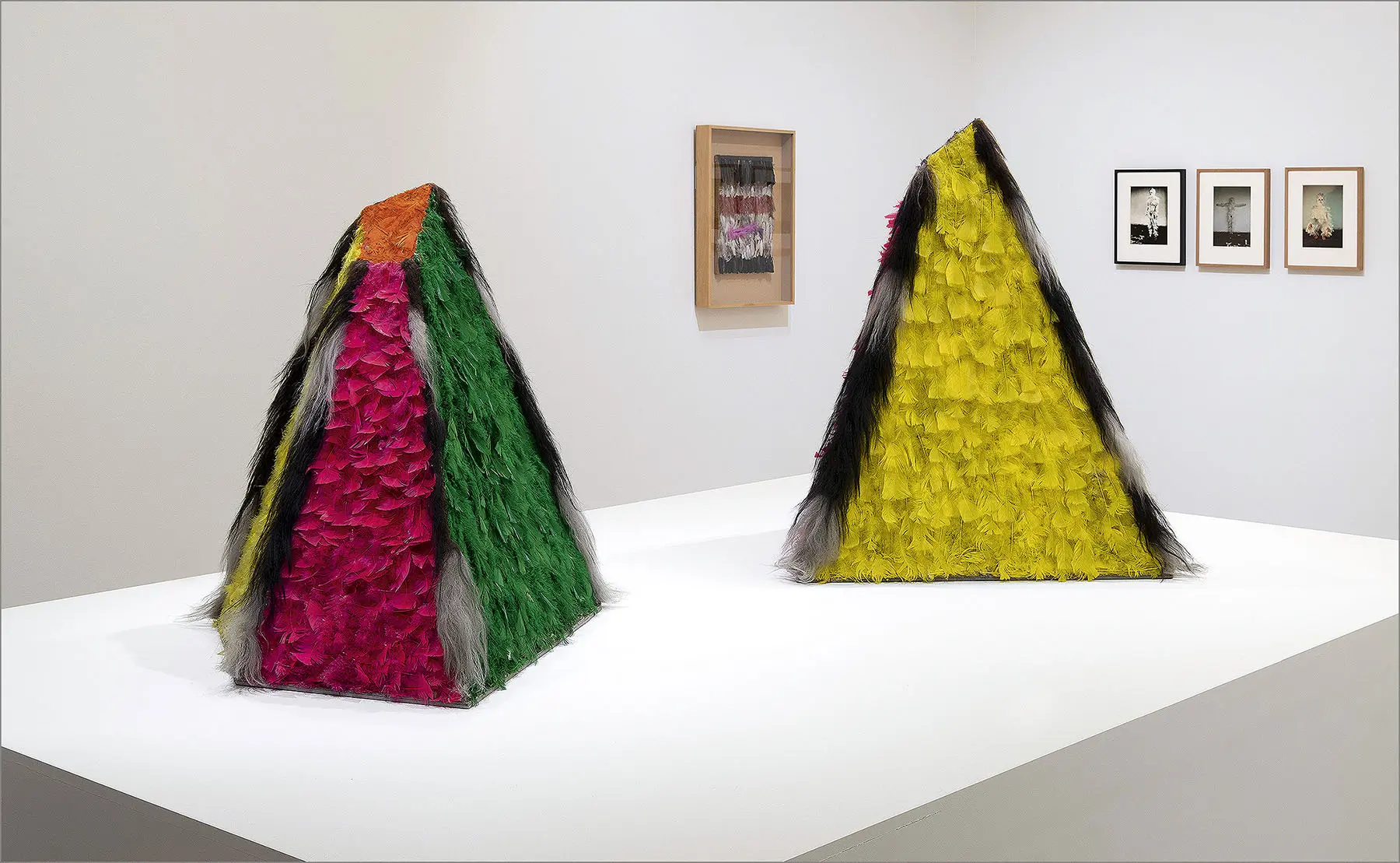
Research into a pre-Hispanic past inspired Ortiz to scale up the form of a stone axehead from Puerto Rico (several examples are on display from El Museo’s collection). Two resultant pyramid shapes refer to fetishes that are believed to possess a spirit. Sheathed in feathers, they evoke flight while remaining grounded. Such dualities are inherent in his work.
The third gallery is called “Ethnoaesthetics,” a neologism Ortiz came up with to suggest a personal identity informing art that resists the exclusionary vision of Euro-centrism.
“Destructivism” evolved for Ortiz, as seen in several recent assemblages made from commercially available 3-d model dollhouse pieces. In these attractive works, interlocking parts are rearranged into loosely rhythmic rows rather than into architectural verisimilitude. These propositions disrupt our conventional precepts, creating new associations that undercut the authority of mass production and reassert the volition of the individual.
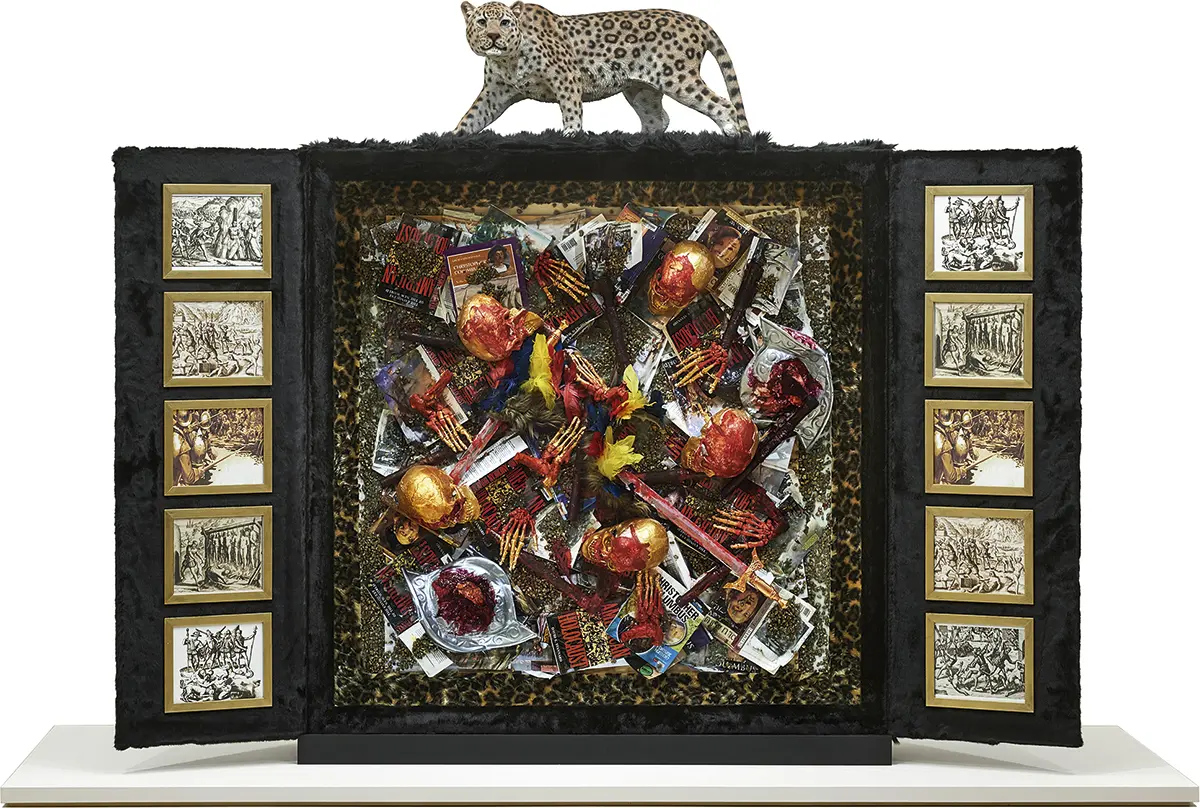
“The Memorial” from 2019 is a showstopper. This combination shrine and wunderkammer spotlights the genocide of the Conquistadors while reclaiming cultural vitality for the victims. Historic illustrations of ruthless oppression line the inside of flanking doors, opened like wings.
The entire outside of the cabinet is ringed with furry black fabric, suggesting a subversive regrowth. On the inside, symbols of the interface between cultures clash in a mashup of dented helmets, golden skulls, skeleton hands, beans, feathers, blood, and pertinent books. On top of the cabinet, a taxidermied jaguar recalls an Aztec totem spirit. It could be interpreted as a symbol of pure loss or untamed triumph.
Gallery four is called: “Physio-Psycho-Alchemy,” an apt name for Ortiz’s manipulation of materials and emotions. His exploration of filmmaking techniques (begun in the ’50s), continued with films from the ’80s, wherein he isolated and repeated scenes at a frantic pace. The short clips flicker in mechanical repetition as a hypnotic critique of the American dream.
The final section also includes digital paintings. Cosmic texts and inspirational scenes are separated in bold, geometric tableaux printed on vinyl. Like modern illuminated manuscripts or updated stain glass, they evoke a sense of higher purpose and aesthetic synesthesia, though bordering on the didactic.
A series of concentric circles and mazes is timeless. Presented in an op-art style, the lines create the illusion of depth. The simple, geometric motifs become symbols of eternity, reconnecting art with myth while offering pure visual verve.
Ortiz shows how art can be a revealing act of informed, sustained resistance leading to transcendence. This comprehensive overview of his complex legacy will enhance his reputation as a groundbreaking innovator with a unique and ever-developing vision.
Curated by El Museo’s Chief Curator Rodrigo Moura, and Guest Curator Julieta Gonzalez
The exhibition is on view at the Museo Tamayo until Abril 2, 2023.
JEFFREY CYPHERS WRIGHT