For Materia lítica: Memoria /Procesos /Acumulaciones (Lithic Matter: Memories/Processes/Accumulations), her important exhibition at the Amparo Foundation in Puebla between February and May of 2017, Mexican artist Perla Krauze (1953) spent several months exploring the region, visiting quarries and salt mines, and talking to stonecutters and other artisans, already with the goal of inquiring into the nature of the relationship between people and the contexts they inhabit. Krauze’s current large-size installation, presented at MUCA under the curatorship of Michel Blancsubé, revisits the same idea: the incidence of a given geology on a specific environment—in this case, the volcanic-rock expanse of Pedregal, south of Mexico City—“reinterpreted” in the exhibition space’s 2000 square-meter floor and the four surrounding walls. Closely related to Robert Smithson’s ideas and his “nonsite” concept of the 1960s, Krauze’s aesthetic project appears to also be influenced by artists as diverse as Anselm Kiefer and Land Art practitioners like Andy Goldsworthy and Mario Merz, if we talk of arte povera, and it must also be kept in mind that Krauze herself declares a proximity to her compatriot Mathias Goeritz, in terms of the use of gold leaf. Whether conscious or otherwise, these legacies have helped Krauze broaden her initial intention: to transfer one site’s constitutive elements to a different location, enhanced with her own creations, such as pieces of colored resin (generally in indigo blue); markings and traces on paper and fabric; resin molds of rocks; cyanotypes on linen and cotton; flowers and branches lost-wax cast in lead and aluminum; aluminum plates; graphite-on-canvas tracings; the integration of water into certain items; some videos; etc. What took shape in that manner was the reconstitution of that vast mineral landscape on the Architecture School museum, imposing itself as an aesthetic and also as a concept, and asserting a sui generis identity of great vital and formal power.
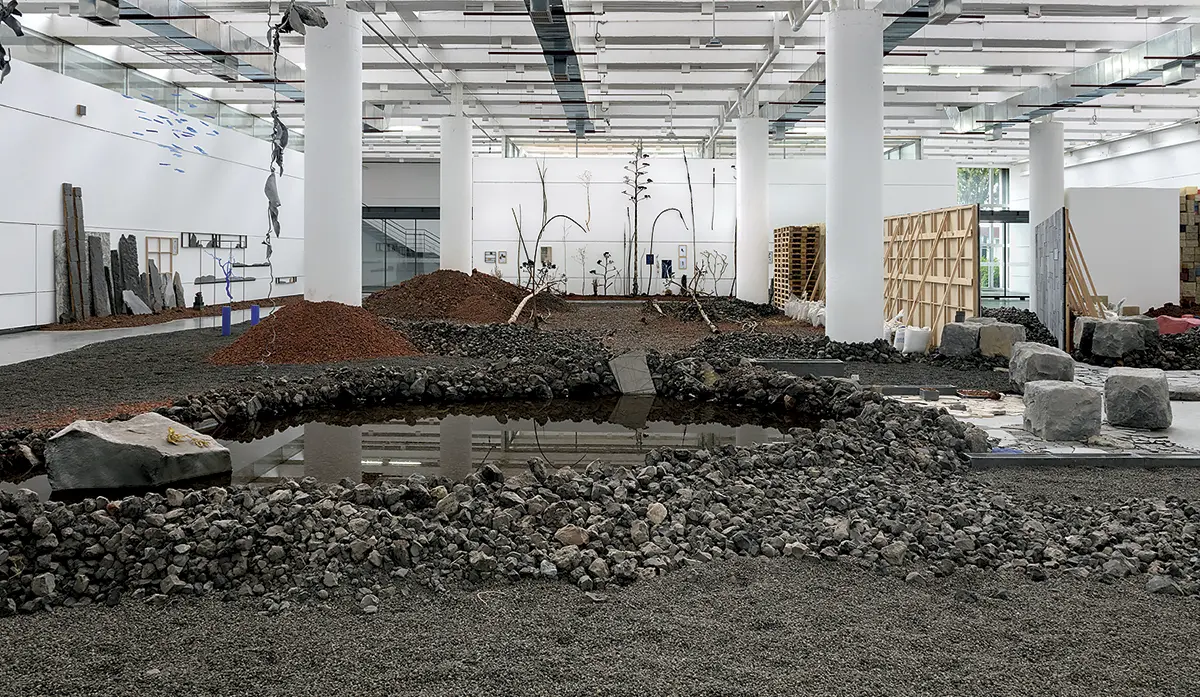
In this overladen megalopolis, long a victim of urban-planning anarchy and exponential growth (a population of almost 25 million), preserved or rehabilitated natural spaces such as parks are scarce. Aside from the large Chapultepec park (center-west), which dates from the Nineteenth Century and houses three of Mexico City’s most important museums, the Pedregal district, in the southern sector, is rather unique, having been built on a volcanic lava flow; there, one finds not only University City, but also apartment buildings and stand-alone homes. Perla Krauze needed extraordinary amounts of energy to “reinterpret Pedregal” in such a large space, bringing together rocks, plants, and flowers to create an installation that breaks common molds on the floor and the walls of the immense exhibition room. A long period of reflection and a sharp sense of space made it possible for Krauze to create this stage/museography, the constitutive elements of which—the variegated multitude of rocks, works, and installations on display—are impossible to count.
Perla Krauze worked on site for a number of years, collecting materials diligently—mostly rocks and stones but also plants, twigs, and flowers—in the locations where she carries out her research. What guides and inspires her is the labor of memory of what connects us with an origin: the earth, the rocks, plants, water… “The world began with rocks and seeing them gives us emotions,” declared Roger Caillois, writer and mineral collector. The selection of a rock for its shape and size, its nature (calcareous, volcanic, or granitic), its rough or smooth texture, is never haphazard. Krauze chooses, gathers, draws, imprints, organizes, and installs. She constructs an imaginary geometry, a recreation conceived as an echo of natural disorder, since, for her, creation sets up oppositions to better rethink the memory of the world. Her interest in and attraction to minerals, now transformed into the materials for her work as a sculptor/interventionist/installationist, hark back to her childhood. Indeed, it was in the Pedregal district when from an early age Krauze was in contact with a unique context: a solidified lava flow produced by the 1635 eruption of the Xitle volcano, which created a vast, 80-square-kilimeter volcanic expanse and gave shape to a landscape that for a long time remained free of construction, but has been savagely urbanized since. The only area preserved as an ecological sanctuary is the spot where, in the 1950s, Mexico’s University City was built out of volcanic rocks. (Diego Rivera’s sculpted and painted frieze for the Olympic Stadium was also made using lava from Pedregal.)
To enter this large and well-organized complex, one traverses a narrow, funnel-shaped corridor with sides formed by a geometric arrangement of gray volcanic rocks. On the ground, irregular fragments in a lighter color are gathered, mosaic-like, encrusted with small pieces painted with gold leaf. Reaching the vast space and discovering the installations, like aesthetically self-sufficient “islands” that nevertheless participate in a unit conceived as a totality, becomes an initiation experience. The visitor is overwhelmed by an accumulation that can hardly be encompassed by a single view. Yet, one soon begins to comprehend the rational character of the staging and the imbricated meaningfulness of the various elements on display. Some of those “islands” are comprised of solid materials, such as aluminum plates salvaged from the offset printing business owned by the artist’s father, their reverse still showing the traces of old printing jobs, and function as the background for a sculpture in black resin (with folds that bring to mind the work of British sculptor Tony Cragg) that replicates a volcanic rock Krauze collected in Pedregal.
For her ambitious reinterpretation of Pedregal, Perla Krauze incorporates a liquid element in different spots, like the “pond” over which vines and leaves in lead and aluminum hang. We again encounter the presence of water in the combination of lead squares that sketch a kind of gigantic puzzle/hopscotch/mirror. Two further “islands” incorporate a light, transparent material: a fabric veil printed with flowers, rocks, plants, and leaves that connect the white color with a hue closely resembling Mexico’s typical indigo blue; this material reappears to form the rounded module that hosts the video (now featuring a mostly green print pattern). The latter two installations introduce a note of lightness and life, as do the small mounds of ochre-red gravel set around the base of the broad, round and white pillars that support the ceiling in the exhibition space. The scant color notes to be found in this rather somber universe of rocks and stones are those that the artist herself contributes, with her interventions in resin. Also, every plant that grows on the lava field is represented here in one way or another: molded in aluminum or etched and printed on stone, along with those that belong to the Pedregal herbarium, or the dry plants and shrubs Krauze has gathered, also included in the exhibition.
The walls provide a no less important museographic space, one that resonates with what is on display on the ground. Like an open book where logic is affirmed in the face of chaos, what comes into view is the interplay of opposites that fuels Perla Krauze’s reflections: fragility and solidity; plenitude and emptiness; transparency and opacity; organic and geometric; tangible and evanescent; vertical and horizontal. The museography on three of the walls presents us with an elegant constructive arrangement based on compartments, where filled and empty areas alternate in equilibrium, with the white brick wall as a natural ground for the composition. In the interplay between the vertical and the horizontal (with an abundance of “stairs” as geometric compositions), a kind of chessboard of irregular dimensions, the triumph of the human hand to “give form” and aestheticize the raw material is a sophisticated response to the organization of the world.
In this ode to the earth/matter and the riches it provides us with (plants, flowers, trees), nature is never far. This installation in extraordinary dimensions is a visual, tactile, sensible field/song where order and chaos, destruction and reconstruction confront one another. The theme of the trace, and in consequence, memory, is the axis of Perla Krauze’s meditations, and also of the transmission—inherited from the Jewish tradition—of rocks through which the living remember their dead. The landscape is for her a site for creative experimentation, thanks to the rock as motif; it is also a foundational act in the search, through the trajectory freely presented to visitors, of pathways for the preservation of that which exists, reconstructing a fragile and subjective aesthetic testimony of belonging and permanence that challenges the threats of destruction, be it natural or human.
CHRISTINE FRÉROT