Today, the convent of the Carmelite Sisters of St. Teresa, a Catholic congregation set up with the purpose of providing religious instruction to disadvantaged children, is part of the neighborhood of Bellavista, but back in 1896 the location where it stands was a placid summer spa area, isolated from the rest of Santiago and accessible only by the Puente del Arzobispo bridge.
The site, located at the foot of San Cristóbal Hill, was named Montecarmelo in reference to its natural beauty. It possessed an exuberant plant life, abundant in native species and even fruit trees, in an agricultural expanse irrigated by the Carmen and Santo Domingo canals. At the end of the Nineteenth Century, a number of mills, a pasta factory, and several orchards could be found around the convent. Today, Bellavista is in the middle of the city, in arts district urban context.
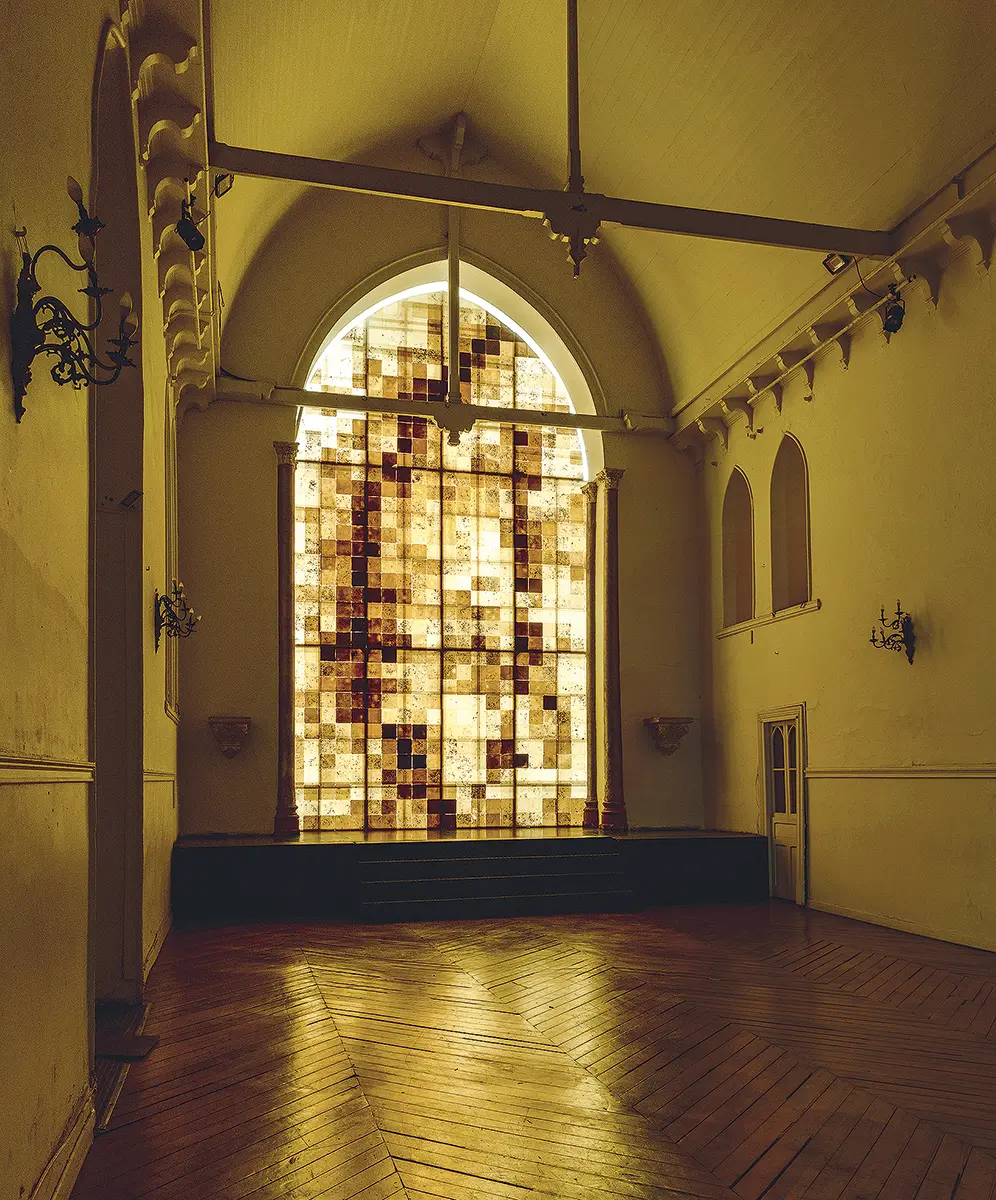
The convent’s chapel was built in a hybrid, neocolonial church architectural style with clear Spanish influences, where the use of couple adobe bricks as a construction system stands out alongside the fine woodwork of the structural elements in ceilings and hallways, and the colonial-style roof tiles of the coverings. What makes this construction especially valuable is the fact of its being one of only a handful of examples of this traditionally Chilean architectural style, along with the Lo Contador House in the Pedro de Valdivia Norte neighborhood and the Lo Matta houses in Vitacura. The convent’s traditional style is not only an architectural symbol, but also the location of a great religious and educational inheritance, thanks to the Carmelite Sisters of Montecarmelo.
The cultural center established in the old convent occupies a spot between two natural spaces, San Cristóbal hill and the Mapocho river, which places it in a special orbit and sensitive to the context of Chile’s national culture.
This was the special location chosen by Paz Lira Campino for the exhibition of her more recent production, an encaustic work that revisits and updates an earlier project from a few years back.
For the placement of this two-dimensional item, Lira selected the lancet arch where the chapel’s altar was originally situated.
The challenge the artist posed for herself was to create an encaustic painting using stained-glass techniques, recycling one of her earlier works on the subject of beehives. The technique of encaustic painting exists since time immemorial. It consists in using beeswax as pigment binding. A thin layer of hot wax is carefully applied to the work, which is then polished with a linen cloth.
Paz Lira’s proposal here—one to which, it should be noted, she has devoted a long time—is a monumental stained-glass window covering an eight-meter by four-and-a-half-meter surface, comprised of seven hundred and fifty blocks, each twenty-one by twenty-one centimeters with a thickness of five millimeters, and made, as we said, using an artisanal encaustic technique, all mounted on cotton fabric. Placed high inside the chapel and illuminated from behind by a lighting grid supported on a metal structure, they acquire a spectral appearance.
We are made witness to a work of art that is profoundly meaningful in its execution, its design, the use of light, and, most especially, its color. Evidently, the first source of wonder is the place where the work has been installed; one can certainly perceive part of the history those walls hold. It is, perhaps, the last remaining vestige of a recondite Santiago spot, filled with legends and characters. It is here that Paz Lira’s works seeks to capture time in its light and the natural colors of its wax pigments, in hues that recall a long-past, nostalgia-tinted time. Visitors situate themselves and feel the magic that the artist has been able to incorporate into her work, with the clarity she brings into her creations and the simplicity of the natural elements she uses, caught in playful circumstances that allow for their subtle manipulation and justify their objective.
Paz Lira’s extraordinary creativity should not go without mention. She unfailingly astonishes with works that bring forth straightforward messages about abuses inflicted on nature; in this case, we can also decipher a warning to take better care of all beings who contribute to our permanence on Earth.
In summary, Paz Lira presents us on this occasion with a unique proposal in a complex technique, set in a location filled with remembrances of a distant past, and fulfills her goal of furthering a clear expression of ecological awareness and reconciliation with the environment.
ERNESTO MUÑOZ