From May 1 to September 4, an exceptional exhibition, both in terms of scale and results, occupied the second floor, the main staircase, and the gardens of the Château de Chambord, as well as the public spaces of the Domaine. Entitled “Débordements” (Overflow), the show revealed a broad imagination, unlimited resources, and noble materials.
Born in Buenos Aires in 1955 and living in France since 1978, Pablo Reinoso is a multidisciplinary artist. The castle project started in March 2020 and was plagued by various external situations, such as the pandemic, storms, and even the restoration of the castle itself. Made to harmonize with the landscape to the Renaissance architecture of the Domaine, Reinoso’s pieces were mostly variants of an original concept related to reassessing the plant world: a reference that was ratified in Augmented Tree (2019).
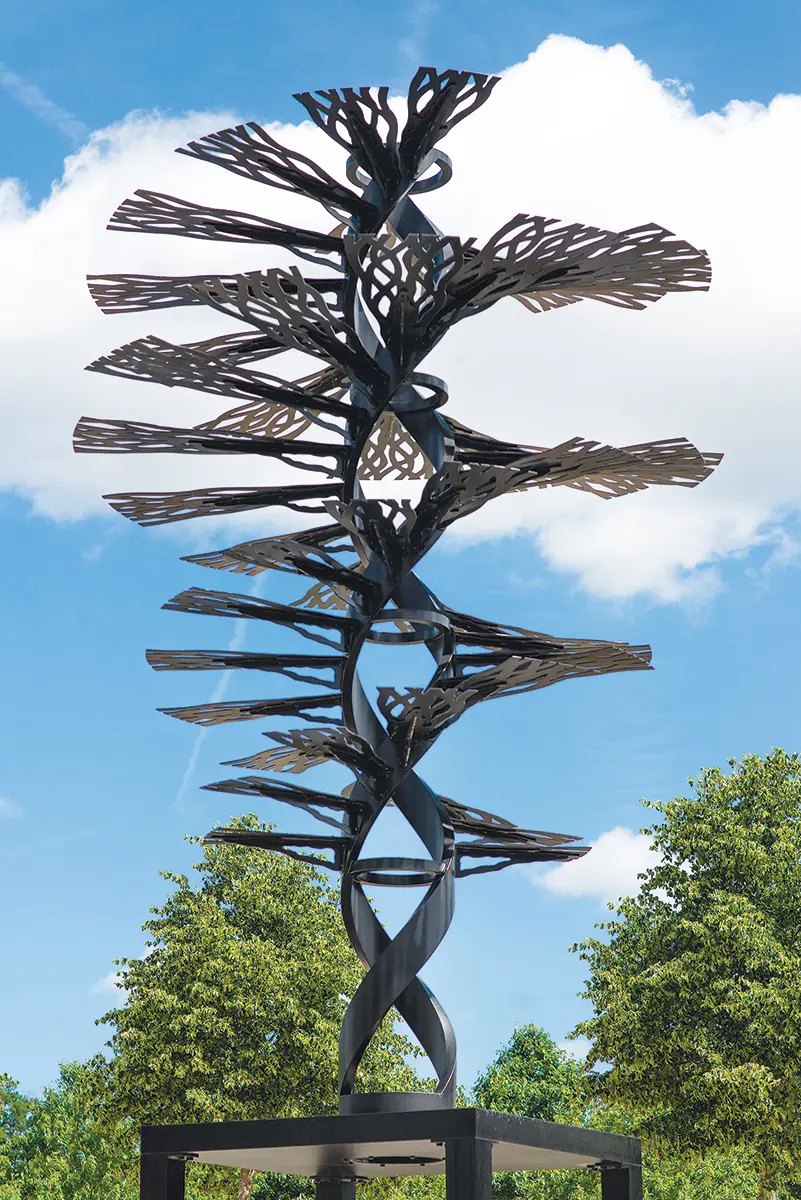
The titles suggest formal parallels or actions. They are not explicit designations. Entramados (Lattices), from 2022, was a printed work covering the external scaffolding of the walls under restoration, and oscillating between a monumental form and a fragile drawing. With this symbol, Pablo Reinoso carried out an intentional colonization of space. Supports and other forms of artifice are seen in some of these works. “These are methods to prolong life. As indispensable for existence as all kinds of prostheses are for humans,” said the artist. With Still Tree (2019), from the series of augmented trees, he sought to establish a meeting point, a dialogue, a selfie.
Among the fifty pieces scattered throughout the place, we can highlight Plant Revolution, according to Leonardo (2022), where each step becomes a plant, a branch, a tree. The work refers to Da Vinci’s sketches and evokes the double revolution staircase. La grande parole (The Great Word), from 2022, was specially designed for this exhibition and is related to the “Talking Benches” series. With Mirador Bosque (Forest Lookout), from 2018, he addresses those who want to contemplate the forest: high chairs, giant variants of the rocking chair, allow for a moment of rest.
The title Feu de tout bois (Pull Out All the Stops), from 2022, is an idiom referring to the employment of any means to achieve a goal. It’s a kind of transmutation; like the salamander that the artist reproduced realistically and placed on trunks. This animal—associated with protection, combat, and fire—was one of the icons of Francis I, who completed the castle project.
Many of the inks executed this year standout for their evocative subjects related to biomorphic forms—air and fluidity, gravity and voluptuousness—explicit in works such as Eclosion and Vibrations: reflections on the search for a harmony close to the total work. In recent years, these reflections were translated into plastic forms around arborescence; both Still Tree and Uprooted can be read as displacements. The artist presented a resized version of Articulations, an early piece from 1969, and works created specifically for the exhibition, such as the “Respirantes” (Breathers) series.
The artist based his exhibition on the harmonious relationship between nature and culture, inviting visitors to rethink about the inescapable collaboration between people and their environment. Visitors were able to establish a formal dialogue with his sculptural pieces by giving them different possibilities of use and observation, which is part of the latest advances in his artistic practice.
Aside from this monumental ensemble of works, Reinoso’s first solo show in Paris took place at the Xippas Gallery, from May 19 to July 23. Together, these two shows presented various historical pieces, such as Le soleil (The Sun), a work in bronze and wood made in 1993, El Virapita (1975), and his first Articulations, offering a journey through his entire career.
Parallel to the gallery wall was a mixture of ropes and branches on paper, Entramados, offering a reevaluation of the plant world. These works may be linked to the subconscious and to the peculiarities of the living. Ink originals of these Entramados (2021)—first presented at the Xippas Gallery in Geneva in 2021, along with the novel series of Chinese ink paintings—were placed at an angle of the entrance to the Paris show.
At other times, Pablo Reinoso delved into the fragility of the elements: water, air, fire mainly, and finally the earth: the subtle enclave where everything is sustained. Some previous works enriched his proposal for Chambord, but the ensemble was especially conceived to resonate with the external and internal spaces of the castle: the installation in the gardens, the chimneys, and the central staircase.
With authenticity and adapting to the dimensions of the gigantic space and the sober walls, the pieces provoked amazement both for their originality and for their aesthetic appeal in the refined context where Leonardo da Vinci lived.
SUSANA SULIC