Pablo Helguera’s Artoons are the bastard progeny of social media. In Helguera’s own telling, he began to produce his celebrated vignettes in 2008, in the early days of Facebook, because he didn’t know how to interact in the platform and didn’t want to post his personal photographs there. He focused on a narrower network, the art world, and, with his ironic spirit, found ways to inject humor into a series of dynamics, characters, and situations on which we have all been able to recognize ourselves and smile. It shouldn’t come as a surprise that, shared on social media, his caricatures quickly went viral and acquired such relevance as to become one of contemporary art’s indispensable creations.
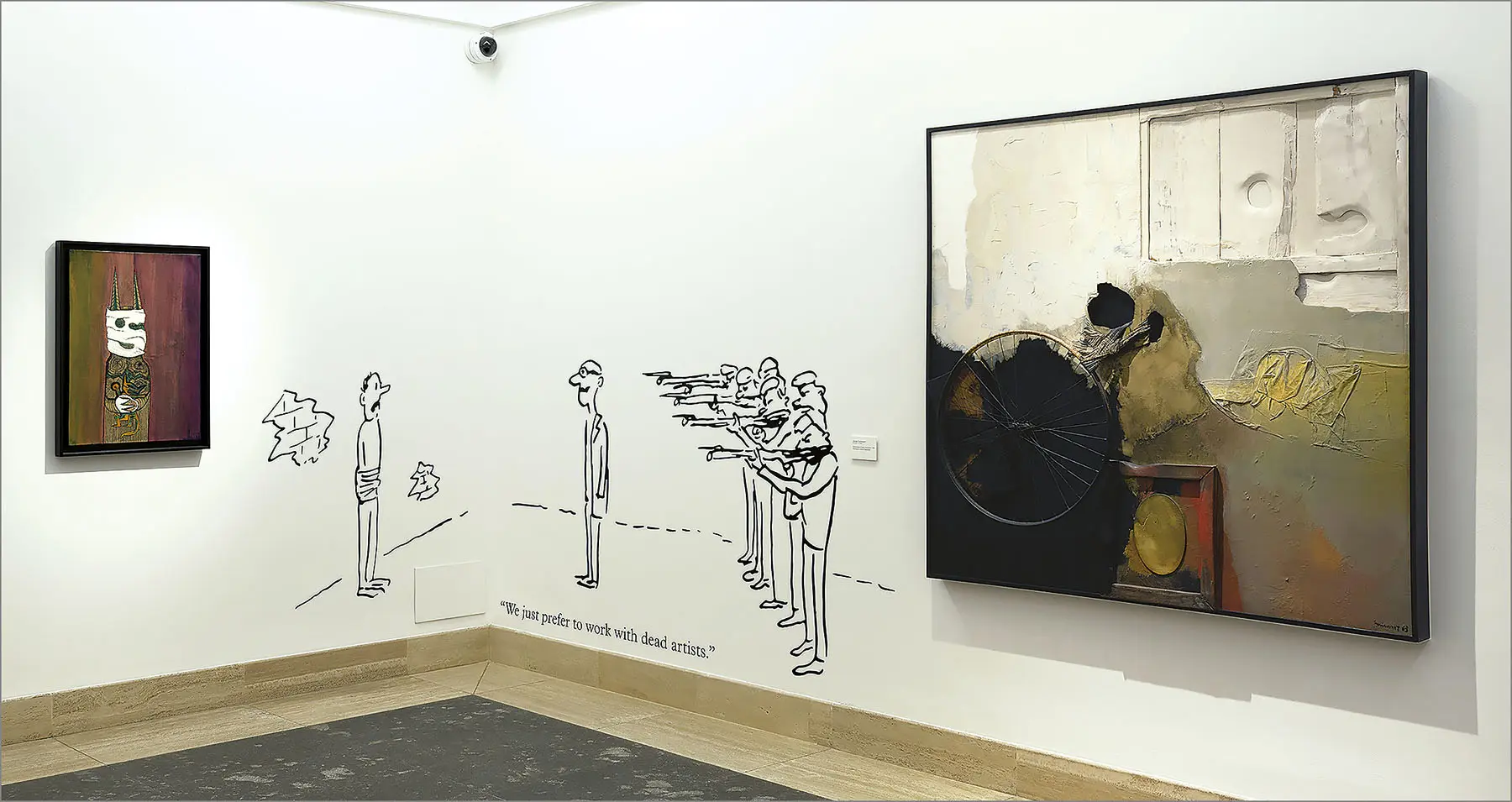
Between November, 2021 and May, 2022, the Joan March Foundation presented the exhibition Pablo Helguera: la comedia del arte (Pablo Helguera: The Comedy of Art) at both its Palma de Mallorca site and its Museo de Arte Abstracto Español, in Cuenca. Arranging Helguera’s Artoons in such exhibition spaces presents a major challenge, due to the format, scale, and content of the series. Curator Manuel Fontán del Junco’s wisest decision was to have them share space directly with the collection in each site, boosting the keen wit of Helguera’s work and making it speak in one of its most foundational contexts: the museum. Aside from those displays, the exhibition features fifteen original Artoons and a selection of publications, among them the three volumes of Pablo Helguera’s Artoons (2008, 2009, 2010) and his Manual de estilo del arte contemporáneo (Contemporary Art Style Manual, 2005).
At Cuenca, the Artoons interact with works of Spanish informalismo (Saura, Chillida, Tàpies) not only at the level of the art as such, but extend their reach by alluding to the whole set of practices and processes through which those very works have been assimilated into and understood in a general system of social valuation.
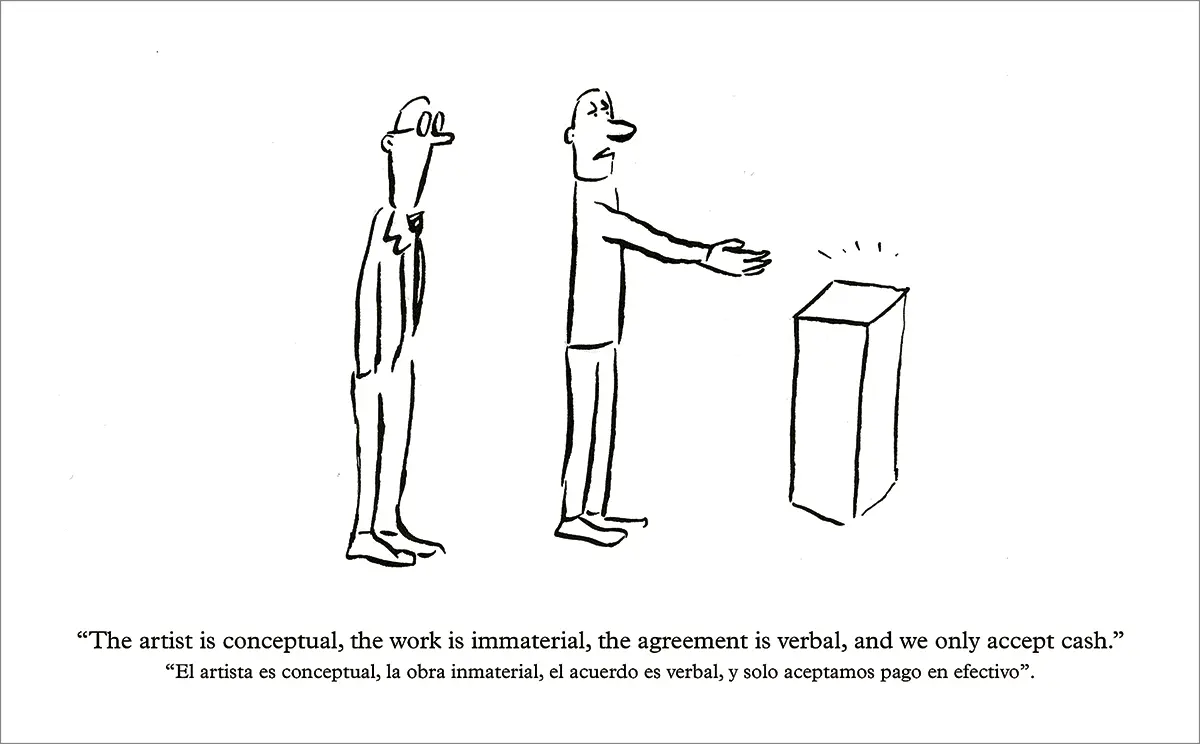
Helguera has always been interested in the interaction between art and its publics. In this connection, his oeuvre has sought to highlight the social relations behind the work of art, and to emphasize the degree to which those relations are what provides a given work with its artistic aura. Seen in perspective, his trajectory has been anchored mainly to processual practices: performance, pedagogy, mediation, book editing, singing, and experiments with discursive situations such as debate forums and lectures. It is not altogether unexpected, then, for someone with such an unconventional, multi-faceted profile to have produced such a sui generis work as the Artoons.
The universe of the Artoons also brings together other constants in Helguera’s oeuvre: humor and institutional critique. His project Everythingness (2000) consisted in the establishment of a fictional business, supposedly offering the service of eliminating the dimension of time to help customers do things faster. It was a parody of contemporary society’s obsession with speed and efficaciousness. Meanwhile, his performance The Juvenal Players (2009) underscored the contradictions and complexities of the art world’s mainstream circuits.
Helguera’s institutional critique, however, is not corrosive in a mean or damaging way. This is perhaps why it has inserted itself so naturally into the art system. We all enjoy the Artoons and no one feels personally aggrieved because, as Gerardo Mosquera noted in a roundtable discussion accompanying this exhibition, the artist treats his characters with great tenderness.
Show curator Manuel Fontán has rightly called attention to the frequent humorlessness of artistic practices and institutions, “perhaps because, in the effort to convey the validity of contemporary art, museums take themselves all too seriously.” In that spirit, La comedia del arte is a rather unusual exhibition in the Spanish context, not only due to its agenda, halfway between humor and meta-commentary on art, its agents and institutions, but also because of its freshness and innovative spirit, as rigorous and profound as it is averse to phony posturing. The presentation in Cuenca also coincided with the ARCO art fair, which repeatedly fostered a feeling of being a character in one of Helguera’s vignettes.
It has been said that Pablo Helguera is an anthropologist or ethnographer of the art world. Rather than being the result of an external or instrumentalizing approach, however, his gaze comes from inside that world. The artist himself has said that many of the situations he reports come from his own experiences in the New York art ecosystem. The Artoons also make palpable the globalization and homogenization of certain practices replicated, at various scales and with various nuances, in local communities and international spaces. As Helguera says, the Artoons remind us that we are all villagers in the world of art.
DIANA CUÉLLAR LEDESMA