We will not distinguish the true from the false, but will look for the falser than false: illusion and appearance...
Jean Baudrillard
Norton Maza’s exhibition “Analogies of Reality” opened in early August at the Museum of Contemporary Art (MAC) to a huge audience. This was no wonder. The shock caused by the installation that named the show surpassed any expectations about this monumental work by the Chilean artist. In the main hall of the French-styled neoclassical building, surrounded by a two-tiered courtyard of columns and under the central dome, a riot truck was suspended, literally, in space. At a point of impossible equilibrium, as if time had collapsed, the gray mass seemed to collide with the remnants of a barricade made of everyday household objects.
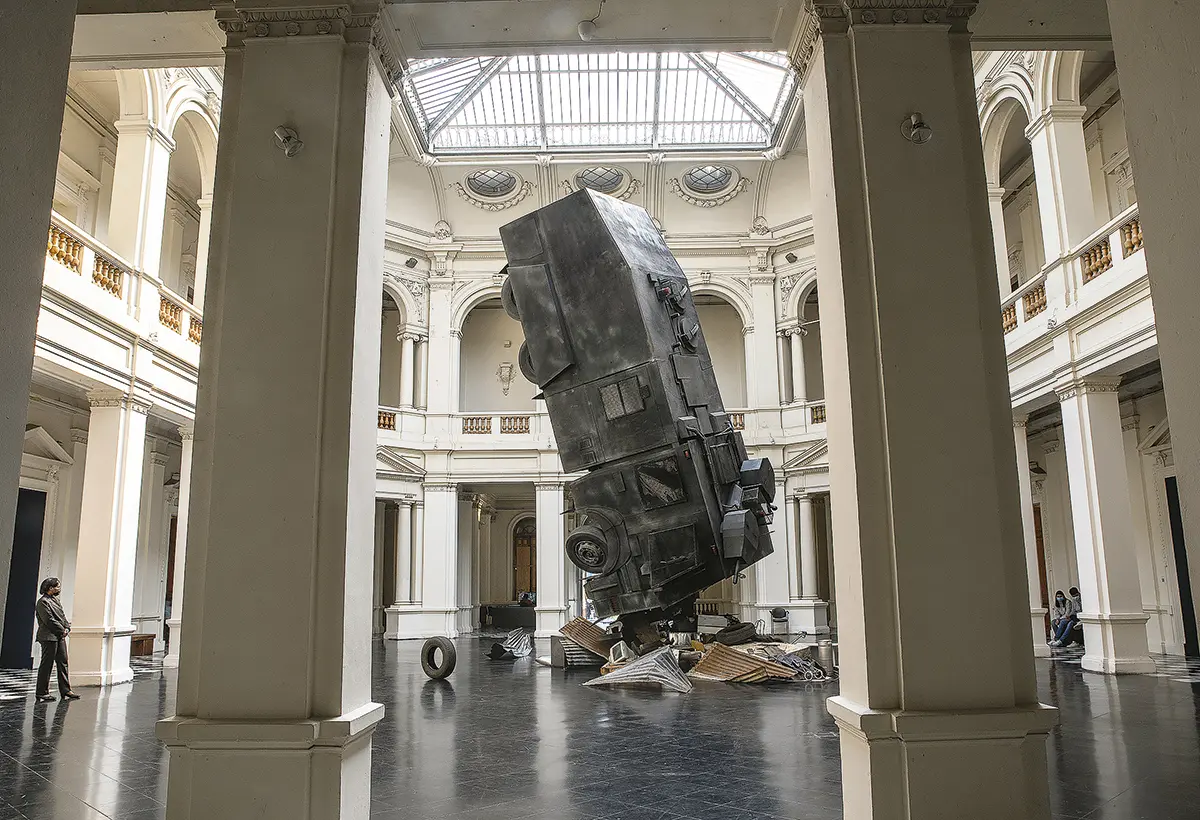
As Baudrillard defined it, ecstasy “is the quality proper to any body that spins until all sense is lost,” so therefore “simulation is the ecstasy of the real” (1). The object trapped us and the impact was almost redundant in ecstasy, since the simulation of something realer than real took us by surprise. In other words, those empty forms attracted and overwhelmed us in spite of knowing, beyond imagination, their real danger. I would rather argue that we were facing the spectacle of a hyperreality that escaped from the streets in the form of an object magically introduced into the MAC and rendered as a slow-motion 3D image. Was that a fatal strategy?
To make things even more intriguing, perched on the top of the vehicle were two peaceful blue macaws (an endangered species). Did these artifacts belong to some dystopia or post-apocalyptic event in a parallel space and time? As we came closer, what seemed to be a barricade now became some sort residual place, as if the anticipated collision had taken place in the dumpster of a hovel. Perhaps the pools of water and the appearance of abandonment attracted the birds. In another room, Fragments of an Impact, made with stones and debris collected from street protests, was covered by simulated fragments of idyllic landscapes, like islands floating in space, reminding me of the Russian film Solaris, by Tarkovsky. What hyperreality then would we be witnessing other than a catastrophe provoked by our sociopolitical and ecological crisis, or is it an archeological image that mirrors the outcome of the Anthropocene? I believe any of these proposed scenarios would be perfectly conceivable.
For Norton Maza, a rather uncommon artist in the Chilean context, his 1:1 “maquettes” are part of a playful game to attract viewers with a mixture of fiction and reality (2). I would add that these simulacra and games with the real pose other kinds of tensions in the artistic context and the sociopolitical reality of a country in rebellion ever since the so-called “Social Outburst” that began on October 18, 2019. Historic events have been experienced, including massive protests of millions of people in the streets of Santiago and other cities. The government changed hands, but has the system that generated so much violence and iniquity really collapsed?
Beyond the postmodern strategy of the simulacrum, the image of a riot tank colliding in a museum points to another type of tactic widely used by some Latin American artists: resorting to fragile and low-cost materials to camouflage the spectacular image to be represented. Without eluding the emptying of ecstatic forms, I would say that they are maneuvers of appropriation and simulation totally disguised by the tension between materiality and a multiplicity of meanings. In this way, Norton Maza is proving his strong ties to the Cuban scene of the 1980s, where he studied art and shared objectual practices with artists such as the former members of Los Carpinteros, Esterio Segura or Kcho, to mention a few.
The notion of the baroque developed by José Luis Brea seems more pertinent to address the totality of Norton Maza’s works. On one hand, there’s the anti-historicism in the space of representation by embracing and deploying simultaneously its “actuality and memory, its past and its future” (3). On the other hand, in his eagerness to saturate the image with palimpsests of cross-references and iconic quotations, he projects an agonizing explosion of meanings. Both criteria can be applied in all his series of photographs with constructed maquettes—like Thomas Demand’s artifacts, but without their coldness—from his Study for the Symphony of Eternal Power (2007) to monumental installations such as El rapto (Abduction, 2016).
Finally, we may wonder whether the tragedy announced by Analogies of Reality (2022) is not precisely the baroque dream itself, but rather the re-presentation of the collapse-catastrophe (4) as spectacle to enjoy as a substitute for the real. In any case, Norton Maza makes us question once again the meaning of the image in times of uncertainty. With his game of appearances, he subliminally detonates the palpable presence of that eternal present that seems to make a possible future collapse at the very moment of the gaze.
NOTES
1. Baudrillard, J. (1990). Fatal Strategies. Translated by P. Beitchman and W. G. J. Niesluchowski. Reprint. Los Angeles: Semiotext(e). 2008, p. 28. Baudrillard’s quote at the beginning appears in p. 27. (Translator’s note)
2. Questions asked to the artist on 13.09.2022.
3. Brea, J.L. (1989). “Por una economía barroca de la representación.” Los manifiestos del arte posmoderno: textos de exposiciones (1980-1995). Anna María Guasch, ed. Madrid: Ediciones Akal. pp. 225–227.
4. I’m referring to Baudrillard’s notion of catastrophe: “The catastrophe is the maximal brute event, here too more eventful than the event—but an event without consequences, one that leaves the world in suspense” (Fatal Strategies, p. 36).
DERMIS LEÓN