The pathway through this exhibition started with a quote from Nietzsche’s emblematic work, Thus Spoke Zarathustra: “Three metamorphoses of the spirit do I designate to you: how the spirit becometh a camel, the camel a lion, and the lion at last a child.” It could almost be said that the show began at the end: with the child. There are lions, tree branches, flags, photographs of children, outlines of animals, and as we went further into the gallery, we traversed, as in a dream, a rearview mirror of sensations that became, and deeply so, an aesthetic experience, one that pivoted on the child, the origin.
In his theory about the agricultural revolution, Harari tells us that there was a point of inflection in the history of humanity, when the need arose to create permanent settlements and to begin to “control” nature. The cultivation of food products began as a way to supply the needs of small settlements, and afterwards, to exchange with others that requires a bit from here and a bit from there. One of the theory’s strong points is its interrogation of where all of that has taken us. Because that’s the point of origin of the history of labor, of commerce, of wealth and poverty, of civilization. And, given the 300,000 years that homo sapiens was inhabited a world that formed over millions of years, it has been too rapid a step for the body to adapt to the new demands. Which is to say, there is a natural, primeval being that revolts inside us all the time, calling us towards the original state of things, the state of the agricultural revolution. It is surely that state that Nietzsche permanently claims for in his meditations on the origin and our return to the origin, to the shaman, to the child.
Something similar occurs with colonialism and its persistent drive to impose ideas, beliefs, symbols, and new forms of existence upon structures that appear more fragile, but continue to hold on to their origins over time. Time, which ends up bearing witness to small transformations barely able to impact the character that saunters between several worlds. Along that order of things, what is a flag? A nation? The flags that Mario Opazo are nothing but symbolic representations of a state in search of identity, history, and frame of reference for something that the primeval being mentioned above refuses to comprehend. His gamble focuses on a continental flag. Something more connected to the millions of years that it takes for a continent to form than to a contemporary representation, which could change tomorrow without a single person to be affected genetically.
The visit continued with outlines of animals: a capybara, a tapir, a caiman, etc., contrasting with the silhouettes of cutouts of pharmaceuticals boxes used in the control of the expansive human construction encompassing schizophrenia, depression, and anxiety. Little happy pills that, sadly, can ultimately only cause dependence on happiness itself. Is that the world we have built and hold on to? Did we promote an agricultural revolution in order to live at ease, only to have the opposite effect? The animal we have tried to obliterate, the nature we seek to control, and even the happiness we so badly want to capture in a bottle, remind us of how far away we are from the shamanic human being who coexisted with nature and surrendered to other forms of representing himself symbolically in his environment. It is not by chance that, to go with those little happy pills, here in Colombia we have invented “Bienestarina” (“Wellbeingerin”): a dietary supplement intended, as its name suggests, to provide well-being for all children. Have so many years of “Bienestarina”, almost fifty, really achieved that aim?
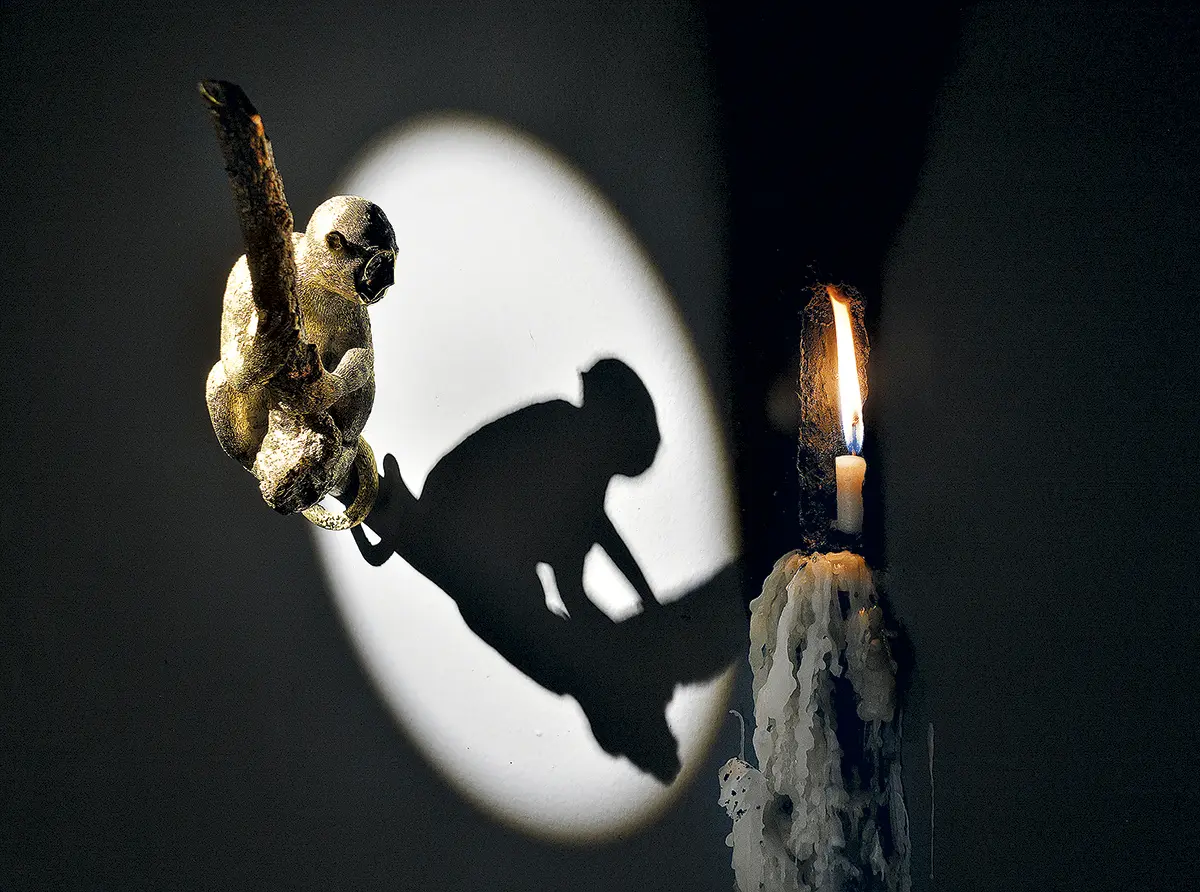
The exhibition was an expanded installation hinging, even if it sounds excessive to put it like this, on a copper monkey mesmerized by a candle flame. Grasping a tree branch, the monkey turned its head dumbfoundedly towards a lit candle that slowly dripped the wax fueling it. Three simple elements: monkey, branch, and candle; and a key detonator: fire. All of it demands silence, meditativeness, contemplativeness. The entire exhibition is enunciated in such simplicity. Opazo takes us by the hand to that cavern where everything was otherwise. Humanity grew up. Becoming more adult, it saw itself building a “better” world, but at such speed that it continues to cling to the child who questions it in its simple way. This is what the show that started at the end was all about: the child-shaman; as Mario Opazo so beautifully puts it, “a being who lives in the dimension of things without a name.”
ANDRÉS GAITÁN T.