“… if nothing passes away, there is no past time; and if nothing arrives, there is no future time, and if nothing existed there would be no present time.” (1)
Saint Augustine raised this reflection on existence for his readers to become conscious of every instant of their lives. This idea resonates in the exhibition “Un lugar en el presente” (A Place in the Present) dedicated to artists Alexander Wtges and María Camila “Remedios” Bernal, and curated by Loliett M. Delachaux. With the works as triggers for emotions and reflections that encourage viewers to experience the moment—where the memories evoked by the pieces coexist—we were invited to forget the future and the past in order to enjoy the here and now.
Their stimulation would not have been possible without the space that hosted the encounter, one of the oldest venues devoted to art in El Salvador: the 1-2-3 Gallery, founded in 1971 by María Celia de Cohen.
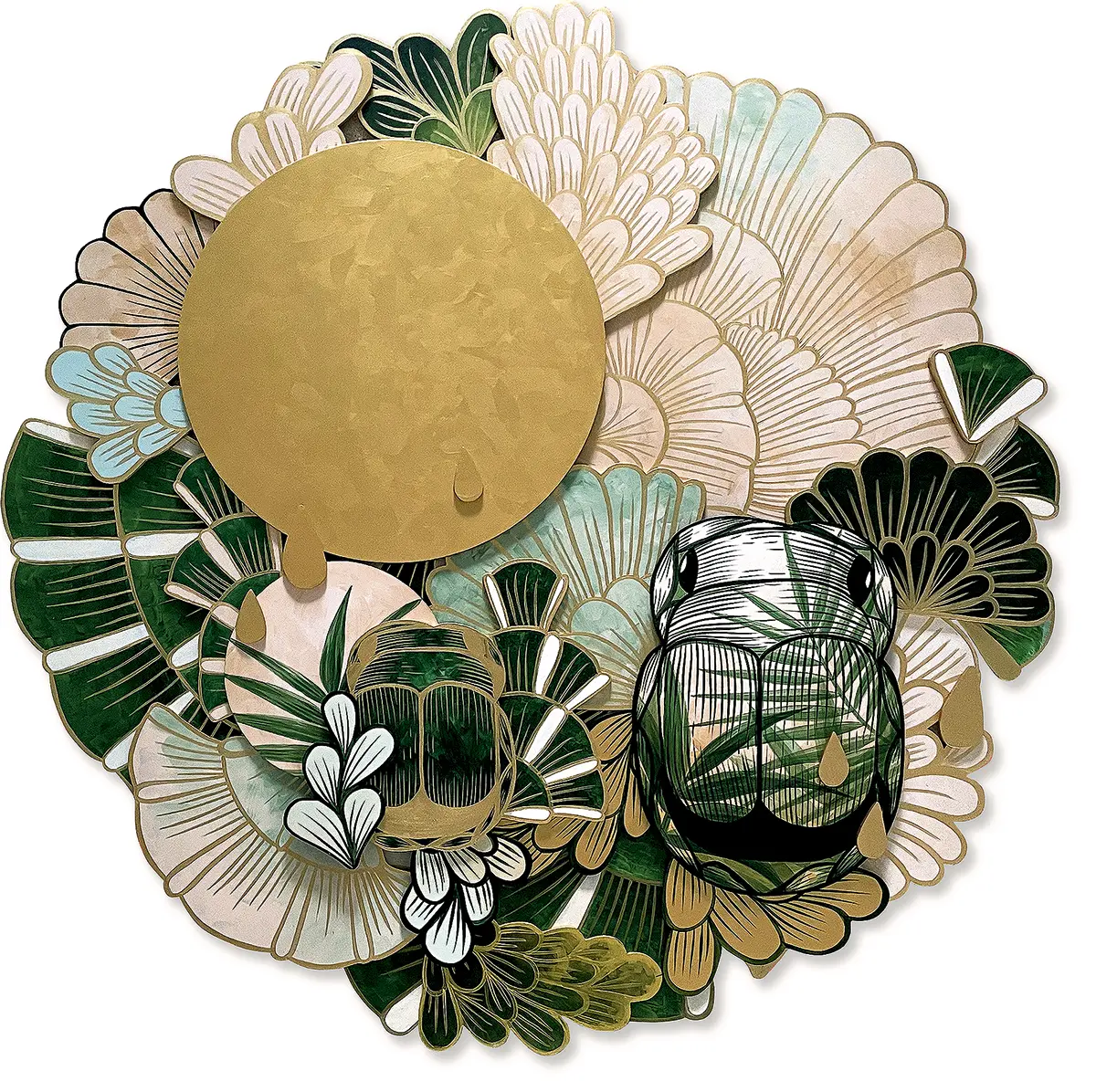
“Un lugar en el presente” allowed us to get acquainted with the individual work of each artist. Wtges’ pieces reveal infinite compositions, with their geometric territories as fragmented spaces that are reconstructed in rhythmic and ordered shapes, pointing to a personal graphic style. The aesthetic influence of Latin American kineticism and the constructive universalism of Joaquín Torres García can be perceived.
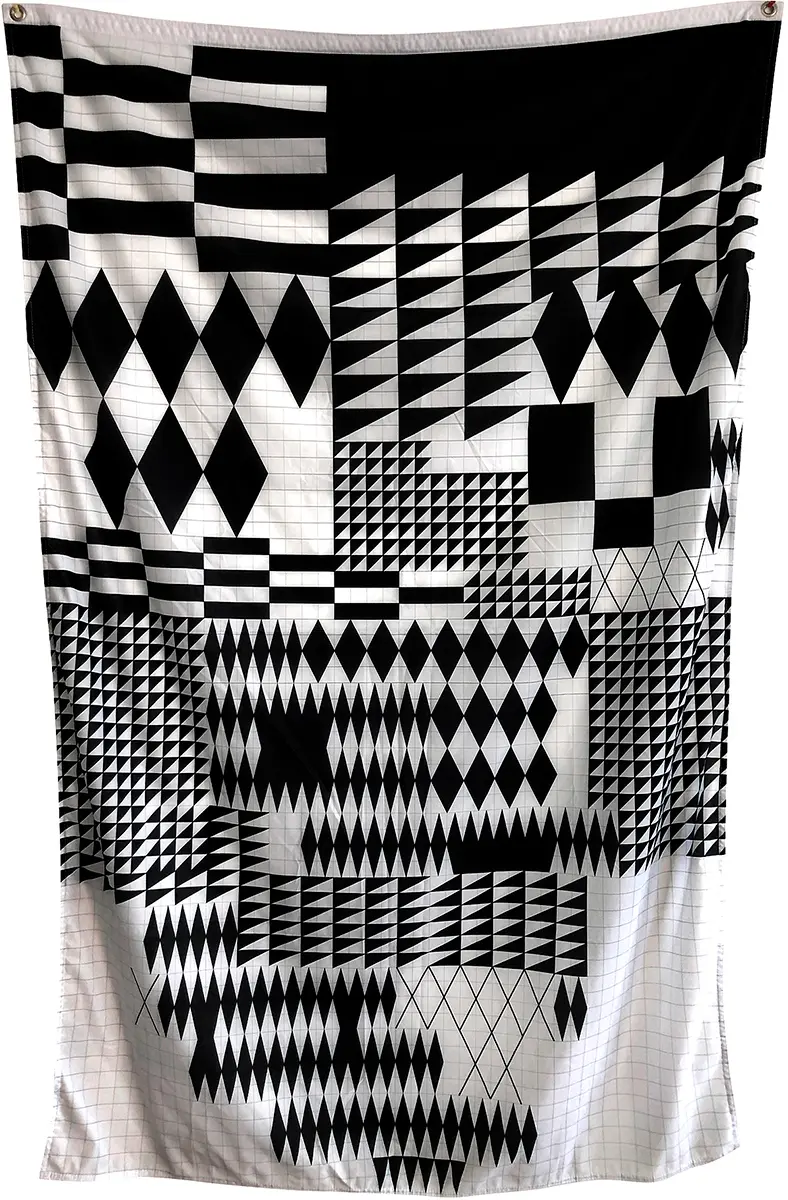
Remedios, on the other hand, takes us into a dense jungle; a collage of planes, characters, foliage, insects, and other elements. All this alludes to the overlap of leaves, branches, bushes, trees, and animals that we observe as we walk in nature. But beyond that, her works are like fragments of an adventure; a journey through an imaginary, fantastic, and magical tropical jungle that only exists in our dreams and where there are treasures to be discovered.
However, the most interesting aspect of this exhibition are the works they created jointly. Building metaphorical forms of harmony, they merged two aesthetics that seem so contradictory when viewed separately.
Their willingness to work together proved to be a valuable topic of reflection since the exercise of mutual construction and intervention requires the coexistence of many factors. And it could not have been an easy task given that two different ways of making art have bonded to generate a unique and deeply balanced composition.
These pieces are especially relevant in El Salvador, a context that stands out internationally for its high levels of insecurity and violence (2). The artistic process of Bernal and Wtges is an example of a harmonic construction between two seemingly opposing creative paths that nonetheless appropriated each other’s operations and, in the process built a dialogue to achieve a balanced result. This should be the goal of Salvadoran society.
Although the rates of violence have been reduced, this is still a country marked by a history of political disputes and conflicts with huge repercussions in the social and economic spheres. The high level of crime has led us to mistrust each other. This is evident in the various and abundant security measures in the capital city, which, far from bringing comfort, can be distressing. And although friendly people are plentiful and collaborative work is part of everyday life, as in any other society, these situations have marked the image of the country abroad and the lives of Salvadorans.
The local context is worth mentioning because it contrasts to a great degree with the proposal offered by Remedios and Wtges. On the positive side, the pieces presented here in El Salvador may move us to realize the enormous need for this society to peacefully build a more harmonious future together.
NOTES
1. Augustine (1992), Confessions. Translated by H. Chadwick. Reprint, Oxford University Press: Oxford, 2008, Book XI, Chap. XIV, 17, p. 231.