The work of Marcela Armas (Durango, 1976) is on exhibit at Museo de Arte Contemporáneo Carrillo Gil, with a selection of thirteen projects curated by Mauricio Marcin. This engaging show spans twenty years in the career of an artist who has exhibited in the United States, South America, Europe, Russia, China, and India.
Armas’ goal is to prompt reflection about the ways in which the wasteful use of energy shapes ethics in a social, political, and economic model supported on a voracious system of production and consumption.
Based on this premise, the machines and devices she creates are intended to interrogate capitalism and its impact. At the same time, she is deeply interested in the recovery and caretaking of ancestral and communitarian knowledge, as a way of counteracting the noxious spread of mineral extraction or unsustainable agriculture, which can be profoundly damaging to entire ecosystems. Animals, plants, and anything living on the land is subject to their devastations.
Appearing at the start of the exhibition, I-maquinarius (2008), comprised of an industrial chain, a motor, a lubrication system, and petroleum, immediately grabs our attention.
The oil in I-maquinarius takes the inverted shape of the map of Mexico. This work was created at a time when Mexico’s legislators debated an energy reform, bandying about ways to exploit and privatize the nation’s hydrocarbon resources. The process presented in I-maquinarius is powerfully illustrative of the importance of those resources for the country. It is a multi-dimensional work of art that engages our gaze, our hearing, and even our sense of smell, as we perceive the odor of the oil that recirculates, spills, and stains everything around it.
Another highlight is Cenit (Zenith, 2007), on loan from the Jumex Collection. As a hydraulic pump fills its plastic hose with a steady flow of used motor oil, the device it features slowly sketches the outline of an imaginary city. Cenit illuminates the megalopolis’ dependence on the runaway use of fossil fuels and their derivatives.
In Noches incandescentes (Incandescent Nights), we encounter a series of 25 light boxes with engravings based on satellite photographs of urban sprawl around the world. Under a zenith-point perspective, they resemble images of the cosmos and the stars.
Ironically, what makes it more difficult for us to contemplate the actual skies is such light pollution from the cities. This pollution, a radical change, emblematizes the amount of energy that cities require in order to exist and how they contribute, along with other factors, to phenomena like global warming.
Our idea of progress and development has been anthropocentric, and while light and energy make modern life possible, their consequences for the natural world and for human life may be irreversible.
In this section, with light as its subject matter, we also find Resistencia (Resistance, 2009), which depicts the US-Mexico border using a metallic filament ignited by electrical means and emanating heat, activated by a sensor as the visitor approaches. The heat is a symbol of political tension. Resistencia metaphorizes a migratory situation exacerbated in recent years by people’s increased need to flee conflict zones, or simply to seek a better quality of life.
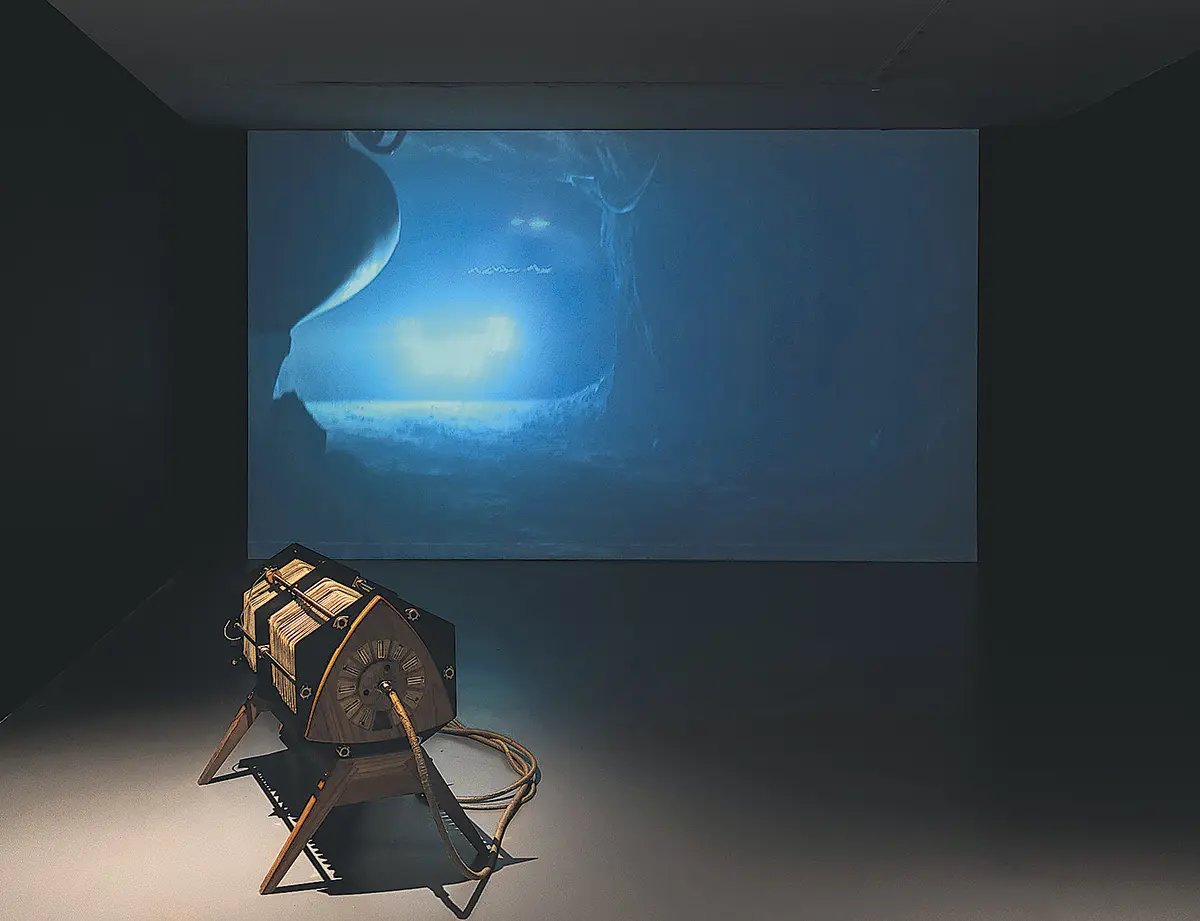
Tsinamekuta (2016-2021), made in collaboration with Gilberto Esparza, Diego LIedo, Bruno Monsiváis, and Daniel Llermaly, is exhibited here for the first time. The product of five years of research and fieldwork, the project includes musical instruments, storyboards, watercolors, photographs, costumes, videos, and maps. Tsinamekuta means “house of rain,” and is the name of a ceremonial center in the Wirikuta region of Mexico that has resisted for more than a century the activities of mining companies in the area. Taking the mineral pyrrhotite as its starting point, Armas’ project set out to dialog with the local community and resulted in the creation of musical instruments that express the rock in sound, under the premise that the salvage and valorization of the community’s ancient traditions helps confront the devastation by fostering renewal and mutual nourishment between different beings.
This riveting exhibition is an excellent demonstration of the way in which art can be a vehicle for transformation, generating critiques and offering possible alternatives to contemporary problems.