The work of Lucía Pizzani (Caracas, 1975) is structured around the relationship between body and nature, the life and death processes that emerge between them, the metamorphoses of the skin, and the fragility of time. The exhibition Tiempo membrana (Membrane Time), curated by Lorena González, brings together nearly fifty works, arranged as series and stand-alone items, along with a site-specific clay mural, and documentation of performances. The arrangement in the gallery doesn’t follow a chronological or linear logic, but rather a circular one based on the connections between the works and the series, in terms of the materials and concepts used in each. Covering a fourteen-year span, the exhibition reveals a solid and coherent trajectory, its tenor at once poetic and heartrending, that unfolds between translucent membranes, redeemed bodies, lacerated bodies, furrows, fissures, plant species, tree bark, cocoons, larvae, sacred clay, organic earth, leaves, seeds, and skins in transmutation.
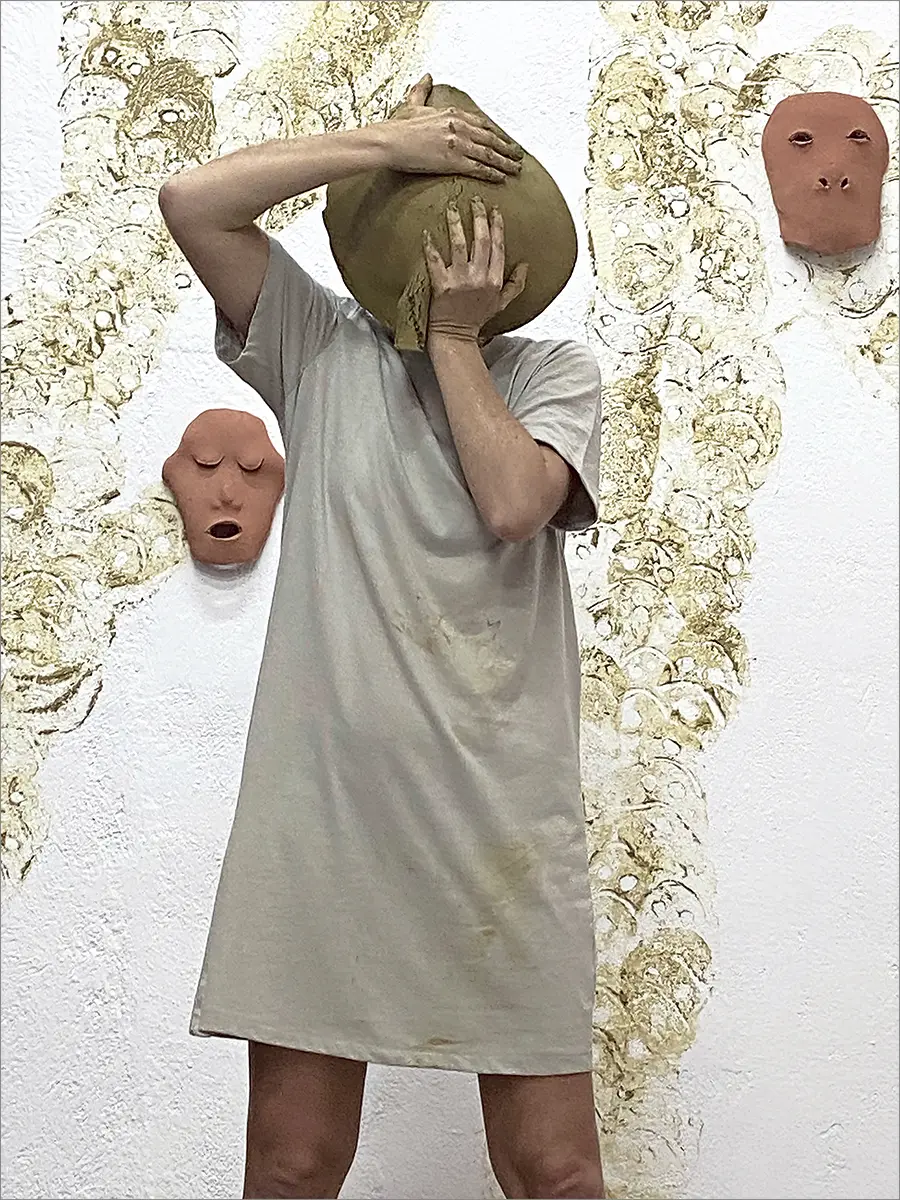
Migratory processes have been a familiar experience for Pizzani since childhood, and the state of being in one place while belonging to another, that condition of being-in-the-other, of changing cities and changing bodies and spaces, traverses the development of the works on exhibit here. It is expressed, for example, in Cortezas e Híbrida (Bark and Hybrid), from 2021, a series of photographs of Lucía Pizzani’s body encased in a ceramic double skin. As she leaves behind an old skin, which begins to mutate, Pizzani projects onto the human the shedding of skin we see in animals, a resource for regeneration and healing. Her performance Ritual circular (Circular Ritual), from 2022, insists on the creation of a double mask, a second skin. The idea has been an anchor of Pizzani’s work for a number of years, as she has incorporated animal carapaces and revised Mesoamerican rituals like those honoring the Aztec deity Xipe Totec, who wore the skin of a defeated warrior to mark the start of the corn season, life emerging from death. The double hand or the double face are clearly an allegory of the transmutation that leads to new life. The expression of life flowing from the entrails is also seen in Cuenca, from 2013, a series of four photographs depicting the emergence of life from large vessels made using traditional techniques by a village’s female artisans. As the artist’s body emerges from the clay and moves out into the world, it fleshes out the vessels, which in turn have the shape of human hips and signal a birth, a transformation in the act of being born.
This metaphor of transformation and renewal reappears in even greater splendor in Mariposario (Butterfly House), an installation comprised of glazed ceramic pieces resembling butterfly cocoons, placed between plants on the wall, as if waiting for their moment of birth. These cocoons are concentrated around the video Cronógrafo Monarca (Monarch Cronograph): twelve Monarch butterfly cocoons, organized clockwise, were recorded in real time until the emergence of each insect, which broke free and flew off. The video recording, which ultimately featured nine births, two deaths, and one disappearance, is a precise representation of the fragility and the strength of life as it starts its journey, but also of migration and transformation. With their many layers of glazing, those ceramic pieces—on the verge of dying so that the butterfly can live—were brought to a human scale in the form of textile cocoons inhabited by women who, in the middle of a forest, tried to leave those skins behind. The video of this 2013 action is included in the exhibition with the title Las cáscaras (The Shells); also included is a series of prints of the cocoons on small wet collodion plaques.
Experimentalism and the use of alternative techniques in the production of her works are resources that Lucia Pizzani uses to assert her commitment to the environment and to ecological protection. We see it in Membranas solares (Solar Membranes), from 2022, a three-piece series that uses solar printing on muslin with photo-sensitive ink to imprint the shape of seed-filled pods of the guaje plant, which is common in Oaxaca, where she was completing an artist’s residence. Painting over the imprint, Pizzani took advantage of the shadows left behind by the pods to create anthropomorphic and abstract figures in homage to the Sun, which makes life on Earth possible. The softness of the muslin allows the works to float in the exhibition space and become, once again, a new skin, a new membrane. Under all this lies a symbolic connection to nature, to femaleness, and to the environment. It underscores how the fundamental conceptual axes of Pizzani’s narrative manifest with equal expressive capacity and powers of inquiry in a variety of media, at different scales, and through multiple strategies of representation.
MARÍA LUZ CÁRDENAS