In his photographic essay Sorte, sector Sorte, Venezuelan photographer Leo Álvarez explores the veneration of María Lionza, a deity said to inhabit Sorte mountain, in the central Venezuelan state of Yaracuy.
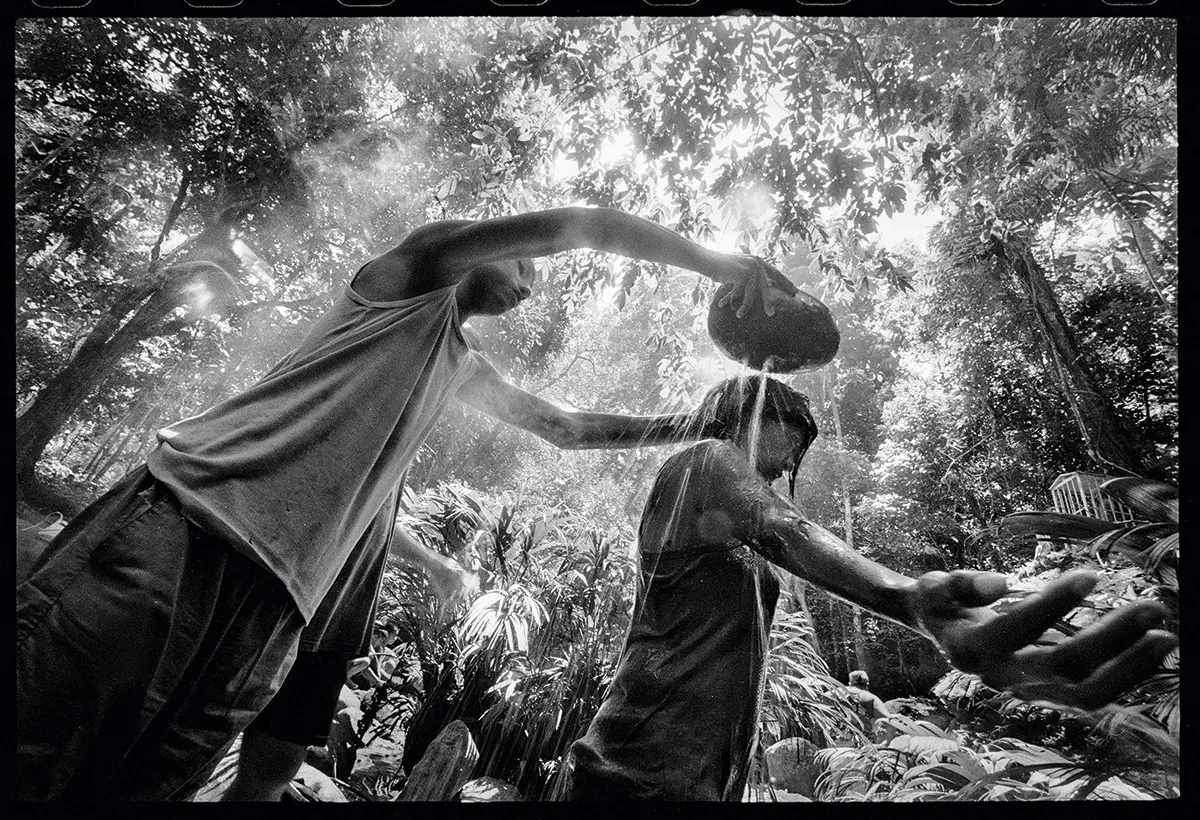
An impressive selection of 64 photographs from Álvarez’s compelling documentarian effort is organized into four “moments” or domains.
The first exhibition moment focuses on the arrival at the mountain, the preparatory rituals, masses, prayers, and baptisms; the second exhibition moment comprises smoke and ash offerings, the tobacco ritual, and the altar; the third exhibition moment is devoted to candle ceremonies, curative rituals, and the passage over glass and fire; lastly, the fourth exhibition moment is titled “Night and Fire”.
To understand these rituals in Sorte, one needs to know who María Lionza is and what she represents in the Venezuelan imaginary. Despite the scarcity of documentary sources, the origins of the María Lionza cult can be traced back to the early Twentieth Century, rooted on a legend derived from an indigenous oral tradition that describes her as a goddess of water and mountains, a ruler of nature. María Lionza personifies the mysterious powers universally associated with femaleness.
In the Twentieth Century, Europe condensed the idea of the nation on images of buxom, powerful women; in Latin America, such figures represent racial fusion and the mestizo ideal as a universal component, a value that gives cohesion to our heterogeneity. A number of monuments erected in Venezuela around the mid-Twentieth Century glorify indigenous and mestizo figures.
María Lionza embodies Venezuela’s traditions and cultural roots. She is an allegory of the mother-goddess who brings together the different groups that form the nation, in spite of their differences.
In Alejandro Colina’s famous artificial stone sculpture (1951), now a replica erected in its original, “ultramodern” context (in the middle of one of Caracas’ main expressways), María Lionza sits atop a tapir, pushing her pelvis gloriously out. She was painted repeatedly by Pedro Centeno Vallenilla, whose María Lionzas contemplate men in a trance, sleeping and vulnerable llaneros, or men of the range.
Since then, many María Lionzas have been incorporated into the syncretic pantheon known as “the Court”, in the pagan altars that are so popular in Venezuela. María Lionza is the white or European component of “the three powers”, alongside Guaicaipuro—an indigenous figure— and Negro Primero, in all their variants.
Leo Álvarez’s work documents his striking personal experience in Sorte, and being able to enjoy a guided tour of it has been my good fortune. After a rigorous initiation ritual that includes the reading of tobacco leaves, Álvarez explains how he secured permission from the spiritual authorities governing the region and, in an attitude of full respect, prepared to enter the territory. For a documentarian, he says, such “access” is all important. At that point, he removes his shoes and sets out repeatedly (over the course of five years) into Sorte mountain.
Visitors who encounter these photographs for the first time will feel themselves immersed in the smoke-filled, diffuse atmospheres presided over by shamans or spiritual guides. Álvarez comments that he uses film “in order not to lose the magic, the weight, the gravity that comes from silver grain.”
Technically impeccable, these photographs have been shot on 35mm film with a wide-angle lens; Álvarez scans the negatives and works with ink injection on a very specific type of paper, 100% cotton.
The rituals depicted perfectly define the term syncretism, interweaving elements from the three cultures that come together in Venezuela: indigenous, African, and European. In these lands, a state of trance accompanied by the sounds of drums is induced to guide the hundreds of pilgrims who congregate every year around October 12, and on Fridays or Saturdays during Holy Week. The work on exhibit was produced between 2015 and 2019, during precisely those peak periods.
With great humility and respect, honoring the privileged access he was granted, the photographer brings us closer to the healing or spiritual growth rituals through which believers seek to raise the spirit outside the body, cure what ails them, and be “reborn”. Through a ceremony that blends tobacco, holy water, and blood, this exhibition puts us in the presence of a humanity thirsty for transcendence.
Madrid’s Museo de América, joined in the effort by Caracas’ Sala Mendoza Foundation and Carmen Araujo Arte gallery, presents the extraordinary work of Leo Álvarez, who in this select portfolio has been able to capture a living expression of Venezuelan culture.
A limited edition, 100-copy publication accompanies Sorte, sector Sorte, featuring Sandra Pinardi’s curatorial text with an introduction by Patricia Velasco.
ELISA RODRÍGUEZ CAMPO