The exhibition titled “Lo inmenso y lo pequeño” (Immensity and Smallness) brought together photographs, videos, and a sculpture by Peruvian artist Katherinne Fiedler, which address the temporalities of body, desire, affection, and life in the form of still lifes and peculiar landscapes. In fact, Fiedler speaks of “desire as landscape,” an idea she explores in her characteristically intriguing videos.
Somewhere (2021) shows a snake sliding in and out of a seashell, while a soundtrack enhances the video’s uncanniness. The camera offers close-ups of this encounter and focuses on the textures (the scaly skin of the snake, the softness of the shell’s mother-of-pearl) and on the rhythm of the movement, preventing us from grasping a clear sense of scale. Finally, the camera films the inside of the shell, but the snake is never seen in its entirety. In the video Inhabit (2022), an albino snake slithers around curved white forms, which are plaster casts molded from the artist’s body, resembling eggshells. The camera zooms in to highlight the smoothness of the movements and the friction of the animal’s skin with the artist’s body substitutes, highlighting the textures of both, and ends by showing a set of stacked casts among which the snake is hiding.
In both works there is an erotic component, but also something mysterious and potentially frightening. What kind of encounters are these? The rendezvous that Fiedler portrays here take place between the animate and the inanimate, reinforced by close-ups that contrast the agile movements of the snakes with the immobile shell and casts. But more than opposing animate and inanimate entities, what the artist unfolds before us is a quest, a dance that aims to seductively conjure an absent body. After all, both seashell and plaster casts refer to a being that is no longer there: on the one hand, the mollusk that generated the shell, and on the other, the body from which the casts were taken. In fact, both elements share certain formal traits in Fiedler’s videos.
On the other hand, an unspoken question is launched by the very title of the exhibition: what is immense and what is small here? Is it perhaps an internally determined scale; that of bodies and the physical and emotional responses they generate together? For example, the immensity of desire and affection faced with the smallness of tactile or bodily points of stimulation. But it could also be about the immensity of death.
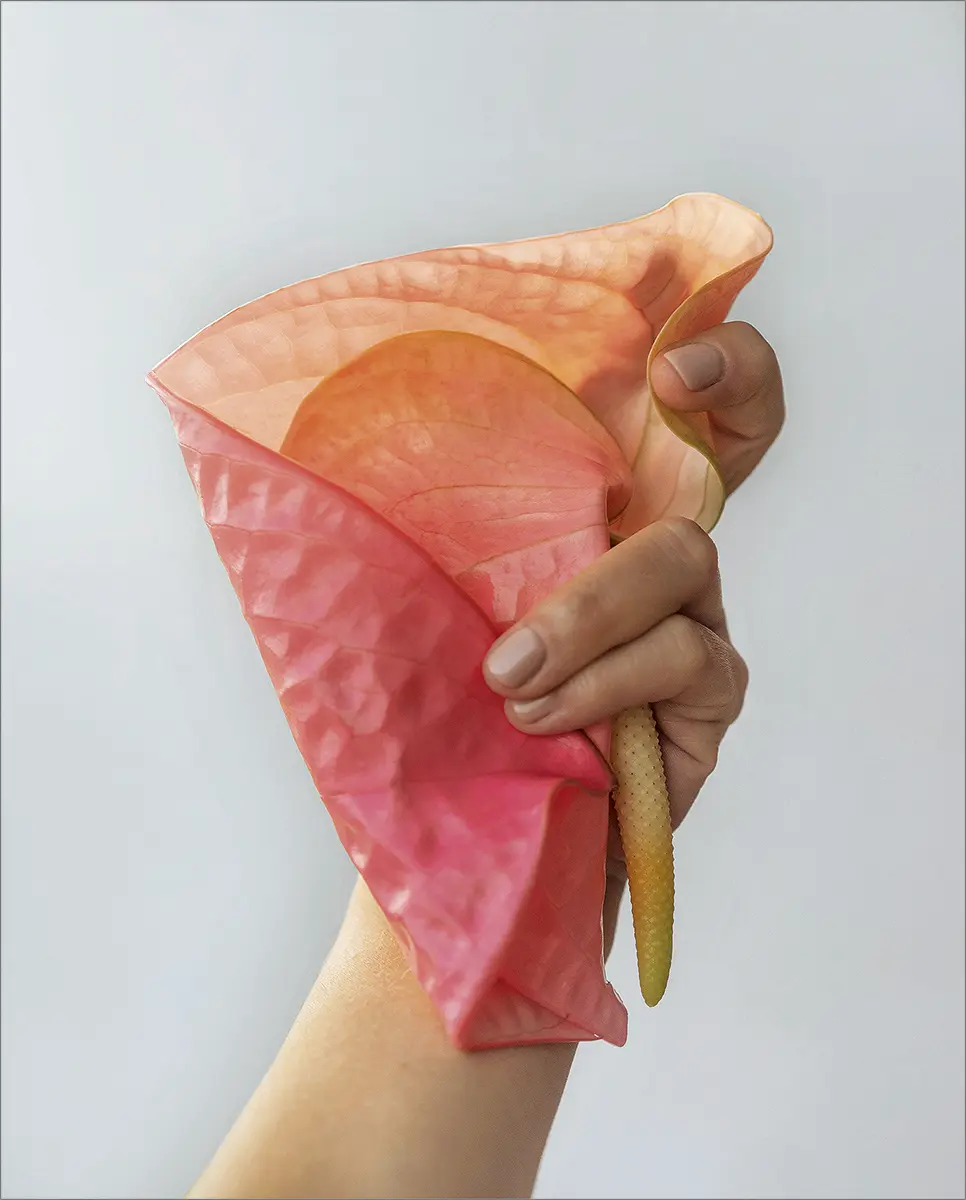
Her photographs seem to suggest this. Moments of stillness are reinforced by the predominant use of white. These images evoke desire and sensuality through forms and elements such as flowers, shells, or snakes. But the stillness is disconcerting: an instant has been arrested in, and perhaps out, of time. For example, in Lo inmenso y lo pequeño (2022), the artist’s hand holds a flower (another organic element evoking parts of the human body). Is she holding the flower or crushing it? Is it a caress or an act of aggression? Guest (2022) shows a tarantula walking on a bouquet of flowers. We perceive the slowness of the spider’s movement: delicate, lurking, sensual, dangerous. In the diptych Refuge I and II (2022), a seashell holds a furry tail (of a fox perhaps) and a coiled snake, respectively. While the sensuality of touch is suggested, we realize that the shell can become a refuge only after the mollusk is dead.
This allusion to death is recurrent: the cut flowers (No Repose, Dark Edge, Guest), seashells, or more obliquely, plaster casts. And also, the snake and the spider, because they are animals that we consider to be potentially deadly. This is the memento mori dimension of Fiedler’s art, which reworks the pattern of the vanitas genre. But the artist introduces a twist, because she not only refers to death itself, but also to la petite mort: “little death,” as the French call the orgasm. “Immensity and Smallness” perhaps points to the fiercely ephemeral instants of life and death, which remind us that encountering the other can upset and transform our lives.
MAX HERNÁNDEZ CALVO