The Museo de Arte Contemporáneo, Panama, presents the exhibition Julio Zachrisson, un artista entre dos orillas (Julio Zachrisson, an artist between two shores). The retrospective, which covers more than five decades of the artist’s pictorial, graphic, and sculptural work, was initially exhibited at the Museo de Arte Contemporáneo de Madrid (2020-2021). According to Juan Canela, curator of the exhibition in Panama, seventy percent of the works were presented in Spain, and the remaining thirty percent were specially selected for this new version. The exhibition includes more than one hundred works, most of which are engravings made using different techniques such as dry point, lithography, aquatint, etching, and woodcut. It also presents some thirty oil paintings on canvas, drawings in mixed media, and sculptures. The curatorship also includes the screening of the feature film Toro volandero (2023) about Zachrisson’s life and legacy and a short film made by Abner Benaím, as well as photographs, historical documents, archives, letters, and publications. As Canela indicates, “the most important thing about this new curatorial proposal is that it is focused on the Panamanian context and the relationship he had with his homeland.”
At the end of the 1940s, Zachrisson (Panama 1927-Madrid 2021) began his studies at the Instituto Nacional in Panama. He later studied at the Escuela Nacional de Pintura, Escultura y Grabado La Esmeraldam in Mexico City and, at the invitation of engraver García Bustos, he attended the Taller de Gráfica Popular. From that moment on, graphics became a fundamental aspect of his artistic production. While in Mexico, he met José Luis Cuevas, Alberto Gironella, and Rafael Coronel, with whom he shared an interest in developing an expressionist type of figuration. In the early sixties, he traveled to Europe and, after visiting several countries, settled in Madrid, where he lived from 1961.
Throughout his career, Zachrisson developed a visual language that combined images and themes inspired by myths and stories from the Western culture with pre-Hispanic oral tradition and Panamanian popular culture. The selection of works included in the retrospective allows us to appreciate how this strategy evolved in the different facets of his career. The early pieces, particularly the drawings and prints, show a strong social component and often feature grotesque images through which he expresses social criticism. The influence of Goya is evident, especially in his black and white engravings. The half-deformed characters from his cosmology confront the viewer and raise questions about issues such as violence, sexuality, and politics.
Throughout the exhibition, we can appreciate various themes such as colonialism, indigenous ancestral symbols, magic, bullfighting, the circus, and mythology. At a historical-political level, works that deal with the right to independence of Panamanian territory and Latin American identity stand out, as seen in the series Panamá (1964), Guanahaní 12 de octubre de 1492 (1982), Simón Bolívar (1981), Cristo Negro de Portobelo (1990) and India Cuna (1957). These last two works clearly illustrate how the characters in his cosmology not only reflect the diversity of the Panamanian population but also recognize the contribution of indigenous and Afro-Americans in constructing its identity. According to Canela, “in these key moments in decolonial thought, Julio Zachrisson’s work affects some issues such as memory, identity or culture, essential to understanding the history of modernity in relation to colonial processes.”(1)
Later his work evolved towards a more symbolic style in which the influence of artists such as Rivera, Orozco, Siqueiros, Rembrandt, Velázquez, Picasso, and Lam can be seen, and his interest in highlighting his roots through the chosen themes and the use of color. His characters belong to a complex universe in which eroticism, love, and the spiritual allude to his Central American identity. Works such as Guaraguao (1983), La saloma (1984), Vuelo nocturno (1985), Monte adentro (1990) y Pájaro azul (1996) illustrate the dreamlike world that Zachrisson creates and reflects life in tropical America. The fauna and vegetation become protagonists in paintings and drawings inspired by equatorial landscapes and Panama’s rich, popular oral tradition.
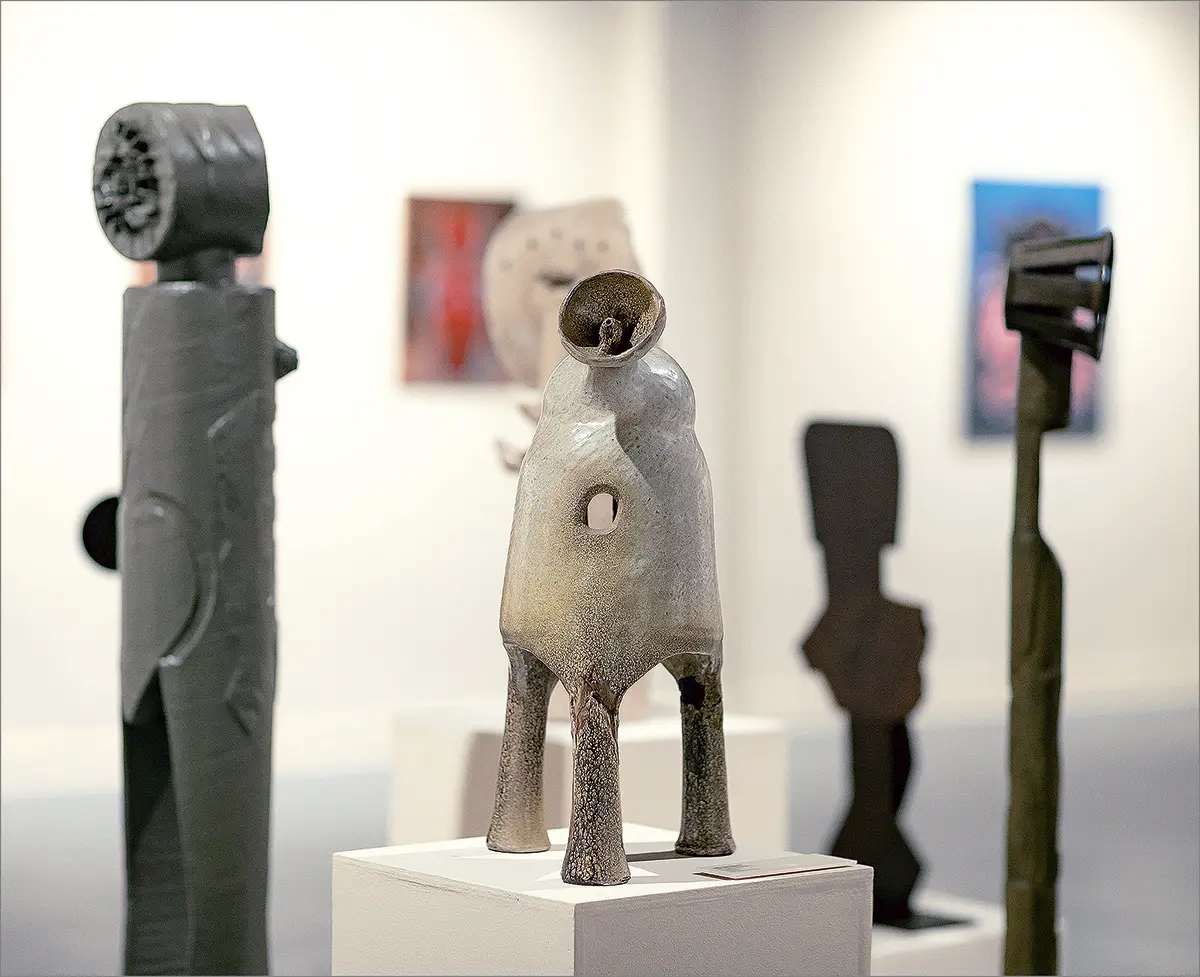
The show also includes twenty-five monochrome sculptures made of ceramics, wood, and cardboard, executed in small formats. These pieces present abstract constructions reiterating the artist’s admiration for crafts and manual labor. Their elongated forms recall the sacred totems of indigenous cultures and connect his three-dimensional work with the spiritual aspect of the pictorial work.
It is important to note that, in addition to presenting a comprehensive vision of the work of this important pioneer of Panamanian contemporary art, the retrospective celebrates the donation of 400 works from the artist’s personal collection to the Museum of Contemporary Art of Panama, which was made before his death. It is also appropriate to mention the exhibition that is presented in parallel at the MAC entitled Trópico Gráfico Mágico. The show focuses on the history of Panamanian graphics with particular emphasis on the Taller de Artes Gráficas, founded by Alicia Viteri in 1979, which played a leading role in the development of the work by artists such as Guillermo Trujillo, Coqui Calderón, and Julio Zachrisson, among others.
NOTES
1. Juan Canela, conversación con la autora, Agosto 22, 2022.
2. Ibid.
3. Ibid.
FRANCINE BIRBRAGHER-ROZENCWAIG, PHD