The very title of Julio Galán’s latest retrospective, as a slice of the world, alludes, on the one hand, to that formal weight that continues to bear down on us, be it in anatomy lessons and all they imply (be it Rembrandt, chiaroscuro, or the canvas as a mise-en-scène), or the wordplay that can ensue between taxonomy and taxidermy, but, above all, to the labor of dissection and exhibition (which could just as well be, as we play with its formal provocations, of cutting and tailoring) that he diligently carries out in his paintings. A weight because it weighs, it weighs on us, as reference and also as leitmotif of an imaginary that is imposed by decree, like that of the late or early muralists, but as an update—closer to Marilyn Manson than to Madonna—of Frida Kahlo.
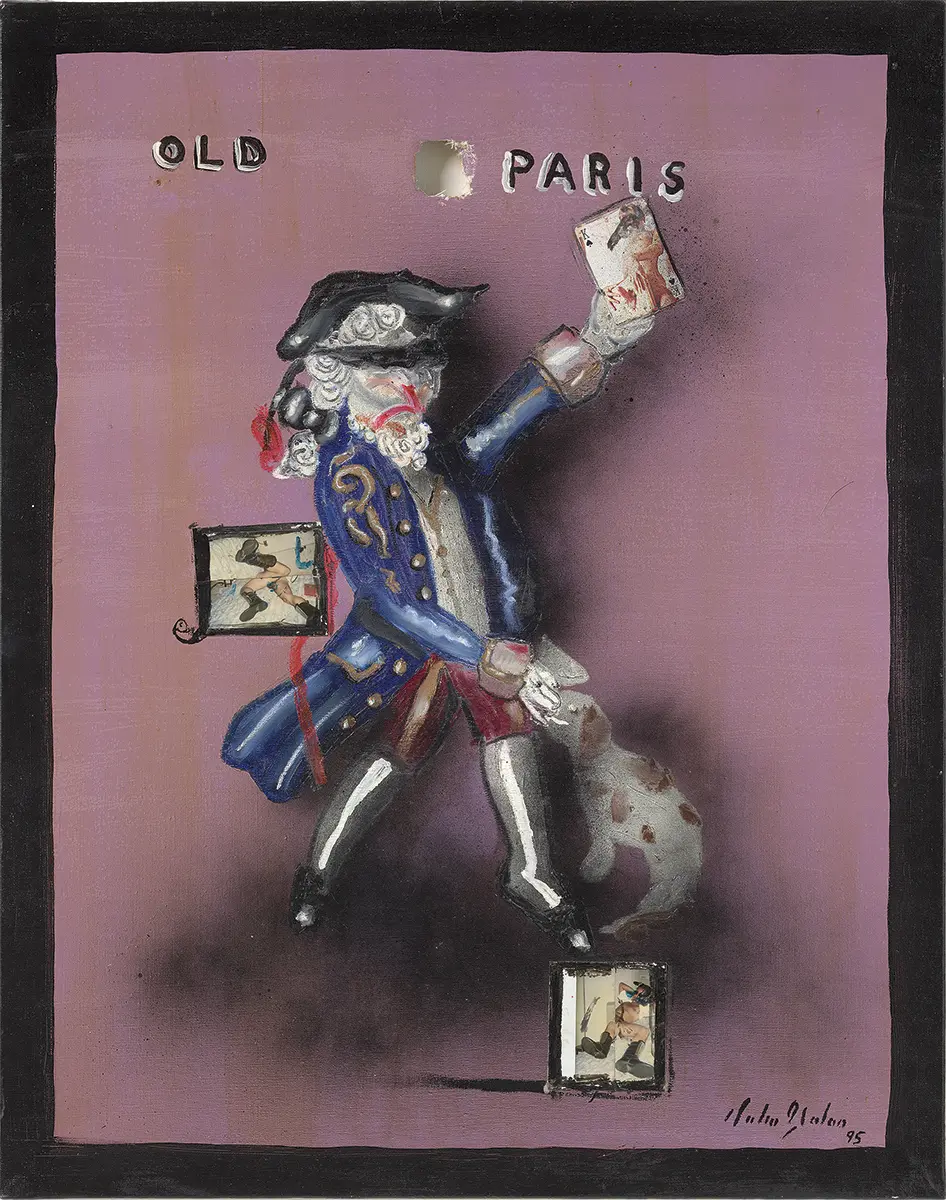
I waver between calling the curating performed by the director of the museum that exhibits it a retrospective or a salvage, with an eye towards not just the place occupied by the paintings, but also their provenance, thinking it more as an actualization, a reference point that breaks and splits—still on the basis of the canvas—all that was yet to come and would come to define the contemporary art scene in Mexico, or one more symptom of the current state of things, especially the deprivations suffered in recent times by the country’s museums and other cultural institutions.
It was precisely on the pages of ArtNexus that I published, some thirteen years ago, a review of the large Julio Galán retrospective prepared by Guillermo Sepúlveda for MARCO in Monterrey, which later traveled to Museo Amparo and to the Antiguo Colegio de San Ildefonso. There is something procession-like in that trajectory, a carrying of icons and images that illustrates the pathways and appropriations of a petit-bourgeois imaginary that believes itself secular in the face of the Vasconcelista mystique—if the description still fits—and the florilegium and many strata of religious syncretism. Flower and song, I’d say as a high-culture quip, when confronted with a body of work that communes—daring word—equally with icons and codices.
Among its formal motifs is the bed, which serves as starting point, a flat surface—in two-dimensional terms—that seeks to open itself—or better yet, to expand—into a haven at once physical and intuited—midway between dreams and their evidence—in paintings like Niño en cama (Child in bed, 1983), on the basis of objects that serve as signifiers or bridges between reality and the artist’s world, perpetuated as childhood sleep—fairytale-like, let’s say—where the skin of a teddy bear watches over, and at the same time menaces, the child-artist in his sleep, a sleep perhaps induced by the pills strewn out of their jar, which serve as a counterpoint to the danger posed by the lit cigarette resting on an ashtray and the cross under the pillow, evoking the preeminence of passions of love and death. There remain the blue slippers and the presence of another animal under the bed, and the chromatic counterpoints of the lines in the bedding print. The small multicolor triangles on the pillowcase in the end resemble tears, paradoxical in their intention.
Over time, Galán’s themes and motifs have moved on and adjusted from the abyss of childhood, taking us, for example, to the emblematic canvas Sácate una muela (Pull Out Your Molar, 1994), where the dream becomes a phantasmagoria to reveal formal echoes that mimic both Surrealism and Abstract Expressionism as they lay conduits or highways—if its lines can be so described—between flowers, insects, and organic machinery (a literal eyeglass eye can be discerned) that rupture and transform the composition’s original design to fold it from its inherent darkness—a bit story-like—into a retablo—or poster—and an emotional path; whether its garments are those of a charro (a traditional Mexican cowboy) remains to be determined.
I could copy myself, repeat the tropes and references of one who can be defined as a late-modernist hinge in a country where the contemporary came by the hand of Neoliberalism. All that seeks to break through the rigors of convention can be intuited in his work, something that leaps and opens up—just like the rabbit that gives its name to the exhibition curated by Magalí Arriola, the museum’s current director—like innards spilling forcefully space. I cannot see it with the same eyes. Galán’s paradoxical retablos reveal later formal explorations, those that were already taking place in the world into which he emerged and which nourished him, to find his own definition in that ever-shifting crucible that defines contemporary art.
Galán leaps beyond painting—as can be seen, for example, in Graciela Iturbide’s photographs documenting his performative vocation—but it is on the basis of painting that it becomes possible to expand and produce traces of what was to come (that which already happened but somehow is still happening). Not as much to leave them for artists who would come later, but to ensconce them—hidden and at the same time revealed—in his canvases, which come to function as Chinese boxes, or black boxes, or green boxes, or shoe boxes. What they offer us is a map, and we can read it as heralds of what is coming, now that it has come; we can see the twists and turns, the normalized transgressions, based on a call that can be described—and here I do indulge in redundancy—as visionary or prophetic, from the standpoint of intuition and instinct, as the hollowing out of an accumulation of knowledges and sayings put together on the basis of a paradoxical assumption that simultaneously follows and breaks with pictorial convention, learned through an understanding of its continuous discovery.
RICARDO POHLENZ