The imagination of this Argentinean artist, born in a Buenos Aires neighborhood in 1933, was always determined by his desire to narrate the substance of a country where the cruelty of everyday life is marked by the ups and downs of politics and the economy, which leave permanent traces. Juan Carlos Distéfano represents a part of history as much for his connection, as a graphic designer, with the legendary Di Tella Institute in the 1960s, as for his personal story, which includes the exile he suffered alongside his wife, the writer Griselda Gambaro, under political threat in 1976. After returning to the country in the early 1980s, Distéfano mostly leaned on his training at the School of Fine Arts, setting aside his work as a graphic designer. His art was most significantly anchored to sculpture in polyester, which allowed him to give matter an appearance resembling human skin.
This show is not connected to the large, well-regarded retrospective that Marta Nanni curated in 1998 at the Museo Nacional de Bellas Artes, nor to Argentina’s selection for the 2015 Venice Biennale, curated by María Teresa Constantín. On this occasion, Constantin has sought to reveal Distéfano’s influences, both local and by the selected grand masters he calls painter’s painters; the title suggests the concept of residual memory as the that which, with its powerful impact, can be evoked through the passage of time. The exhibition eschewed a chronological or thematic organizing logic for the 36 artworks on display, focusing instead around 19 sculptures created between 1972 and 2022, along with 16 studies for their development. Their presentation at the Museo Nacional de Bellas Artes’ Temporary Exhibit pavilion made use of items from the museum’s permanent holdings, both to illustrate Distéfano’s sources of inspiration and to highlight the prominent spot he has earned in the collection.
Constantin’s dual curatorial axis, supported by the excellent relationship she has for many years maintained with Juan Carlos Distéfano, presented visitors painters from the Middle Ages and the Italian, German, and Catalan Renaissance, so focused on the tensions of the body, that are the object of Distéfano’s admiration, as in the cases of Bosch, Brueghel, Matthias Grünewald, and El Greco, alongside masters of Argentinean painting such as Lino Enea Spilimbergo, Ramón Gómez Cornet, and Enrique Policastro. Distéfano’s relationship to painting deserves special note; he initially painted his works from the outside, but not too long ago came to realize that, taking advantage of his graphic-art experience in color handling, he could paint them from the inside out and then use a scraping technique to bring color forth.
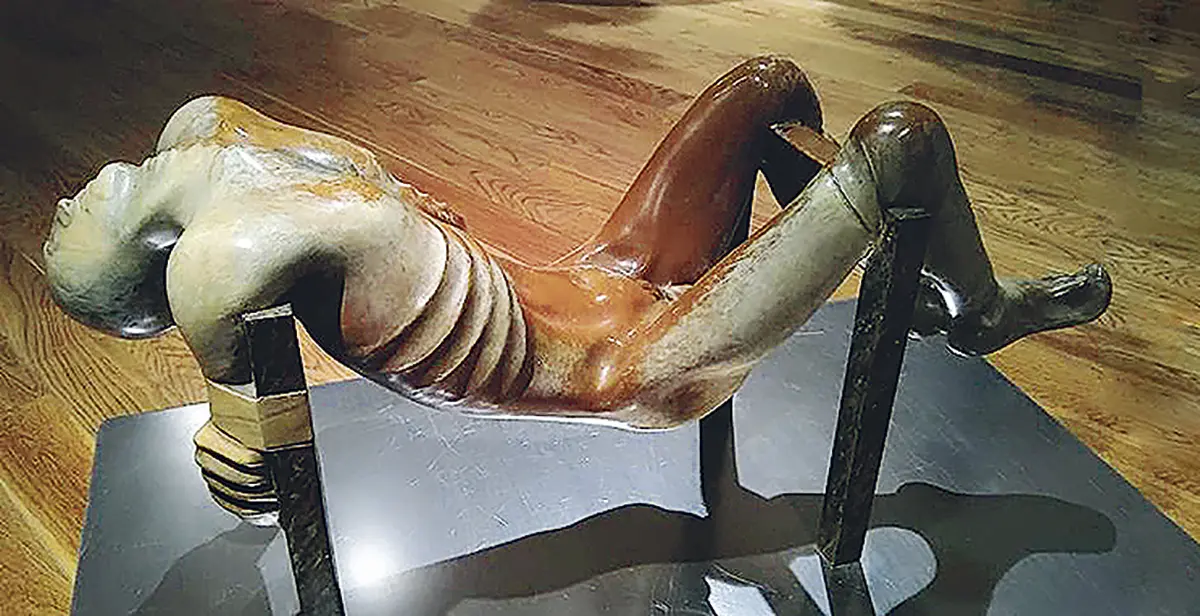
The decision to detail in the exhibit labels the relationships that provided Distéfano with inspiration was a wise one. One of his most iconic works from 1972, Procedimiento (Figura acostada) [Procedure (Lying Figure)] refers to Pietro Lorenzetti’s work, which Distéfano saw at the St. Francis of Assisi church on his first visit to Italy. This contorted figure was shown for the first time in 1972 in this very museum, in a show about the nude theme in Nineteenth and Twentieth Century art. The title “Lying Figure” was intended to help the work slip through the censorship of the era; in truth, the twisted body represents the spasms that result from torture with electric prods.
Meanwhile, in the case of Flotante, from 1987, which was conceived for Parque de la Memoria, where the horrors of the 1976-1983 dictatorship are documented for posterity, there are two interesting coincidences. It is dated in the year when the El Prado Museum was able to acquire the lower portion of El Greco’s painting when the source of its bodily contortions can be seen; it was also in 1987 that the Argentina’s military Junta was brought to trial, in a process that shed light many of its grave human rights violations, including the sadly infamous “death flights”.
Distéfano’s Ícaro (Icarus), from 1978, is the first work in Barcelona where a concession was made to take away pedestals in contemporary artworks. Meanwhile, La Urpila en Buenos Aires (Urpila in Buenos Aires), from 2009-2010, evokes the masterful color work of La Urpila, a 1946 painting by Ramón Gómez Cornet (1898-1964), and appropriates spatiality to update the image of a young girl from the north of the country who, relocated to the heart of the city, transports in her little cart Buenos Aires’ iconic obelisk, a dog, and various other belongings, along a path of coins. In the more recent La necesidad del arco iris (The Need for the Rainbow, 2020-22), the magnificent colors contrast with the fear in the figures’ faces, inspired both in Bosch and in Caspar David Friedrich. It is an invitation to once again find the divine in nature.