In collaboration with SPAZIO ZERO Galería, Sala TAC, Trasnocho Arte Contacto presented Michelena Medusa. José Vivenes between April 9 and June 12 of this year. The proposal is part of the revisionist explorations that the artist’s work of recent years has consistently engaged in, as seen in the shows Basta de falsos héroes (Enough With the False Heroes, 2018), Historia de una infamia (Story of an Infamy, 2018), Hartazgo de la fauna (Satiation of the Fauna, 2021), and Doblepensar (Doublethink, 2021). Two main vectors in Vivenes’ oeuvre come together in this solo show, featuring seventy-three works: the pictorial as artistic expression and narrative as a process of critical reflection.
Vivenes (Maturín, 1977) keenly explores hegemonic discourses, disassembling the official iconographies and scrutinizing the propaganda narratives that have, over time, become idealized—and congealed—as unbudging testimonies of national history, of the history of art, or of culture. Oils, canvases, collages, and assemblages give shape to a connecting thread—including sketches and annotations—that unfolds in phases, thanks to the exhibition’s spacious arrangement and well thought out combination of techniques and formats in various dimensions.
Rooted in the visual traditions of the West, the themes developed along the way are mainly connected to the work of the great Venezuelan painter Arturo Michelena (Carabobo State, 1863-Caracas, 1898), whose legacy is the wellspring for the motifs Vivenes elaborates upon in a sequence of equestrian portraits, characters, heroic events, bullfights, and hunts. Michelena’s scenes, a reference point in personal and collective memory, are here the source of inspiration administering a variety of meanings connected to contemporary political and social realities, which postulates a play of temporalities between the past and the present.
In La vara rota (The Broken Rod), from 1892, the celebrated Nineteenth Century master details the tragic events in a bullfighting ring when the bull attacked the horse before the eyes of an astonished audience. Vivenes starts with the frozen action, then dissects it, separating and dispersing the elements to give them new life in new and renowned canvases, as can be seen in Simple abertura de la boca (Simple Opening of the Mouth), from 2015, whose lines, imbued with white, brown, and black gradients, outline the prostrate body of a horse in the throes of death. He also attempts other interpretations of the same source, titled Un acontecimiento pintoresco (A Picturesque Event), from 2021; Algo pintoresco, (Something Picturesque), from 2021; Aparentemente pintoresco, (Seemingly Picturesque), from 2021, and Desdoblamiento, (Unfolding), from 2021; these register as revisits of a sort—or, more concretely, as “variations on a theme”—that resize the original painting, which allows Vivenes to suggest several aesthetic readings. Fecundo en sólo el instante que deja el campo libre a la imaginación (Fertile Only in the Instant that Gives Free Rein to the Imagination), from 2021, is an oil painting describing two horses, one in full figure and mounted by a sketched semi-figure, and the other one with only its head peeking from the left-side edge of the frame; both are arranged against a yellow-ochre ground, which covers the surrounding landscape. The gestural brushstroke signals the quadrupeds’ frantic rush, an allusion to Michelena’s monumental canvas Pentesilea, from 1891 (700 x 433 cm).
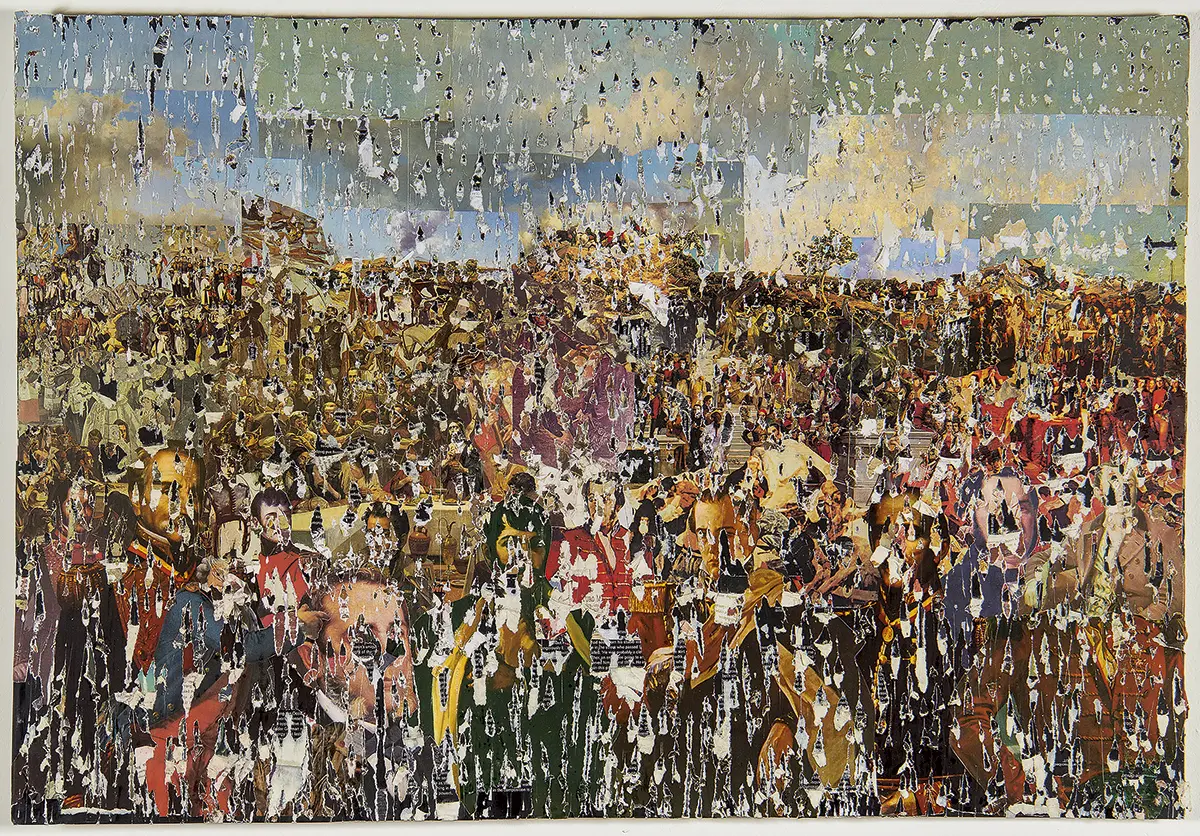
The same gestural stroke is seen in Naturalidad (Naturalness), from 2022. It is based on La joven madre (The Young Mother), an 1889 portrait of a beautiful, distinguished white lady clad in a pink dress and with her child on her lap, now intentionally replaced with the image of a mulatto woman, which brings to mind the paradigms of identity promoted by the current government in its attempt to favor the downtrodden. Camino de estacas (Picket Road), from 2022, exemplifies an interesting approach to the use of collage as an artistic practice; here, the fragmented—pulled apart, atomized—appearance of the reproductions transforms the painting into a “pixelated” surface. The torn edges and the overlaps of the pieces of paper glued to the plane tend to disorient the gaze, as the dismembered and interlaced contours are perceived as a woven structure of multiple contrasts, expanding beyond the boundaries of the frame. The viewer’s initial difficulty in recognizing the content, here transformed into “disfigurements” of a sort, prompts a sharpening of the optical exercise, given that the distorted shapes simulate a state of continued decomposition.
For Luis Enrique Pérez Oramas, curator of the exhibition, “the basic effect that Vivenes’ painting has on Michelena’s archive is, literally, that of a certain roughness: Vivenes seems to infuse Michelena’s iconography, the formal elegance of which can barely mask the persistence of a death drive, of death and holocaust in his images, with a new, brutal honesty…”
GLADYS YUNES YUNES