A retrospective exhibition of the work of Jorge Alonso Zapata, perhaps the city’s most active chronicler, was on view at the EAFIT cultural center since December, 2021. Zapata, a self-taught artist, has developed over the course of two decades a notable, vast body of work, focused entirely on exploring urban marginality in the Colombian city of Medellin, with its long-suffering history of criminality and drug trafficking. In the manner of a photo reporter, Zapata seeks to capture in his work street scenes where all kinds of commerce (bodies, drugs, imported goods, contraband, stolen property, forgeries and knock-offs) become a nucleus of human activity, and where street peddlers, street musicians, cops, prostitutes, children, beggars, thieves, lovers, and absentminded passers-by cross paths and connect. With painstaking attention to detail, Zapata depicts in his tumultuous scenes a world of contrasts where tenderness and love coexist indistinctly with aggression and violence. The ebullient, strident colors of the streets are brought to life by the artist not just in his “easel paintings”, but also in the many objects he elaborates on and decorates (CDs, buckets, boxes, etc.)
Zapata carries forth the particularly critical and acerbic vision, heavy with black humor, that has characterized the city’s most notable artists, from the cartoonist Ricardo Rendón in the 1920s, to Débora Arango—an emblematic figure in Medellín—in her paintings of the 1940-1957 period, to today’s practitioners, like such Zapata contemporaries as Camilo Restrepo and the photographer Santiago Mesa. Interviewing Zapata in November of 2019, I inquired about his interest in not only portraying the underworld, but also inhabiting it. In the context of Mona®Co, memorias (i)lícitas contadas sobre el arte (Mona®Co, (I)llicit Memories Recounted by the Arts), I asked Zapata about the atmosphere of illicit-substance traffic and use that enshrouds his work, its settings circumscribed to the city center, and he answered: “In fact, such places actually find me, walking along Barbacoas street I discovered The Bronx, went in, and began to encounter stories about all that happens there, stories that in one way or another, have found me. Telling these stories that nobody wanted to tell was my duty. Now The Bronx has moved across from my studio, I live alongside these situations, they are there all the time and you see drugs being used the twenty four hours of the day, a profitable and efficient enterprise, there’s constant resupply, the police raid it and ten minutes later everything is back in place. What can I say? The images spill over and it is impossible to remain indifferent, to devote myself to painting flowers and cows. I aim for people to dialog with these stories, and in a way to make them public, to have them be in the public space.”
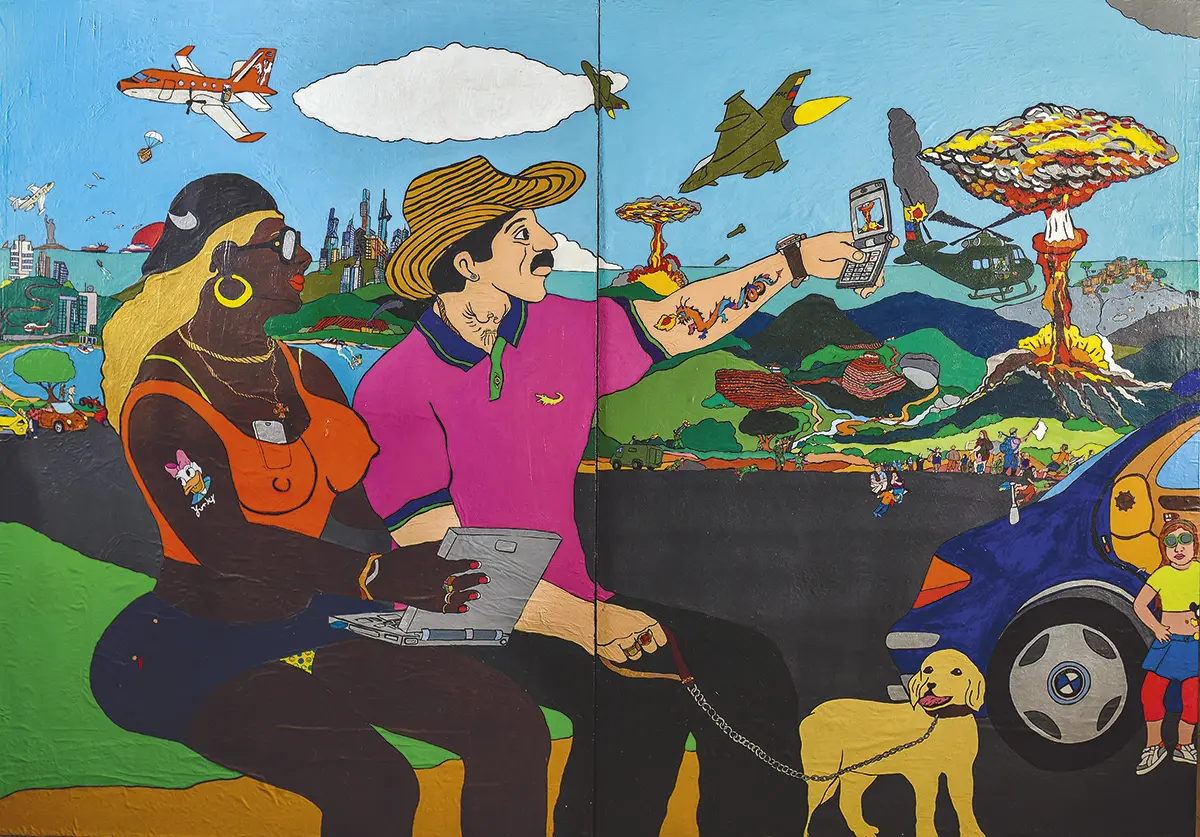
As a way to kick-start the debate in and about what is and isn’t public, Zapata made a version of the foundational painting of Antioquia’s identity: Francisco A. Cano’s Horizontes (Horizons, 1913). In Cano’s original, a colonizer couple, the man carrying an axe and the woman a baby, rest and gaze at the still-virgin landscape of the Antioquia forests. The man’s outstretched arm—modeled after Adam’s in the Sistine Chapel—signals towards the promising future that awaits them.
In Zapata’s version, the colonizer holds a smartphone to photograph not a biodiverse future, but the giant explosion left behind by a combat airplane. Attack helicopters get ready for an assault, while at the foot of the hills, a multitude marches raising flags of peace. The mountains visible in the distance are hollowed out by open-pit mining; a heavily polluted river flows by. Most interesting, perhaps, is the female character. Instead of the self-sacrificing white woman of the original, we are presented with a voluptuous, tattooed afro-descendent figure with a head of long blonde hair, a computer on her lap and a leash for her pet dog in one hand. And all-too-real depiction of rural Antioquia today.
Curated by Sol Astrid Giraldo, Zapata’s exhibition and the new horizons it points towards cannot be seen as separate from recent attempts at recovering the city’s hidden memories. Such efforts to remember and understand what has been repressed—consciously or unconsciously—have come about rather suddenly in Medellin, perhaps in connection with more general social transformations in today’s Colombia. They have been organized by various art collectives, among them Narcos Lab, Mauricio Cardona’s book-project Expurgo (Expurgation), and the already mentioned Mona®co, by Harold Ortiz and this reviewer.
As a closing note, it is gratifying that this harrowing yet entertaining exhibition took place at EAFIT, the host of important retrospectives of outstanding Medellin artists who are nevertheless seldom exhibited beyond the city, such as Marta Elena Vélez, Ethel Gilmour, Flor María Bouhout, and Álvaro Marín, and that on this occasion, as in those earlier ones, a catalog of the artist’s work was published.
SANTIAGO RUEDA FAJARDO