The sixth edition of the Face à Face program, which since 2018 has presented Cuban art at the Brownstone Foundation in Paris, brought together Humberto Díaz (Cienfuegos, 1975) and the renowned artist Abraham Cruzvillegas (Mexico City, 1968). From April 9 through May 7, 2022.
With installations specifically designed for the exhibition space, Díaz and Cruzvillegas dialogued about such topics as the natural world, the environment, and identity, always on the basis of their critique of aesthetic values. Their encounter is not gratuitous. By means of objects, installations, and architectural interventions, they both point towards to social and political realities around them.
Visitors to the exhibition found themselves faced with dispersed but not unconnected items that drove towards the commonalities, tensions, and challenges between meanings and objects. A fictitious, interwoven, arborescent nature that nevertheless alludes to the factors of production at play in the contemporary world.
Humberto Díaz’s practice is oriented towards installation and objets trouvé. First with ancestral techniques like ceramics, and later with his site-specific installations.
“My work encourages viewers to reconsider the implications of the relationship between man and nature, and the methods through which the media influences our notions of modern life and tradition,” the artist says.
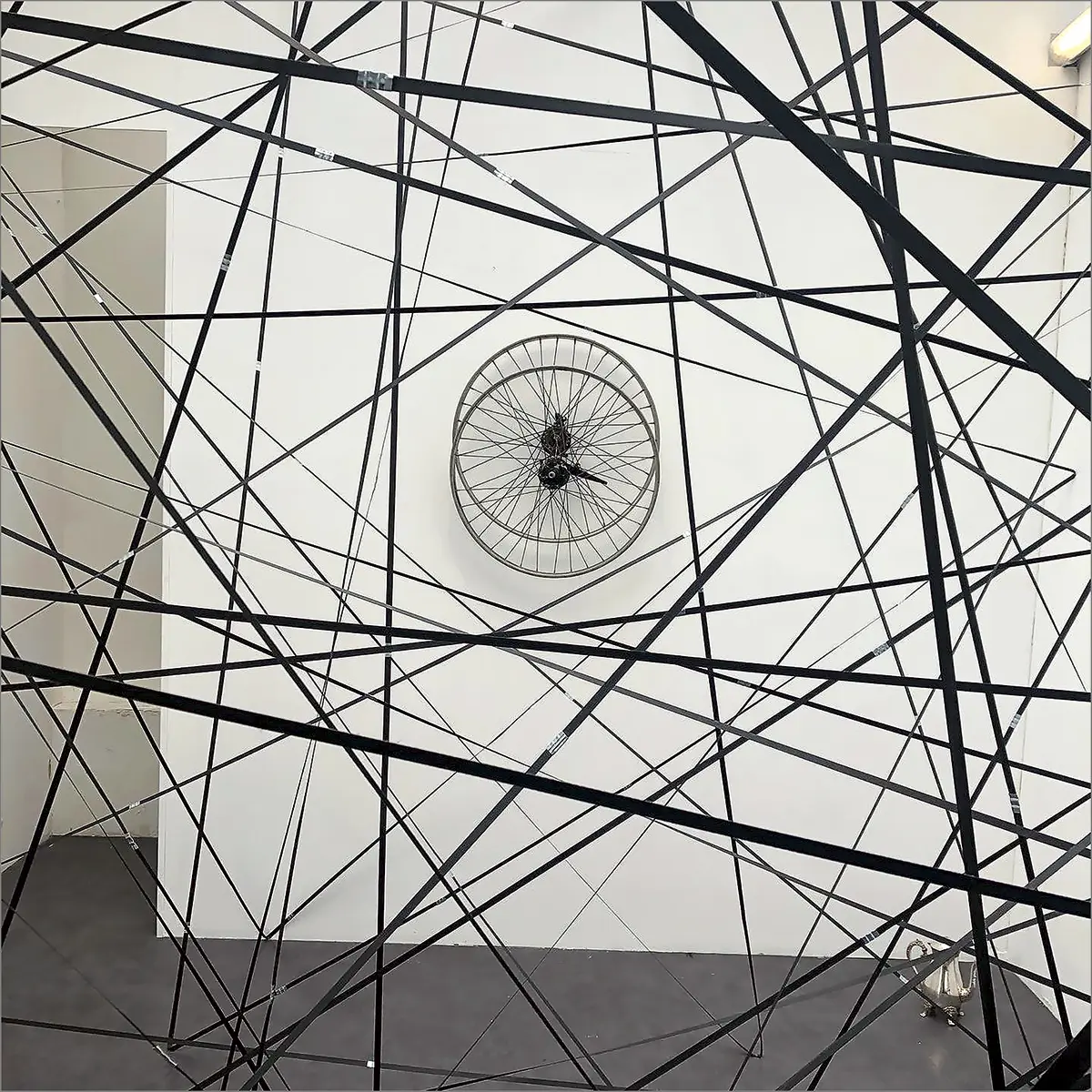
Je t’aime, je te hais (I Love You, I Hate You) is an installation of black cables occupying the center of the exhibition space. Using bands of interlaced ribbons and wood supports, Díaz seeks to startle viewers who live trapped inside the DNA-like structure of a globalized, post-industrial world. In an interplay of contrasts, Dark Light and Soleil de Paris (Paris Sun) stand out as key parts. These works, created specifically during the artist’s three-week residence, are a challenge posed to the viewer. Produced as an installation, the set plays with the opposite notions of balance and instability, at the boundary point of resistance between objects.
In a new assemblage using wood and black ribbons in the shape of a cross, the Dark Light installation unfolds independently: a kind of inverted big bang.
Meanwhile, Soleil de Paris, circling perpetually with the simple mechanics of two bicycle wheels and interlaced cables, brings about a speeding up of the system. This entire group, including the wheels and the cables, makes up a single work.
And, as if to leave no doubt of the irony that undergirds this reality, Como dedo en el culo (Like a Finger in The Ass) is comprised of a metallic silver-colored material: small in size, it suggests a massive, over-the-top object. Más rollo que película (More Roll than Film) uses wires and a glove hanging from an iron beam.
In his complex message, Díaz dialogs with reality; in his selection of forms of his own, he implements a diversified artistic matter. He is not lacking in sensitivity to details, and, in connection with the elements, provokes a poetic image without obsolescence.
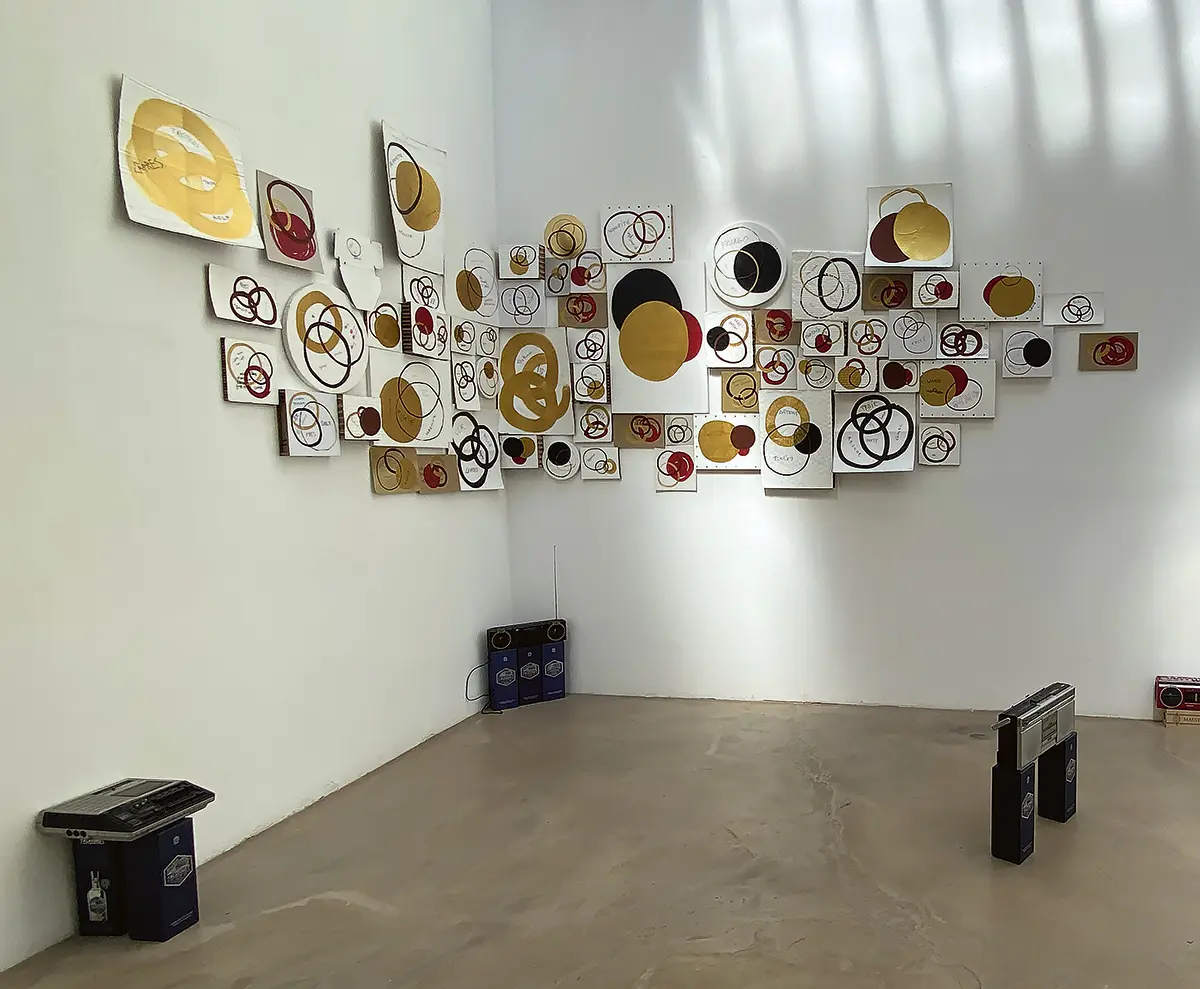
For his part, Abraham Cruzvillegas presented A semiotic selfie - 2018-2021, made with the participation of students in the period of its title. It is a collective creation that combines painting and written messages (acrylic and marker on recycled cardboard, in variable dimensions), arranged in the manner of Cruzvillegas’ Blind Self-portraits. Students from atelier13 (at ENSBA, in Paris) wrote random words inside Venn diagrams painted on recycled packing materials. These diagrams are the first graphic representations of logical deductions within a limited set of components. Three regions of overlap are possible. The intersection is formed by the elements that are common to both sets. With this representation, the artist seeks to provoke empathy in the viewers, inviting them to imagine new social relations.
With respect to Facing Faillibilis in France, from 2018-2021, Cruzvillegas says: “This work is composed of three sets of experiences, accumulated over forty months in Paris: listening to music, encountering friends, and drinking tequila.” A number of cassette tapes, with segments recorded haphazardly by Cruzvillegas, contain motifs and sounds he composed starting in 2008 and into the present day. The different musical styles are interrupted for very brief moments in the sound artwork, comprised of the tapes and recorders arranged on the floor.
“Self-construction” is a fundamental principle in the work of Abraham Cruzvillegas. “I try to let go of myself and my own experiences, of who I am, who I believe myself to be, and where I come from,” he says. “‘Self-construction’ is about people, communities that are built together… It is a matter of staying with the local communities in order to learn from local folks.”
Abraham Cruzvillegas’ work, be it in performance, sculpture, or painting, expresses diverse aspects of human reality. It connects with Humberto Díaz’s by means of its unstable, unpredictable element, but also its power, in terms of the selection, the act, and the making as it evolves. Both artists share and alternate their results. These works, in a process of identity construction, are a paradigm for the reflection of the system and its critique. They also suggest an active listening, an understanding of their interlocutors without passing judgment on their arguments; these interlocutors, thus, feel listened to and respected. They can use silences and display empathy. The work can be seen as a universal analytical instrument. Challenging the limits of aestheticism, it brings into high relief the contradictions of the system. The limitations and languages of late capitalism at its marrow, interpreted as reflections of the mass media. Between them, Díaz and Cruzvillegas produced a new, complex and formal intersection.
SUSANA SULIC