
“Into the same rivers we step and do not step; we are and are not.” Heraclitus of Ephesus wrote this. The phrase is fascinating for its ambiguity, although he also stated that opposites are not in conflict, but in constant dynamic unity. Heraclitus’ Panta Rhei (“Everything flows”) means that the river’s water is never the same, while its opposite, the riverbed, guides the water’s movement. Change is not just an aspect of our lives, but our very essence.
In previous videos by Gianfranco Foschino (Chile, 1983), such as Towadako (2021), water occupies the entire screen: a wide zenithal view of a lake is fractured by waves reflecting the sunlight. His new work, Reflecting Pool (2022) captures “a movement that does not move:” ripples in the water are shown on a screen in a fixed-plane sequence; the camera lens zooming in just inches from the surface. His source of inspiration was an entry in artist Bill Viola’s diary about his desire to find a place that would make him experience the end of the world: “to stop and gaze at the void, and then at the world beyond.” Further on Viola confesses that this void is within the self. Following this equation, Foschino ends up inside the element itself.
Reflecting Pool is a two-dimensional haiku. For several minutes, growing circles that interrupt the water’s stillness form a natural kaleidoscope. For a moment, I established a connection between the image and the vibrations coming from the gallery’s floor, which was caused by the traffic outside; the river of cars into which we step and do not step. I remained in front of this inward-looking work, gazing at a puddle that reflected neither me nor the camera that recorded it, but some trees and—behind their leaves and branches—a glimpse of the sky.
On another wall, a second video, One Single Drop (2021), brings us even closer to the microscopic. The main character of the plot is a tiny branch on the tip of which a drop of water gradually forms. Contemplation lingers until the expected denouement arrives: the drop falls from the branch. There is no suspense; we expect no surprises. The mind patiently awaits the logical outcome: the descent of the accumulated dew. And while here we still feel somehow compelled to watch in concentrated expectation, in Reflecting Pool we are only asked to observe and meditate. This represents a novelty in Foschino’s art, which had us accustomed to works such as The Kids & the Ax (2012), where our attention was captured by a feeling of suspense. Even in Ando (2021), where the protagonist is also an element of the plant world, the viewer could harbor a dose of unease.
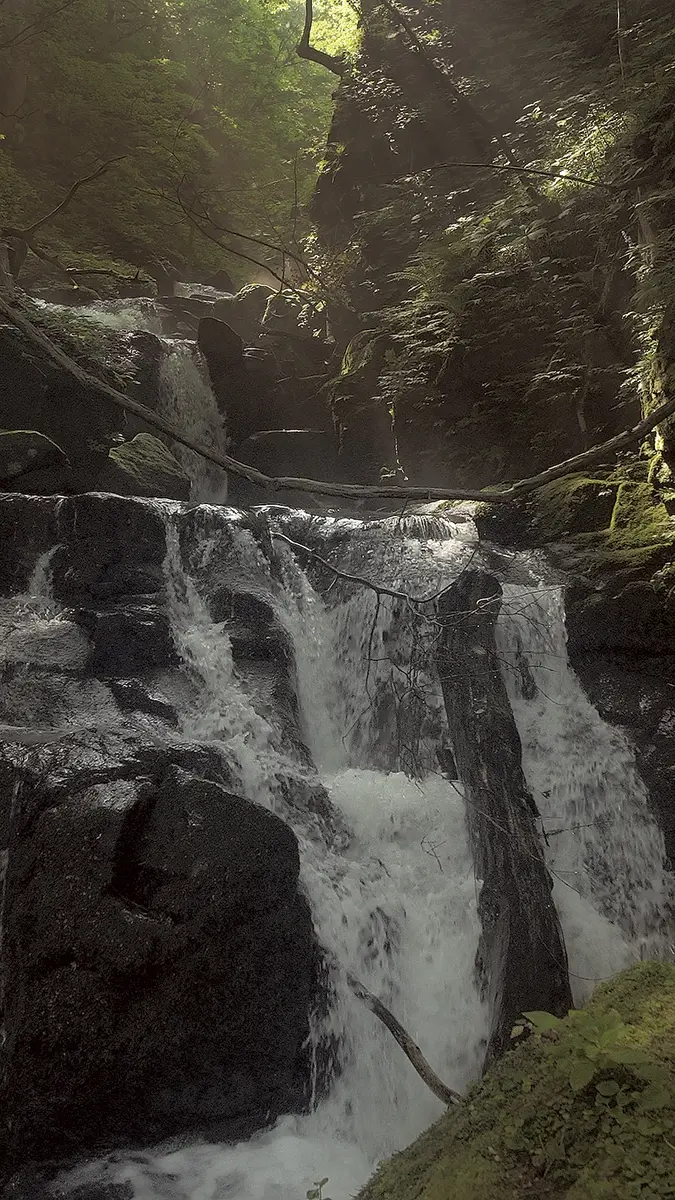
Our reactions are sublimated by the absence of sound, and our appreciation plunges into the aesthetic; into the illusory pictorial component of the moving images. This artist is more interested than ever in the search for a pause, in the emission and reception, as opposed to the “everything flows” of the present. A static journey takes place inside us against the current context of circulationism and presentism without limits, where everything is directed towards the outside; these are all implicit reflections underlying the artist’s impetus. A third work, Oirase (2020), connects oriental sensibilities with the natural environment through the portrayal of a waterfall in Aomori, Japan.
There is another possible exit in the same exhibition room: to escape reality through dreams. The third work on display is Souls (2021), a desert landscape inhabited by a disoriented, motionless, and perplexed cow, as if it had just had the pasture removed from under its legs. After several minutes of immobility, the cow seems to accept the vanishing of its food, and slowly exits the frame. The entire scene is layered with fog, just like in Summit (2016) and Holy Ghost 1 (2013). Fog, a very cinematographic resource that invokes flashbacks or dreams, gives the action a surreal atmosphere. However, dreams do not distract us from reading between lines of this short film: landscape as allegory of the destructive impact of our economic development on nature. Even more so when it comes to Chile, a country whose natural resources have been privatized and exploited to the point of being in danger of extinction.
JUAN JOSÉ SANTOS