Objetos-Forma (Objects-Form), an exhibition curated by Michel Favre and presented by The Geraldo de Barros Archive and Luciana Brito gallery, provides an excellent opportunity to reacquaint ourselves with Geraldo de Barros’ inventiveness, thanks to the curatorial attention to previously unseen works. This attention is the result of Favre’s research into a key moment in the artist’s career, his participation in the 1979 São Paulo Biennial with five paintings in aerograph ink on lacquered wood. In those works, de Barros offered a preview of the industrial-focus his work would later develop, with the use of plastic laminates such as Formica.
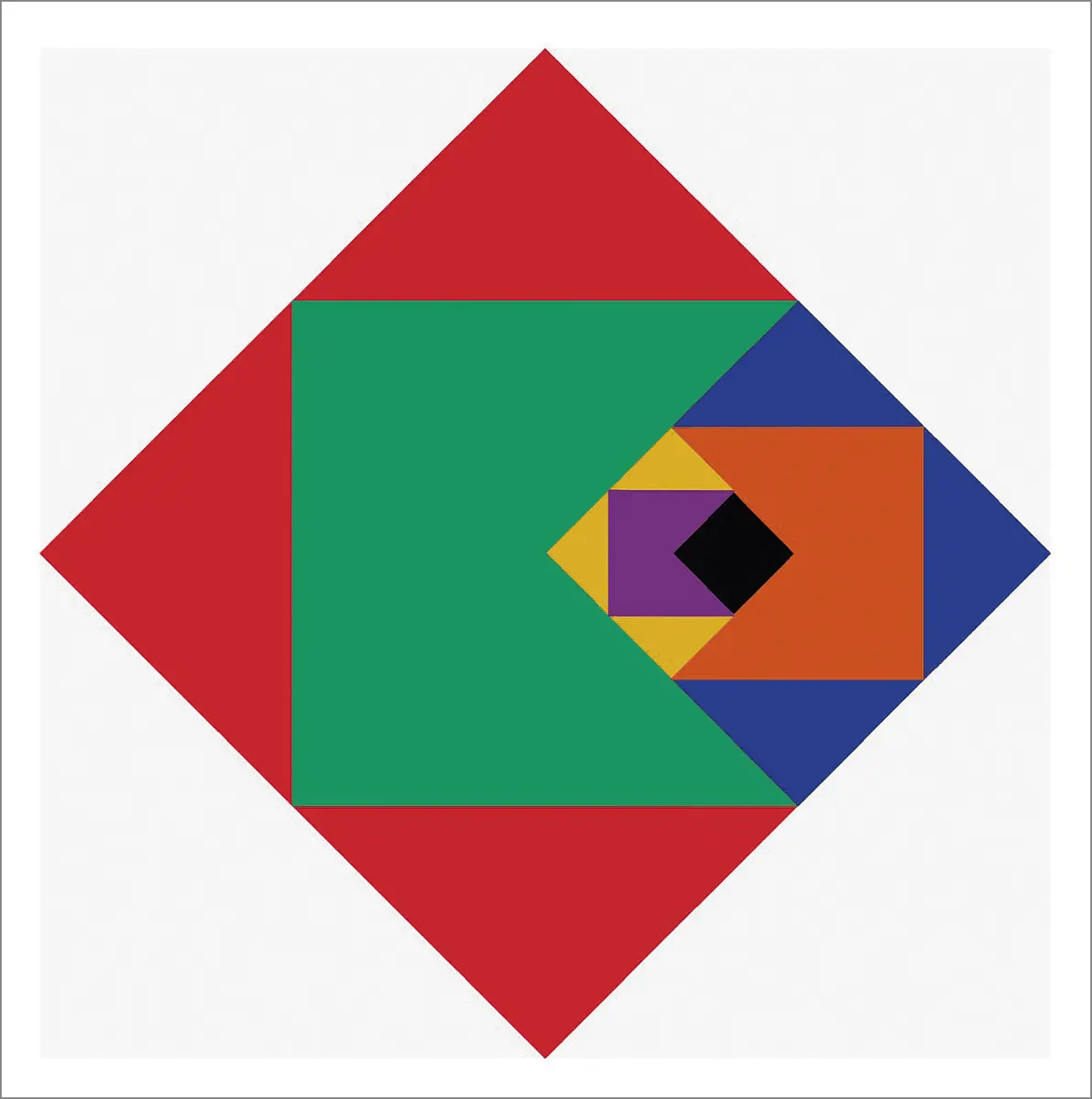
For this exhibition, the Geraldo de Barros Archive produced 66 new serigraphs based on the artist’s directions in the brochure he prepared for the XV São Paulo Biennial. The series explores every possibility anticipated in that manual, in terms both of chromatic variations and of shapes. The serigraphs were produced in Italy, in collaboration with Galleria Michela Negrini of Lugano/Milan, under the supervision of Fabiana de Barros and Michel Favre.
Geraldo de Barros’ proposal for the XV São Paulo Biennial had to do with a project of D-I-Y works of art; cleverly, the artist distributed his graphic brochure among visitors to the exhibit, challenging them to reproduce the works at home under the directions provided.
This “Geraldian” proposal resulted from the artist’s long-nourished process of constant reinvention and multiple interferences, be it in photography, with innumerable manipulations, or in his reconstruction and dialogs with society and the city based on billboards and advertisements that he was able to appropriate and redirect thanks to their technical reproducibility, thus reinventing something that had already been created by consumer society and adding his unmistakable aura, in Walter Benjamin’s sense of the term.(1)
The seeds of de Barros’ project were, indeed, on Benjamin’s concept, applied to works in wood based on advertising-billboard images whose stippling captured the artist’s imagination. In that project, de Barros worked on the wood with his preferred inks, at the time the Wanda brand produced by the ink and varnish manufacturer R. Montesanto. With its greater adhesiveness, aerograph ink fit the requirements of the new technique for working on lacquered wood.
The concept behind this show coalesced for Michel Favre after several years of inquiry into and study of the “Geraldian” soul. Favre manages and directs alongside Fabiana de Barros the Geneva, Switzerland-based Geraldo de Barros Archive. He has expressed a deep interest in the period of de Barros’ career around the 1979 Biennial, a time when the artist began to move back in the direction of Concrete Art. According to the curator, it was during that period that an opening took place for a simultaneous confluence: on the one hand, a retrospective view, a Geraldo de Barros revision of his Concrete-Art productions through the 1950s; on the other, the beginnings of a prospective move, with the radicalization of seriality and the production of Concrete Art in Formica and plastic laminates.
The curatorial idea was built on that backbone of Concretismo, which de Barros defended in his 1979 manifesto. There, his reasoning began on the basis of the Fotoformas (Photoforms), touched on issues of modern photography, and connected the Modernist experience with the Bauhaus’ exercises in serialization and its investment in furniture, all to bring forth the use of plastic laminates and the reproducibility of the work of art. An understanding of that autonomy is precisely what emerged for Favre from his investigation into that period in the artist’s life, heavily influenced by Max Bill’s Ulm movement.
In his exhibition at the XV São Paulo Biennial, with a pamphlet containing instructions for members of the general public to recreate his art at home, Geraldo de Barros prompted the reproduction of his works according to his own concept, based on a methodology related to the golden ratio. In this way, by means of a manual, the artist made his art accessible to all and opened the door to many possibilities: he not only provided a “formula” for visitors to create their own works based on the original, but in fact authorized them to do so, as long as the guidance provided and the prototypes on exhibit were followed.
The 1979 Biennial was organized in a revisionist spirit. All the award-winners from the previous fourteen editions were invited to present recent works. Geraldo de Barros had already been exploring retrospective revisions of his Concrete Art works, and even found an opportunity to exhibit them twice in 1977, first at the Museu de Arte Moderna do Rio de Janeiro, as part of “Projeto Construtivo Brasileiro na Arte: 1950-1962” (Brazil’s Constructive Project in the Arts: 1950-1962), a group show organized by Aracy Amaral and Lygia Pape, and then at the Pinacoteca do Estado, in São Paulo, for which he reprinted the Fotoformas series in new sizes and formats.
De Barros’ return to Concretismo came as a break with his pictorial productions, which were heavily influenced by Pop Art and had expressed figurative elements since the 1960s. Based on that strategic decision, he moved towards producing works of art under objective aspects aimed at mass consumption: “Do It Yourself”. His intention is recorded in the pamphlet, in an authorial text about the historical foundations of industrial design and Concrete Art.
NOTE
1. The Work of Art in the Age of Mechanical Reproduction (in German, Das Kunstwerk im Zeitalter seiner technischen Reproduzierbarkeit) is an essay by sociologist and cultural critic Walter Benjamin, published originally in 1936 and republished in 1955.
HÉLCIO MAGALHÃES