Geles Cabrera is testament to the plurality of Latin American Modernism and the latter’s evinced in just a few examples from its ample corpus: Whether it’s Wilfredo Lam and his Afro-Cuban inspired Cubism, Xul Solar’s conflation of astrology, tarot and his playful, polychromatic archetypes, or Joaquín Torres-García’s pre-Hispanic geometric abstractions, Geles Cabrera’s art, too, contributes to Modernism’s heterogeneity.
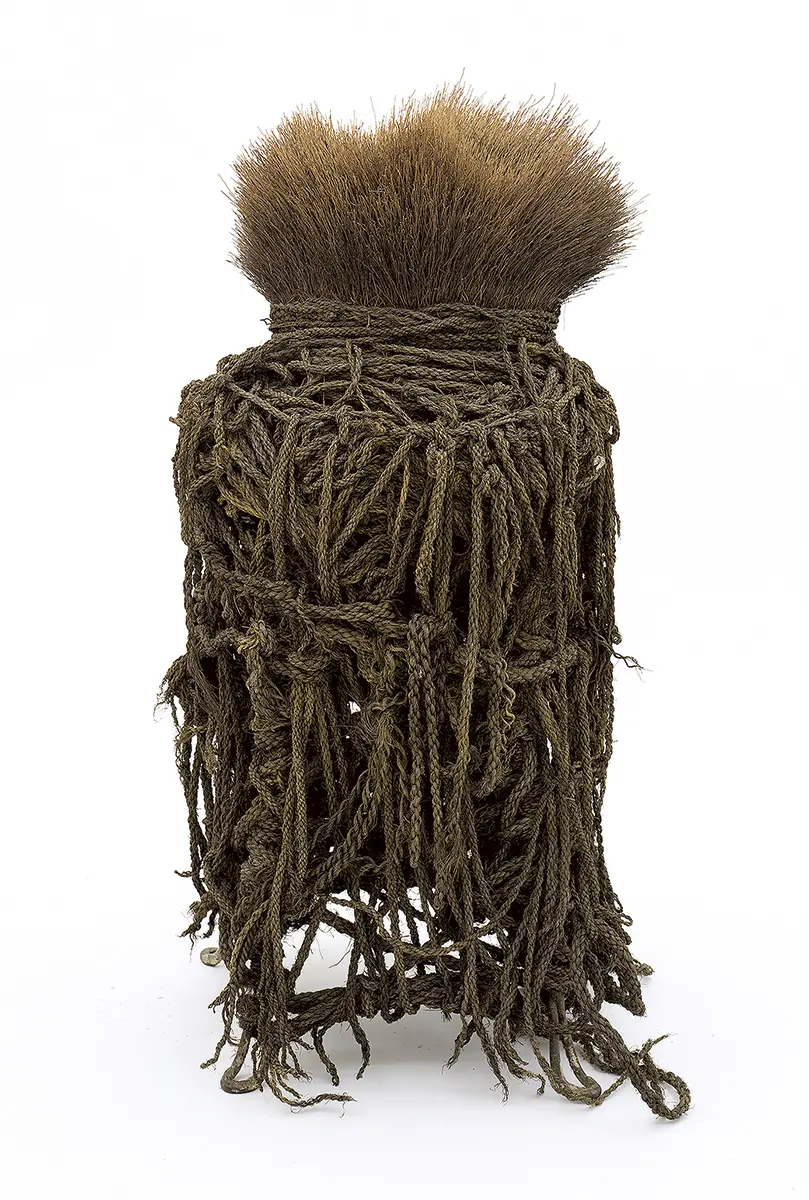
Underscoring this was Cabrera’s deftly curated solo exhibition at the Americas Society consisting of around 50 sculptures in diverse media including various types of stone, wood, iron, bronze, and fiber. There was also biographical ephemera and reproductions of Cabrera’s previous exhibitions that the artist designed herself. In one sense, what was presented was not unlike a retrospective which offered a detailed panorama of an important artist who needs further contextualization within the backdrop of her colleagues in the Americas and those across the Atlantic. Born in 1926 in Mexico City, Geles Cabrera is considered Mexico’s first woman sculptor and though it’s tempting to situate her within that important milestone, it would be shortsighted to only locate her through the singularity of that lens. More interesting is to see how she astutely works through a myriad of themes as well as formal challenges which she resolved in a variety of ways, much like her artistic contemporaries in the Americas and Europe. The broad purview of material and formal investigation that the exhibition revealed with such aplomb was astonishing: Sculptures of metal with extreme geometric angularity alluded to Continental abstraction, others seemed to poetically oscillate between figuration and non-representation. Then, of course, are the diversity of sources ciphered through a distinct aesthetic. Cabrera’s thematic mainstay, however, has been an exploration of the human form. And because she strips signifiers away to make her sculptures transcultural and difficult to pinpoint any determinative cultural and historical reference, they reach for loftier thematic goals. She even achieves this when her subject matter may be more ubiquitous: Some works may be discernably maternal in that they appear to be a feminine figure with child; the tenderness she evokes in these couplings is not sentimental but humanistic and archetypal. In this sense, they speak to us in a direct manner, which is a telltale sign of artistic intelligence, and she articulates this through a stylistic interplay of abstraction and an ambiguous mimesis.
There were and are many artists who work with dichotomies of representation and abstraction, but Cabrera’s approach equally considers materiality as more than just a formal element, however. The type of stone she works in, for instance, is not strictly selected for aesthetic reasons alone. Her sculptural material has a historicity as well, which allows Cabrera to embody her works at an atomistic level with meaning. This, too, is a marker of a complex artist who thinks beyond the visual confines of the work she makes manifest. And because the artist is 96 years old, to refer to her artistic contemporaries entails an incredible historical arc in which to place her. Take, for example, her compatriot Gabriel Orozco: When Orozco works in certain materials like a truck’s innertube tires and transforms them into spherical sculpture, one can frame it as equally responding to Minimalism and the rubber artworks of Robert Morris and Eva Hesse, but also to pre-Hispanic Mesoamerican cultures that used rubber balls in their ballgame. Thus, Cabrera’s use of volcanic rock is as much about its porousness linking her to colleagues who explored this material characteristic including Isamu Noguchi or Gonzalo Fonseca, as it can refer to the monumental works of the Olmec. A long artistic life that continues to this day, starting with her first exhibition in 1949, has led to an engagement with her peers as a who’s who of art history: Louise Bourgeois, Sarah Lucas, and Eva Hesse are just a few of the many artists with whom she has been in dialogue. While this may be a point of contention with today’s critics and historians of tomorrow alike, what is certainly a consensus is that one cannot gloss over her attainments as a sculptor, regardless of gender. But this metaphorical mountain she has climbed also reflects the obstacles a woman faces regardless of where and when a woman’s artistic trajectory takes place and commences. Thus, once the critic or historian acknowledges this inequity, one can proceed to see her work more critically both externally in its contextualization, but also from within; that is to say, seeing that her work too, like her peers, can be both topical and personal, of the moment as well as being within an art historical lineage of those that may have worked in similar formal and conceptual registers. There’s no doubt that Giles Cabrera’s artistic shadow looms large and underscores the necessity of ever revising Modernism’s canon to give us a richer and fuller view of the past. And the Americas Society exhibition gave us a glimpse to that but underscored more than ever, that much work still needs to be done on such an imitable artist as Geles Cabrera.
RAÚL ZAMUDIO