The sculptures, paintings and reliefs produced by the artist Frans Krajcberg reveal the inseparable articulation of his poetics with his environmentalism. This is evident in “Frans Krajcberg (1921-2017): Nature in Black and White,” hosted by the Cultural Pinakotheke in Rio de Janeiro to commemorate the centenary of the artist’s birth.
Created in collaboration with the Friends of Frans Krajcberg Association and organized by curators Galciane Neves and Max Perlingeiro, the exhibition established a dialogue between the works of the artist and the photographs and films of Luiz Garrido, his friend and undying supporter. A Jew of Polish origin, Krajcberg arrived in Brazil under tragic circumstances, at the age of 27, seeking to overcome the horrors of the Second World War, which robbed him of his family members, who all died in concentration camps. Besides being an exceptional artist who received awards at important biennials such as Venice and São Paulo, and whose works belong to collections of outstanding museums, such as the Beaubourg in Paris, Krajcberg was also a militant environmentalist, at times when society had no interest in the ecological agenda.
In March 2000, as an art critic for São Paulo’s Gaceta Mercantil, I went to see Krajcberg so I could write about him. Living with the artist for five days was a fantastic experience. We held extensive conversations in his studio-sanctuary, surrounded by native species of the “Atlantic Forest” (1), near the city of Nova Viçosa, in the extreme south of Bahia. On that occasion, the artist told me that to live alone was one of his goals in life after losing his family in the war. Krajcberg settled on the inhospitable border between the states of Espirito Santo and Bahia, contrary to the majority of artists, who were betting on the promising art market of Rio-São Paulo. When he began the construction of his private refuge—a kind of open-air artistic temple, with wooden structures such as a huge pyramidal studio and Treehouse, designed by architect Zanine Caldas—he was also interested in finding more about materials for his sculptures, such as the twisted trunks of the marshes.
The reasons that led Krajcberg to withdraw from people are decanted in his works. Using natural pigments—mainly black and red— the artist did not intend to limit the repertoire of his poetics exclusively to the chromatic tones of fire. The color of blood and the twisted forms of the intertwined vines also expressed a broader and more subjective content: a kind of open sore within society; an incurable wound. “My art must transmit my rebellion more and more. It’s not easy to make a sculpture that screams,” he stated, pointing to a piece with circular drawings produced by the natural course of river water. What perhaps best represented Krajcberg’s misanthropic stance was Treehouse, his home, built between the branches of a gigantic, seven-meter high pequi. (2)
Krajcberg has always been on the fringes of artistic quackery in Brazil. While artists belonging to the higher social classes could afford to offer vernissages and whiskeys at the newly opened galleries, Krajcberg worked as head of General Services at the Museum of Modern Art in São Paulo. In Europe, he proved to be an involuntary nomad: he was always sleeping at friends’ houses, since he had no money to pay rent (in Ibiza, Spain, he had to live in a cave). One of his first hosts was the Russian painter Marc Chagall (1887-1985), whom he lived with in France during four months at the end of the 1940s. Despite his disagreements with the concrete artists in Brazil, he had good friends among them, like Alfredo Volpi (1896-1988), who worked with him at Osiarte, painting tiles for Portinari’s panels.
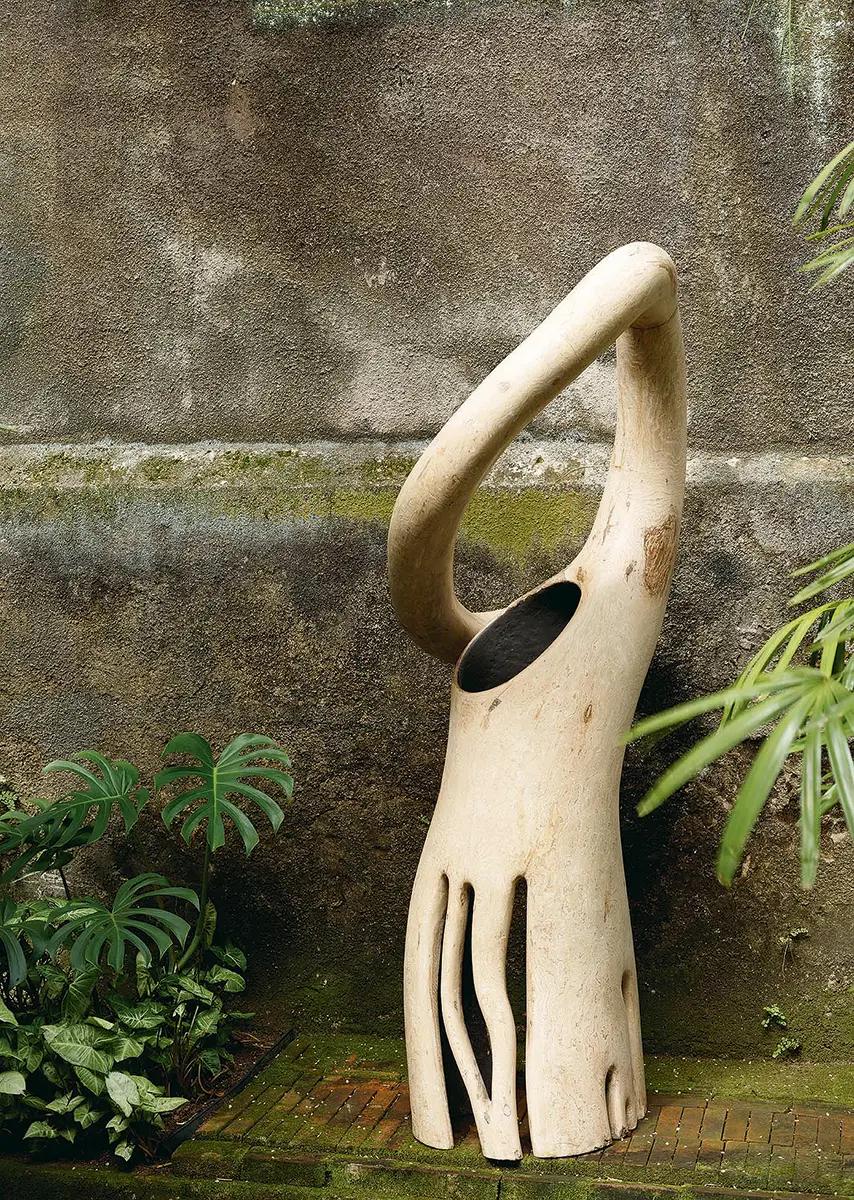
Growing more and more interested in using natural materials, Krajcberg ended up in Nova Viçosa. “In this jungle I observe the small lives: the lives of ants,” he remarked as a way of conveying his love for detail, expressed also in the beautiful photographs of plants and insects that complement his work. Only isolation could give him the concentration needed for his meticulous work, even on sculptures as monumental as the totem poles carved from trunks, which the artist imbued with the same pigments as his tree venation drawings.
In this recent exhibition, the photographs of his friend Garrido illustrate the artist’s relationship with nature; enveloped by leaves or mud, his portraits express the condition of a visual poet of nature. The idea of “black and white” as a guide to the exhibition also stems from his poetic sensibility. In fact, from the artist’s own words: “I was dreaming, and when I woke up, nature was black and white.... The white attenuates the blackness of the burnt trees.” Without colors, his twisted forms intensify their organic power; they seem to represent those who remain silent in the face of humanity’s perversities.
NOTES
1. The type of forest found on the south-central coast of Brazil.
2. A very thick tree belonging to the Caryocaraceae family and common to dense jungle areas.
ALESSANDRA SIMÕES