Federico Klemm is nowadays considered a queer icon, but for many years he was stigmatized and castigated by the police, who persecuted adulterers and men who wore their hair long. That did not discourage him from leading a rich life, pursuing his relationships, and participating and animating exciting alternative scenes.
Federico Klemm was a colorful and generous member of the Buenos Aires art scene, from the fervent sixties until his death in 2002. Twenty years later, the Federico Jorge Klemm Foundation— created in 1995 by this artist, cultural animator, collector, and patron of the arts—is celebrating his life throughout the year, at the very place where the gallery with his namesake was active between 1992 and 1995.
A free-admission space open to the public, the Foundation hosts temporary exhibitions and displays a selection of modern and contemporary art from the more than 750 works in its collection. The pieces belonged to Klemm’s eclectic personal collection, with local artists such as Roberto Aizenberg, Nicolás García Uriburu, Guillermo Kuitca, Enio Iommi, Raúl Lozza, Xul Solar, and international artists such as De Chirico, Chagall, Warhol, Beuys, Basquiat, Koons, Yves Klein, Lichtenstein, Magritte, Mapplethorpe, Man Ray, Avedon, and more. It is located in front of San Martín Square, just steps from the touristic Florida Street, and is managed by the National Academy of Fine Arts. In addition to its annual exhibition program, since 1997 the Foundation has organized the Klemm Visual Arts Award to promote young artists.
The project “Enchanter of the Night. Federico Klemm 1942-2002”, occupying the Foundation’s space throughout the year, celebrates not only the twentieth anniversary of his death, but also the fact that the artist, born in the former Czechoslovakia in 1942, would now have been 80 years old. The exhibition, curated by Federica Baeza, Guadalupe Chirotarrab, and Santiago Villanueva, consists of three episodes displayed successively in the “Bonino” room (where the traditional gallery was originally located). There were also parallel interventions to the permanent collection displayed in the other rooms.
These three episodes feature works—photo-paintings and photo-collages—by Klemm, as well as objects, archival documents, furniture, and an accomplished video made by Joaquin Aras with photographs belonging to the Foundation’s archive. Photographs of his life show the artist and patron of the arts with an array of celebrities he knew, admired, and loved, such as Rudolf Nureyev and Maria Callas; after the artists’ deaths, Klemm bought the Russian dancer’s python suit and acquired an armchair that belonged to the opera singer.
Inaugurated in March, the first episode, “Telecrystals and Homoeroticism,” was set with lights and shadows. The curators pointed out that Klemm “explored the representation of the male body in figures camouflaged through myths and religious stories,” as is seen in the paintings Narcissus and Aphrodite, from 1994, and Metamorphosis of St. Clare of Assisi, from 1997. Beautiful bodies of young women and men, virgins, saints, and energetic stones proliferate in these pieces. The works denote his sexual preferences, religious expressions, and the use of myths to sublimate, albeit superficially, what could not be said or shown as openly as today. Federico Klemm is now a queer icon, but for many years he was stigmatized and punished by the police, who persecuted adulterers and men who wore their hair long. This did not discourage him from leading a rich life, pursuing his relationships, and participating and animating exciting alternative scenes.
A wealthy heir and a flamboyant character, Klemm often wore unique clothes and jewelry. His birthday celebrations were legendary. As curators Baeza and Chirotarrab recalled when they presented the new hang of the collection, it was “configured around his most intimate vital and artistic explorations…. His life and artistic practice were immersed in Pop culture, parties, and glam.
The second chapter opened in July. “The Flaming Swan” focused on the early complicity and collaborative friendship between the artist and Mildred Burton, and featured works by both. The title alludes to Klemm’s 1990 painting The Flaming Swan (The Artist’s Four Elements of Love and Generosity). She contributed to the artist’s visual formation, and also painted his mother, boyfriends, and the living rooms and the rooftops of several of his apartments (one with a lion jumping into the void). Burton’s 1980 painting Invasion II portrayed a section of Klemm’s house invaded by a sort of mysterious dragon-serpent. In fact, she later “invaded” with snake paintings an exhibition of his in the early 1990s. In the 1980s both of them displayed their taste for performances and theatricalizations, which they created in tandem on several occasions, some of them available on YouTube. A selection of episodes from his television program The Telematic Banquet, broadcasted since 1994 and with the theoretical support of the critic Carlos Espartaco, can also be seen on YouTube. In this educational series, Klemm stood out for providing accurate information and for his great histrionics and performative stances. The program made him a celebrity among viewers unfamiliar with art.
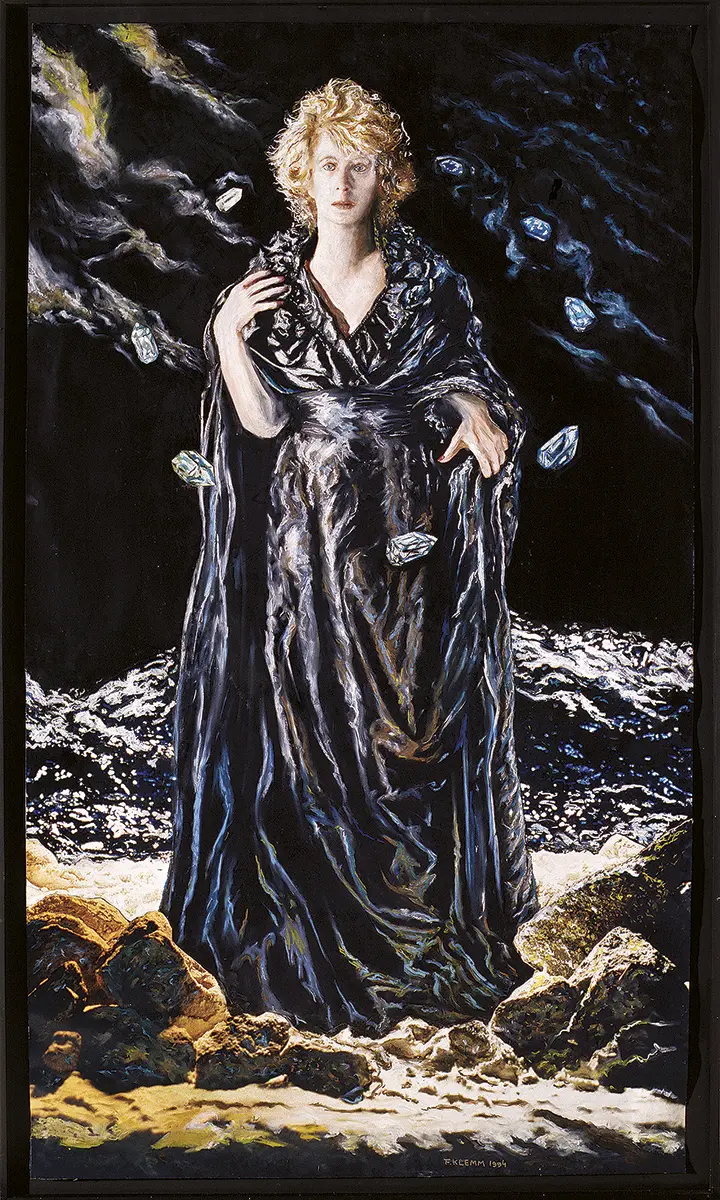
The last show, “Ópera Madre” (Mother Opera), opened in September and focused on the artist’s unconditional bond with his mother and with opera. In the words of the curatorial team, “Federico imagined himself as a lyric singer, a scenic activity that he practiced and deployed in some of his performances and spontaneous appearances at evening events. This opera—a story between drama, tragedy, and comedy—is shown in several of his photo-paintings, in his adoration for Rudolf Nureyev, Maria Callas or Eva Perón, and in the powerful bond with his mother, whom he portrayed numerous times, including at her wake.” Such is the case in Moravian Crystals (The woman-mother seen as a mythical idealization of modernity since Medea, the incarnation of the Virgin Mary and the stark Mother Courage, through the vision of the artist’s mother), from 1994. The theatrical setting—with dark tones, wide curtains, and mirrors—underlines Klemm’s aesthetics, with its exuberance and impasto. The space-as-scene highlights his large-format works in showcases; portraits, characters, and even ghostly presences are discovered in the paintings, furniture, costumes, and archival documents.
The shows were accompanied by fanzines with texts and illustrations. In addition, throughout 2022, the Foundation has organized public programs, lectures, master classes, and other activities related to its founder. The exhibition is open to the public at the Federico J. Klemm Foundation until February 2023 and can be visited on the institutional website, www.fundacionfjklemm.org.