During the mandatory confinement due to the COVID-19 pandemic, which in Argentina was very strict, Ruth Benzacar expanded its exhibition space by adding the meters of an adjoining house. The main room, a former warehouse, is now supplemented by smaller rooms that usually present different shows, except when works of a single artist occupy the entire gallery, as was the case with the exhibition titled “El campeón de los fantasmas” (The Champion of Ghosts). This intelligent project by Fabio Kacero (Buenos Aires, 1961) included “drawings in collaboration with living and dead artists,” a seventeen-century monochrome painting, and a video transmitting a single news item in loop.
According to the curator, Francisco Garamona—who is also a writer and the editor of Mansalva, the publishing house where Kacero has issued three volumes of poetry and short stories—stated “this show can be seen… as the continuation, by other means, of the last book published by the artist.” Antología del sueño argentino [Anthology of the Argentinian Dream, 2021] features a “dream” about a young man who’s given a catalogue by the security guard of an auction house. The guard informs him that the most expensive painting in the world has just been sold. Expecting to see images of famous works, all the protagonist finds is a gathering of signatures and one signature appearing in the lower right corner of every page. “The story concocted by Kacero the writer was the source of inspiration for Kacero the visual artist.” His interest both in the visual arts and in literature has a long history; in this exhibition, he succeeded in uniting both passions. Although his first choice was art, years ago he confessed that “words usually influence me more than images... they have transformed me more than anything else.”
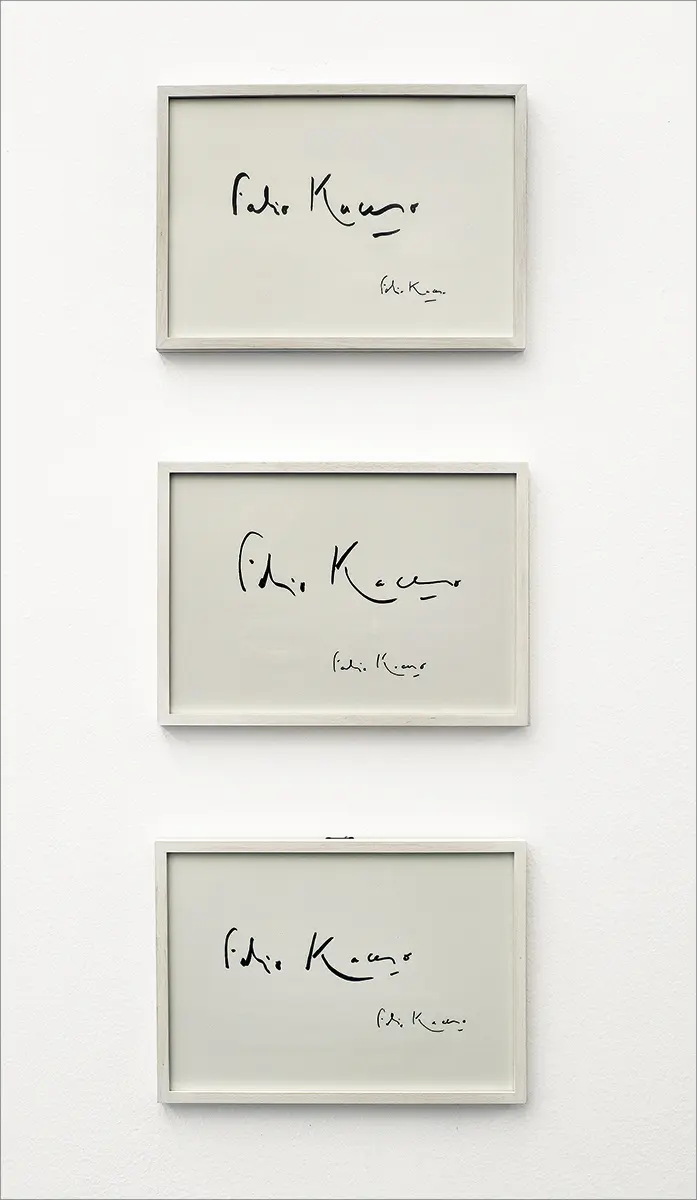
For “The Champion of Ghost,” Kacero displayed a collection of artists’, curators’ and critics’ signatures. Each autograph was written on a small paper, signed by the artist on the lower right corner, and framed. The exhibition began with a list of names, along with an explanation of how he got the signatures from those who are alive during social events (as for those “from the other side,” he resorted to predictable means) and a note on the fact that not every signature collected was on display. An exhibition of, say, 128 signatures belonging mostly to the Argentinian art ecosystem would have felt monotonous. Entries “from the other side” included the usual suspects, such as Picasso, R. Mutt (Duchamp’s signature on his urinal) & Co. The best way to appreciate the ensemble, beyond identifying the signatures, was to see it as a huge and subtle abstract drawing arranged all throughout the huge white space of the gallery. It was also interesting to compare the artist’s own signatures, which were not always the same; experts may have detected in these deviations some traits of Kacero’s temperament: perceptive and sensitive, eccentric and solitary.
One of the small rooms displayed a deteriorated pink painting of a pale seventeenth-century dawn, inexplicably and presumably saved from the flames. Elusive and mysterious, the canvas was presented together with the story The Miller’s Monochrome—available to the public on paper and through a QR code—which gives an account of the origin of the piece. A hardworking miller, through a strange revelation, was commissioned to paint otherworldly presences. And so, the impromptu artist began a double life. He spent his days at the mill and his nights painting, guided by nameless spiritual beings. He showed his work to no one, but his imprudent wife began to wonder about the paintings she had never seen. After a series of events, including an incident concerning a famous local artist, the milliner’s wife burst into the makeshift studio and found dozens of abstract paintings, which she decided burn—taking advantage of her husband’s sudden fever—because she believed they were the work of “evil spirits.” In that same line, centuries later the Nazis called abstraction and modern art “degenerate.”
Mystery also reigns in the video projected in the adjoining room. During an entire hour, Dear Friends announces the deaths of local and international celebrities. In what is clearly the result of the exhaustive edition of multiple television programs, various anchors broadcast that single news item. Images and voices reveal the death of presidents, comedians, Michael Jackson, a porn star, the tallest man in Bolivia, the Peruvian Superman, and many more. Why is it called Dear Friends? Never far from humor, the artist may point to the natural fact that many of the artists who autographed the sheets of paper displayed in the main room will, sooner rather than later, join the ranks of this news bulletin.