In the 1960s several Venezuelan artists produced assemblage art. One of them was Elsa Gramcko (1925-1994). A brief retrospective exhibition of Gramcko’s oeuvre at Sicardi Ayer Bacino Gallery, The Invisible Plot of Things plots the development of her works from her earliest creative period 1954-1955 up to and including her series Bocetos para un artesano de nuestro tiempo, 1974-1978. The title of the exhibit is well-chosen because what is implicit in her more interesting works that include “things” is perhaps more revealing than what is merely visible.
Gabriela Rangel, curator of the exhibit, writes “In 1954, Gramcko attended studio art classes at the School of Plastic and Applied Arts of Caracas conducted by Alejandro Otero, a pioneer of geometric abstraction (...).” Otero became Gramcko’s friend and mentor. Not long after her training with Otero, she was invited to participate in the group exhibit “Artistas de la Cuenca del Caribe” that was shown in the Museum of Fine Arts Houston in 1956; and in 1959 she had a solo exhibit at the Art Museum of the Americas in Washington D.C.
For Gramcko the tumultuous decade of 1960 started with a year in which she explored new media. Rangel writes, “The arrival of Informalism to Venezuela in 1959 also coincided with Jesús Rafael Soto’s and Alejandro Otero’s brief explorations of assemblage and collage as reworked by French Nouveau réalisme. (...) Gramcko began a series of black paintings (R) in which she challenged traditional artistic methodologies with the use of an array of industrial materials such as sand, pigments, and glues to produce barren textures with a tactile quality.” Such is the case with R37, 1960, arguably one of Gramcko’s most elegant works and perhaps among her first decisive moves towards Informalism. R37 displays the kind of technique emphasizing the materiality of the medium favored by Informalist artists like Pierre Soulages or Alberto Burri.
Curiously, Gramcko adamantly rejected aligning her works with Informalism. In a 1976 interview with Juan Calzadilla she stated, “Not a single work of mine is Informalist in the true sense of the term.” An important trait of Informalism may explain Gramcko’s recalcitrance: automatism, the creative procedure brought into artistic practice by Dadaist and Surrealist writers. Even Gramcko’s most seemingly random work is far from automatic or gestural.
The controversy about Gramcko’s adherence or indifference to Informalism should not impede discussing what is arguably the most interesting period of her oeuvre in which her works turned definitively in the direction of assemblage and thematically into a reflection about “things”. Although Gramcko had a reserved personality, she was not shy of ideas. Rangel alludes to the influence German thinkers Carl Jung and Martin Heidegger had in Gramcko’s aesthetic decisions.
Gramcko herself narrated the anecdote that her aesthetic shift towards assemblage with found objects came about after the serendipitous discovery of a dilapidated automobile from which she scavenged a number of parts. It is not clear with what criteria Gramcko began to collect chatarra (car battery parts, lighting components, gears, locks, etc.) that she could use in her assemblages. The word “chatarra” stands for old discarded metal parts that can be used as materials for something else. Although some of her Chatarras assemblages are amusing, they are not cheerful. Their muted palette of ochre, rust, and sepia tones is rather subdued. Nonetheless, they are thought-provoking and initially, at least, they expressed a positive attitude about their “things.” In these works, meaning gradually emerges from formless matter seeking the structure of found things like machine parts.
Gramcko courageously adhered to her own artistic vision in spite of an art rhetoric that was becoming increasingly political. In a 1961 letter to Otero she wrote, “Day by day, anything that isn’t political or social action is less important, and the situation seems so chaotic that we all feel like we’re on the eve of a catastrophe. And I’m a little bit out of touch, without a doubt, since despite this climate, I’ve been even more involved in my work than ever before.”
In the sixties Gramcko produced many works with doors, including Una pequeña edad (1964). Even a simple description of it appears as a psychological interpretation because once doors are part of an artwork implicit dichotomies such as open/shut, inside/outside, private/accessible come immediately into mind. It all feeds into the notion that Gramcko was perhaps less reactive and more thoughtful than many artists of her milieu.
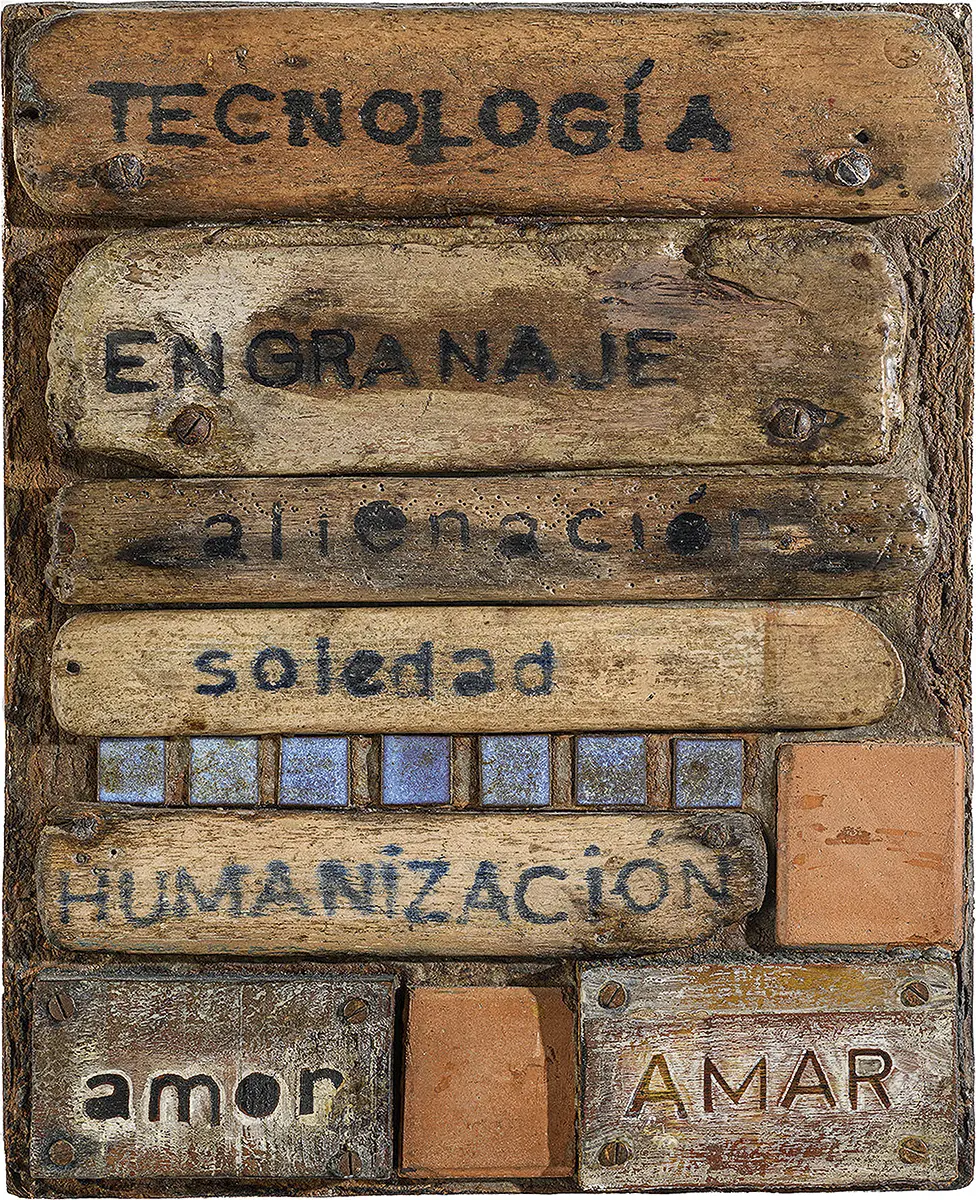
It is during this fruitful period that expands into the 1970s that Gramcko comes up with the series Bocetos de un artesano de nuestro tiempo (Sketches by an Artisan of Our Time). The phrase is cleverly ambiguous between “an artisan belonging to our time” and “his sketches being about our time.” At least two things are different in the works of this new series. First, the kind of things she is using in her assemblages (predominantly worn-out wooden planks). Secondly, she introduces words into some works as if they were “things.” In Número 2 (1976) the words TECNOLOGIA, ENGRANAJE, alienación, soledad, HUMANIZACIÓN, amor, and AMAR are inscribed into small worn-out wooden planks. Making words central to a work of art was becoming common practice circa 1976 as evidenced by the works of Robert Indiana, Ed Ruscha, Jenny Holzer and Barbara Kruger.
Implicit in the “things” in Gramcko’s 1970s assemblages is a change of attitude about what the artist wants us to feel and think about them. With the Chatarras series she had us reflecting upon and empathizing with mechanic parts. With the Bocetos series we are to embrace the fact that the wooden planks in her assemblages were shaped by artisans whose work is not much different from hers. In an interview Gramcko once stated, “a completely mechanized contemporary society, where man is merely a link in the machinery that places technology before the individual, is the greatest threat to our identity.” To be sure, her insights about a mechanized industrial world from decades ago, before the age of computers, robotics and the Internet, are most relevant today.
FERNANDO CASTRO R.