In the exhibition Ensayos de lo sólido (Trials of the Solid), Peruvian artist Elena Damiani presents five sculpture groups and a series of 36 collages, The Erratic Marbles IV (2022), that engage the issue of geological time and scale in relation to the Earth’s origin and formative processes. Damiani’s granite, marble, and travertine sculptures and her collages based on photographs of rocks and rock formations speak of the planet as a giant laboratory, one where a variety of materials (rocks, minerals, crystals, etc.) and geographical features result from long and continuous processes of testing and trial.
The idea is suggested, first of all, by the way in which Damiani handles her materials, highlighting their physical characteristics and their aspect of matter extracted from the Earth. The shapes and finishes towards which she works her material refer to multiple geological and industrial processes, and these references appear condensed into each individual work. One example is Cuñas (Wedges, 2022), comprised of two blocks of travertine in the shape of a triangular prism. It features both well-polished and rough sides, clean and irregular cuts. Embedded into its surface are fossils of ammonite (a mollusk that roamed the Earth hundreds of millions of years ago), the presence of which speaks of processes of sedimentation. Moreover, the structural pattern in the fossils’ shells connects with that of the rock’s veining, establishing a relationship between the organic and the inorganic.
The nexus between the organic and the inorganic is the subject of Célula mineral (Mineral Cell, 2022), as is already evident in its title. The sculpture has a cell as its referent: a bronze outline holds together a multicolor group of oval-shaped marble, granite, and travertine tiles, suggesting the giant enlargement of a cellular sample seen through a microscope. In this way, Damiani not only swaps the macro and micro physical scales, but also, by means of the concept of cell, builds a bridge between the biological and the geological, tracing a parallel between the processes that undergird the emergence of life and those behind the formation of rocks and minerals, and blurring the difference between living and inert matter. At the same time, her peculiar cell also evokes the shapes and materials of contemporary furniture design.
The allusion to design, however oblique, is equally present in Soles en la sombra (Suns in the Shade, 2022), a large installation comprised of a modular steel structure, black in color, resembling a shelving unit and holding several blocks of carved marble. The “shelves” in this metallic structure create a frame for the marble carvings, which in this way begin to resemble landscapes, their irregular shapes appearing to represent of mountains. In other words, these rocks extracted from a mountain are arranged in such a way as to evoke the mountain of their origin, in an interplay of physical as well as temporal scales: the times involved in the formation of metamorphic rocks such as marble, and of mountains as a whole, and the instant captured in their representation as landscape (or their analysis as lab specimens, in the case of Célula mineral). When the volumes have a downwards orientation, they seem to be pointing towards the interior of the Earth, again a reference to their origin. The geological horizon is further underscored by the small disks of molten bronze embedded in the rock, an allusion to the radially-shaped mineral formations known as “pyrite suns”. In those sections of Soles en la sombra where we find a polished, flat marble surface, it is even possible to imagine a body of water.
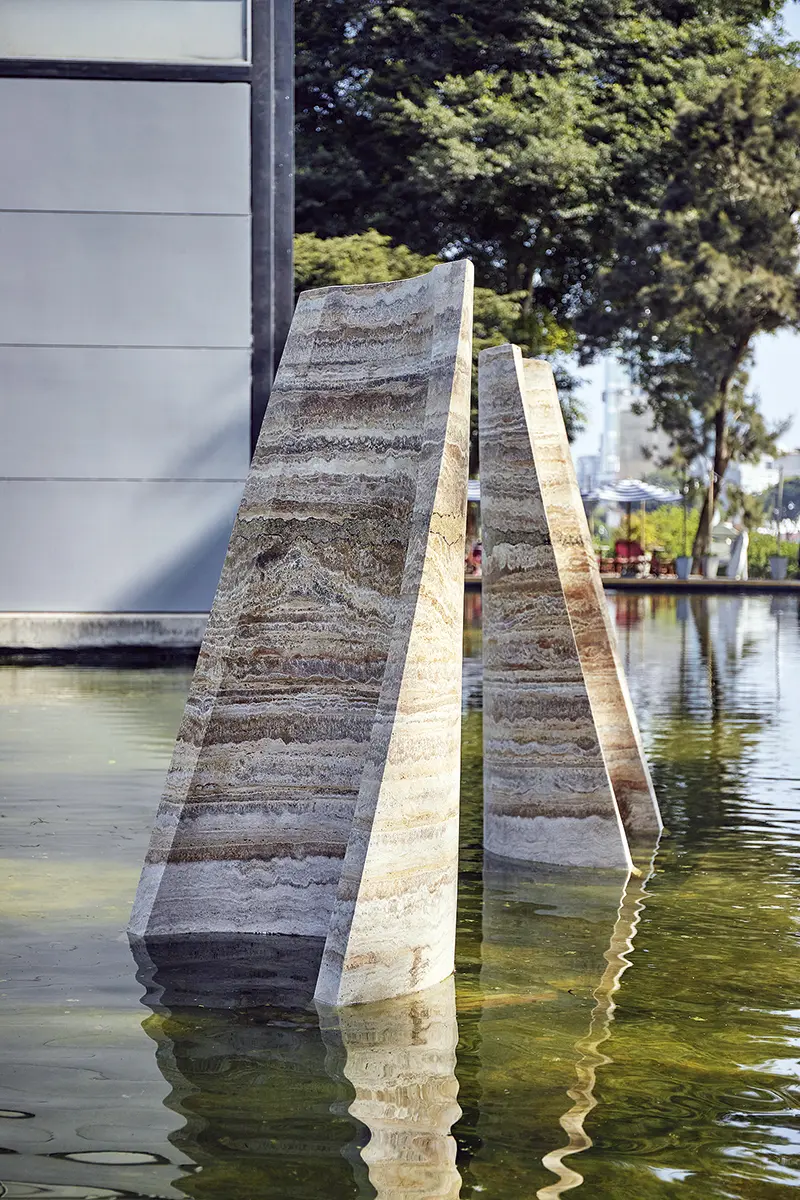
The relationship between rock and water is dramatized in Entre los sedimentos vitales (Between Vital Sediments, 2022), installed in the museum’s reflecting pool. It is a two-part structure, comprised of the two halves of a travertine cylinder split diagonally. Damiani exposes the vein of the material, which is to say, she brings into view the calcareous layers that form this sedimentary rock. The split cylinder suggests a divided (temporal) continuity, while the exposure of the sedimentary layers operates as a section drawing of geological time. Furthermore, the artist introduced resin and onyx between the sedimentary strata, as an alteration of the story told by the stratigraphic narrative. That story, Elena Damiani reminds us in her works, is the story of the formation of our world, a product of the innumerable sudden and drastic catastrophic changes that gave it shape—and us, life.
MAX HERNÁNDEZ CALVO