For the first time in its history, the artistic direction of documenta was in the hands of artists. Moreover, these are artists with a very particular practice. Founded in 2000 in Jakarta, ruangrupa sees itself as an expanded collective of cultural actions, which not only has room for art, but also for urbanism, architecture, design, politics, and play. In an interview with El País in 2020, members of the collective stated: “We have never set foot in a documenta, but neither has any curator, since its first edition in 1955, ever invited an Indonesian artist.” (1)
In addition to their artistic and ideological convictions, by virtue of a gregarious ethos strongly rooted in Southeast Asia and certain Islamic societies, ruangrupa upended the structure of documenta in every sense of the word. Their strategy was simple in principle: they invited fourteen artist collectives who in turn invited other groups, reaching a total of around 1500 participants, most of whom are based in the so-called Global South.
The numerical overflow brought about a fascinating sensation of chaos: the agenda of events was overwhelming; names and people spread like wildfire; different visual and linguistic registers overlapped, and ideas flowed with unstoppable inertia. The city was taken over by a contagious, overflowing energy. The venues were visited by more school groups than by curators, museum directors, or collectors; many collectives do not even see themselves as artists. The shock to the status quo of some of the art world’s practices, actors, and institutions on a global scale was palpable, as was the subliminal bargaining of certain terms of power related to documenta’s Eurocentric vocation.
The curatorial premise was based on lumbung, an Indonesian term that refers to community practices at rice barns. Aside from sowing, cultivating, storing, and distributing the grain, its array of social actions also encompasses the organization, allocation, and tending of the land. Most likely, every ethnic group and culture on the planet has some concept akin to lumbung to designate community practices aimed at living well. We must therefore emphasize the concept, rather than the word, as well as its relevance at a time when unbridled consumption, the incompetence of the political classes, and rampant extractivism have weakened the social contract on a planetary scale.
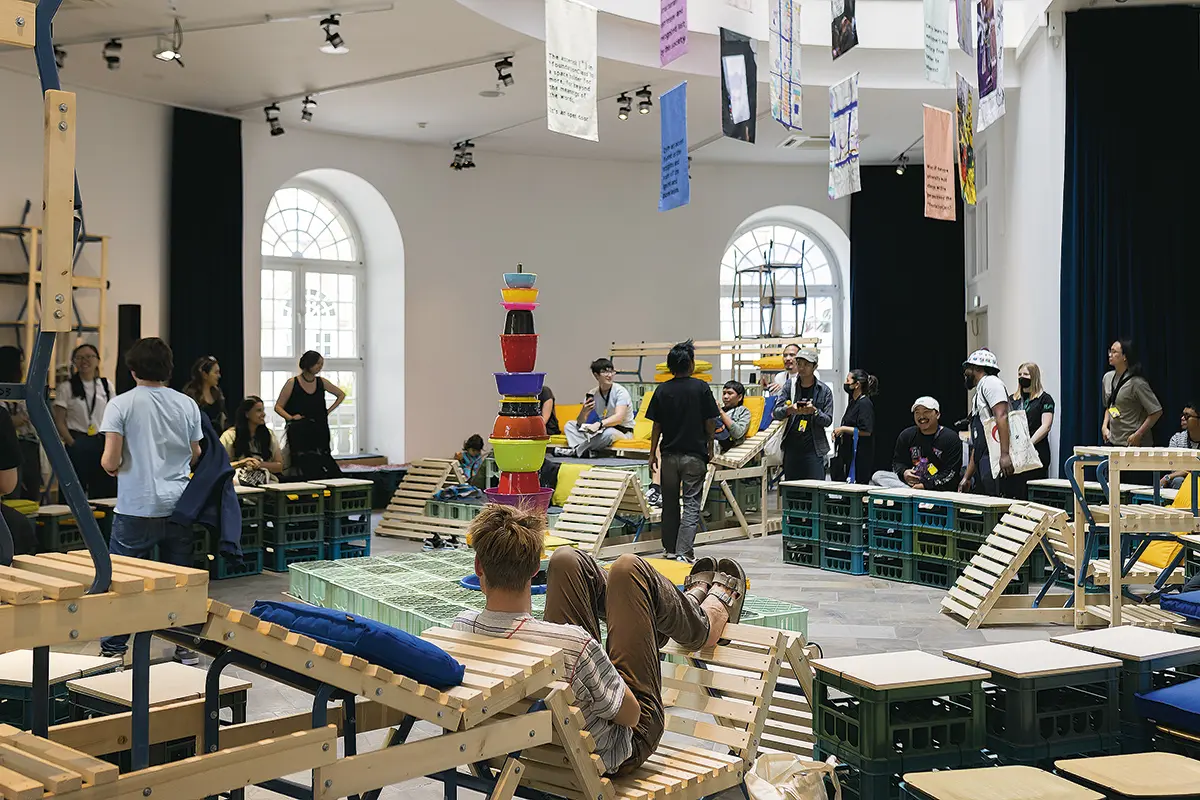
The lumbung documenta did not follow the conventions of art exhibitions, since its vision displaced the aesthetic horizon to the realm of action. The paradigm of the white cube and museum-like settings were traded for a relaxed and almost precarious do-it-yourself aesthetics: many venues, including the emblematic Fridericianum Museum, became meeting spaces equipped with sofas, rugs, work tables, and even a skateboard ramp, facilitating the development of workshops, talks, public readings, and audiovisual projections. Other venues allowed for the contemplation of artworks in more or less conventional formats, but always under the premise that they were the result—or complement—of long and complex cultural processes.
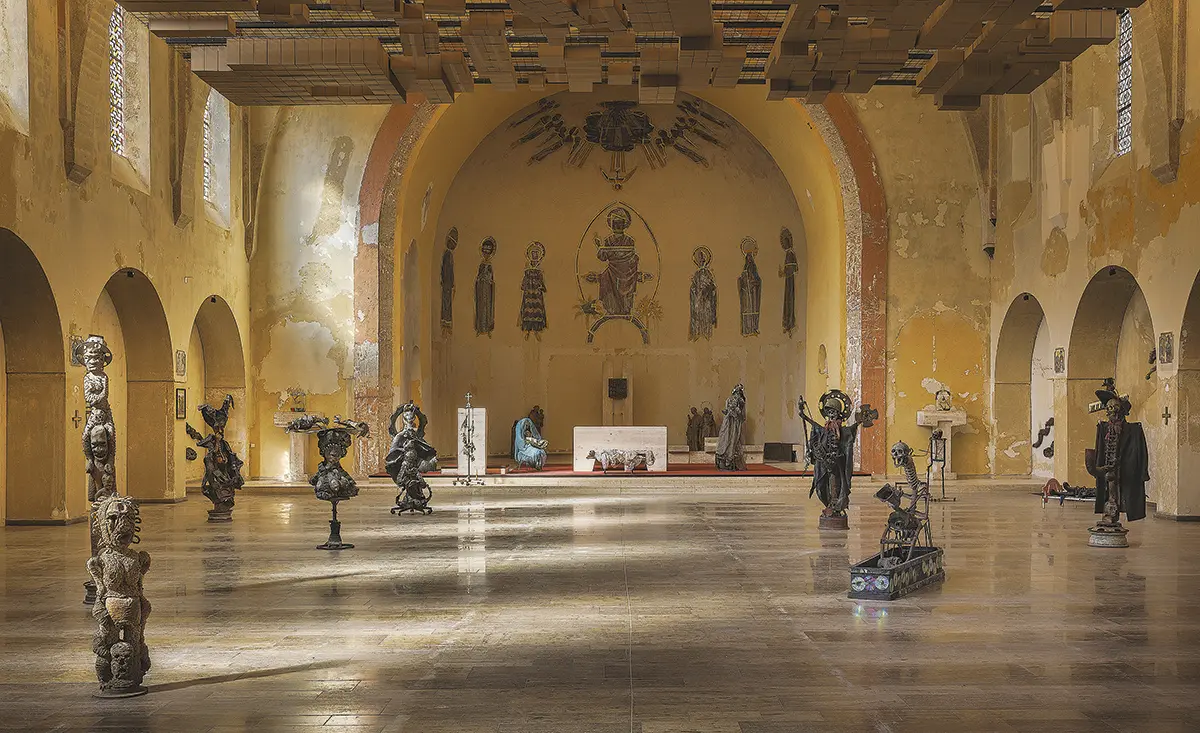
A good example was the show presented by Atis Rezistans, a Haitian collective composed of painters, sculptors, and young artists who create slam poetry, photography, video, and performance. In 2009, Atis Rezistans organized the Ghetto Biennale, which has taken place in Port-au-Prince ever since. For this edition of documenta, multiform and varied pieces by some members of the group, ranging from sculpture and painting to sound installations and architectural interventions, were displayed in San Kunigundis Church. The exhibition included a memorial to the artists who died in the 2012 earthquake, as well as graphic explorations of the Haitian Revolution, geopolitical discussions, and contemporary elaborations of voodoo. It was a magnificent show in aesthetic terms and on the basis of the pieces themselves. However, their social and communal context—their way of operating as a team—is what gave them their singular heterodoxy and richness.
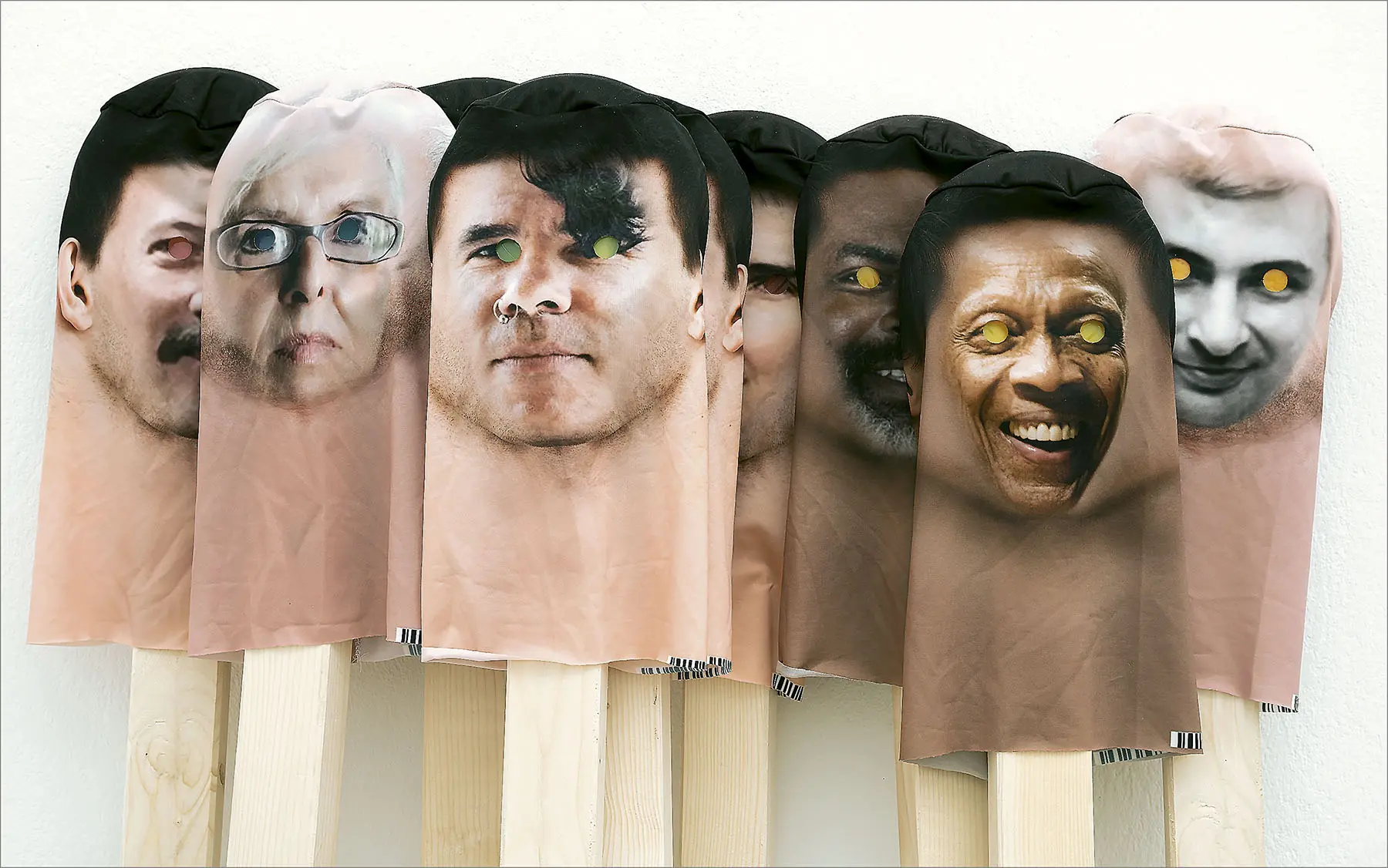
The Museum for Sepulchral Culture hosted Manifold (2022), an installation by Mexican Erick Beltrán, based on representations of individuality, relationships, and community. Inspired by the theories of Furio Jesi, Aby Warburg, and Horst Bredekamp, Beltrán delved into the editing processes and mechanisms that define, classify, reproduce, and distribute images and discourses. The artist worked with researchers from the University of Kassel’s School of Fine Arts and asked ordinary citizens how they see the image of power. The result was an installation of great aesthetic impact, which, once again, was sustained on the basis of transversal knowledge and the generation of shared spaces for thought.
Terms such as assembly, ecosystem, honeycomb, network, and collaborative resonated in Kassel almost like a mantra. The semantic field of collectivity took the form of concept maps, flow charts, and other devices produced by group actions. Social orientation was directed towards caring, with special attention to disadvantaged groups, such as children, adolescents, and neurodiverse people.
Around the world, a huge multiplicity of human groups struggles against the exclusion of minoritized sectors, violence of every kind, forced displacements, and the environmental debacle from positions in which culture, far from being a commodity for the consumption of elites, is the catalyst for social action. As was to be expected, their gathering at the same time and space made it possible to sketch a revealing and eloquent world map where social inequality and the ecological crisis are accentuated in the Global South. A cultural world map that mirrors the geopolitics and concentration of wealth.
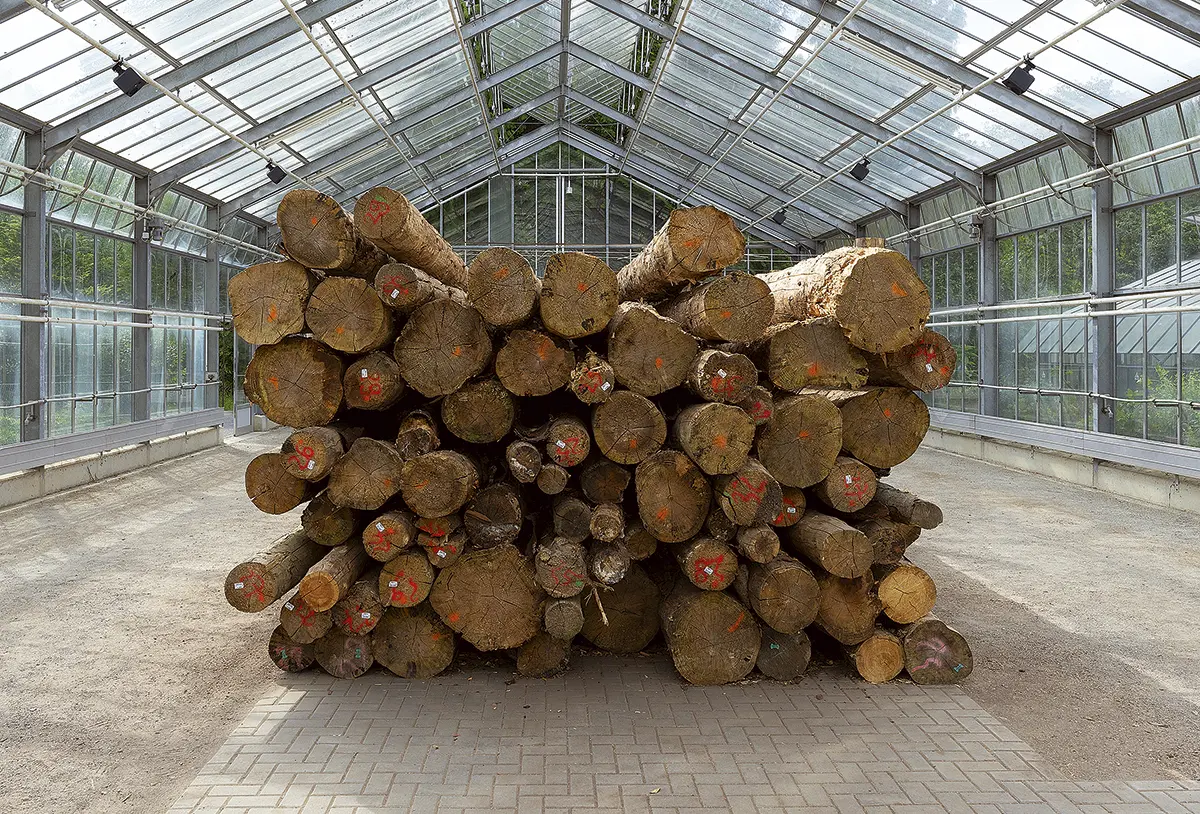
The Colombian collective Más Arte Más Acción (More Art More Action), focused on promoting critical thinking through art on the coast of Chocó, has launched the concept “space to reflect,” which promotes shared thinking between artists, writers, scientists, and activists on the challenges of land struggles, ecological extractivism, and the social crisis in relation to climate change. Their installation at the Glass House—composed of beetle-infested tree trunks gathered from the forests around Kassel—was accompanied by sound pieces that allude to the Colombian Pacific region. A similar spirit sustains La Intermundial Holobiente and its “interworld document:” The Book of Ten Thousand Things, for which the Argentinians Erica Bohm, Lucas Di Pascuale, and Tulio de Sagastizábal acted as intermediaries.
As J.J. Charlesworth affirms, this edition of documenta ran the risk of fetishizing communities under a romanticizing aura (2). He and other critics have echoed Claire Bishop’s thinking about relational aesthetics, which, from the author’s perspective, tends to disguise political antagonism under the guise of frictionless coexistence. Although ruangrupa was able to gather the protagonists of socially-motivated artistic actions and recreate certain spaces of coexistence, they were unable to transfer to Kassel the frictions and hostilities that gave rise to those cultural movements. This, however, does not mean that they don’t exist or that they don’t keep wounding their places of origin. Notwithstanding the beautiful installation of Más Arte Más Acción, Colombia is still considered the most dangerous country for environmental activism, according to Global Witness.
Furthermore, the Hannah Arendt Institute of Artivism (INSTAR), headed by Tania Bruguera—who participated in a previous edition of documenta, marking a milestone for Latin American art—has become one of the main forces of the civil movement against political repression in Cuba, where artists Luis Manuel Otero Alcántara and Maykel “Osorbo” Castillo are still imprisoned as I write this, and several young people have been sentenced to more years in jail than they have been alive for publicly expressing their political disagreements with the regime. Bruguera launched an ambitious program that could well constitute a biennial in itself: ten exhibitions in a hundred days, accompanied by lectures, discussions, concerts, and a film series, with the aim of generating a counter-narrative of Cuba’s cultural history and doing justice to all the intellectuals censored by the regime throughout its existence.
The friction attracting the most attention was the one related to the Taring Padi collective, whose mural People’s Justice had to be covered up and then removed due to accusations of anti-Semitism that were added to similar accusations proffered ever since ruangrupa invited certain organizations advocating the cultural boycott of Israel (BDS) to participate in documenta. In his column in the Berliner Zeitung, Michael Rothberg stated that the Star of David in the mural had nothing to do with Jewish identity, but instead was meant to denounce militarism and Israel’s support of Haji Mchammad Suharto’s dictatorial regime. During the speech he gave at the German Parliament, Ade Darmawan explained that although the mural responded to the history of Indonesia, and specifically to the genocide perpetrated by Suharto in 1965, its display in Germany had reverberations of another kind. Unfortunately, the media coverage gave rise to all kinds of shallow controversies and hasty decisions, as well as outbreaks of polarization and violence. The Question of Funding, a Palestinian collective, and Delhi’s Party Office, as well as other artists, were harassed and threatened to the point of having to leave Kassel because they feared for their own safety. On this occasion, none of the sharing spaces kept their commitment to sustain a dialogue.
Critics have also pointed out that, in spite of shifting the focus beyond European art hubs and within the larger Global South, there was scant presence of certain regions compared to others. Although large artistic events on a global scale are expected to present a plural and inclusive panorama beyond hegemonic centers, an encyclopedic and universalist aspiration common to biennials and large exhibitions should be avoided since they tend to offer bland multiculturalisms driven by quotas. For instance, Latin America’s presence in documenta fifteen could certainly have been greater, and yet, by focusing mainly on Southeast Asia, ruangrupa’s curatorship not only offered an epistemic contribution that deliberately evidenced the impossibility of a neutral position, it was also a good opportunity to meet and promote artists, movements, and thinkers from a region of the planet that has historically been excluded from art narratives.
Sharing has been the great achievement of this documenta. New contacts and networks are giving rise to inter-and-trans-regional constellations of artistic activism and activist art, as well as to a collective awareness of the expanded landscape of civil action on a planetary scale. This will undoubtedly have a direct impact on the agendas of the participating artist collectives in the near future, which will also spread to their successors and peers. To have been included in a cultural event of such magnitude will also give these groups visibility and relative protection from powers (organized crime, authoritarian governments, large corporations) that threaten many because of their actions.
Even from a critical standpoint, a sense of hope remains because documenta testified to a world where new generations do not remain indolent in the face of injustice, ecocide, and the vices of power. For the arts-and-culture professionals, this edition has also bolstered faith in the existence of active and proactive artistic spaces capable of operating beyond specialized circles and market interests, thus emphasizing the transforming power of culture right where it is most needed.
NOTAS
1. https://elpais.com/cultura/2020/03/13/babelia/1584113923_635238.html
2. https://artreview.com/documenta-15-review-who-really-holds-power-in-the-artworld-ruangrupa/
DIANA CUÉLLAR LEDESMA