There is a dispute in Chile over the genealogy of concepts and practices surrounding the notions of engraving and edition. Initial formulations by independent scholars such as Justo Pastor Mellado are still in force. (1) More recently, some specialists have been revising the history of printmaking between the end of the 1970s and the beginning of the 1980s, as evidenced by the emergence of books on post-historical analyses. (2)
It is within this context that we must approach the recent group show at the Arteespacio Gallery, titled “Artistas del desplazamiento” (Displacement Artists: An Unprecedented Exhibition on the 1980s Avant-Garde). Curated by Jorge Padilla, professor at the Arts School of Pontificia Universidad Católica de Santiago (PUC), the exhibition brought together period pieces (1978-1983) and valuable archival documentation from artists Alicia Villarreal, Silvio Paredes, Arturo Duclos, Mario Soro, and Carlos Gallardo. The end result of the research that Padilla initially developed with video-documentaries, this show sought to validate historical works that had “been forgotten or plagued with inaccurate or misleading ideas.” (3)
In Artespacio’s main hall, with dark gray walls as backdrops, individual works by each artist interacted with all the others, given the open character of the space. A mural displayed black-and-white documentary photos of public interventions by the five participants. All the works had three things in common: they were ephemeral, process-based, and performative. For the most part, they were reconstructions of the original pieces, with the exception of some works by Mario Soro and Carlos Gallardo. The mere fact that some of them have survived is in itself meaningful given the conditions and contexts in which they were made. In this sense, the show was a valuable testimonial reconstruction of the movement.
This show labeled the participating artists as a collective. Except for Alicia Villarreal, they all belonged to the Taller del Grabado, the printmaking workshop led by artist, professor, and National Art Award recipient Eduardo Vilches. In other words, the works were produced while they were still students at the PUC and Gallardo was the workshop’s assistant. Located in Lo Contador campus, it became a space where writings were discussed, artists and scholars were invited to talk, (4) and practices inspired by Luis Camnitzer’s influential Text (5) were incorporated. In a predominantly repressive context—the Pinochet dictatorship—it became a fundamental place for experimentation that led to the displacement of engraving, an endlessly debated chapter in the country’s art history between 1978 and 1983.
It was therefore important to pair the exhibition with a catalogue that serves as record and reference, in order for these so-called “displacement artists” to secure a place within the minefield of the Chilean New Vanguard, known as Escena de Avanzada, a term coined by the theorist and critic Nelly Richard (6). In addition to the essays written by Padilla and the scholar Rita Ferrer, the book’s importance lies in the testimonies and analyses of each artist’s autobiographical take on the displacement of engraving (7). This new paradigm challenged the higher visual arts education.
Carlos Gallardo is a central figure, not only for having been Vilches’s assistant, but also for his remarkable essay describing, in seven hands-on hypotheses, his ideas on displacement. His concepts originate from the experimental work he developed since 1977, especially the series “A la carne de Chile” (To Chile’s Meat), carried out at La Cisterna Industrial Slaughterhouse in Santiago. Gallardo proposed a new way of thinking about engraving, starting from the very foundations of the medium: the matrix, the means of transference, and the support-surface. The artist considers photography and printmaking as equivalent operations. During his interventions in the slaughterhouse, he conceived a matrix based on repetitive acts. Hence, the matrix was created by the butcher’s actions on the body of the slain animal: a clear metaphor for Chile’s political condition at the time. This concept is key to understand all of the group’s works of displacement (8).
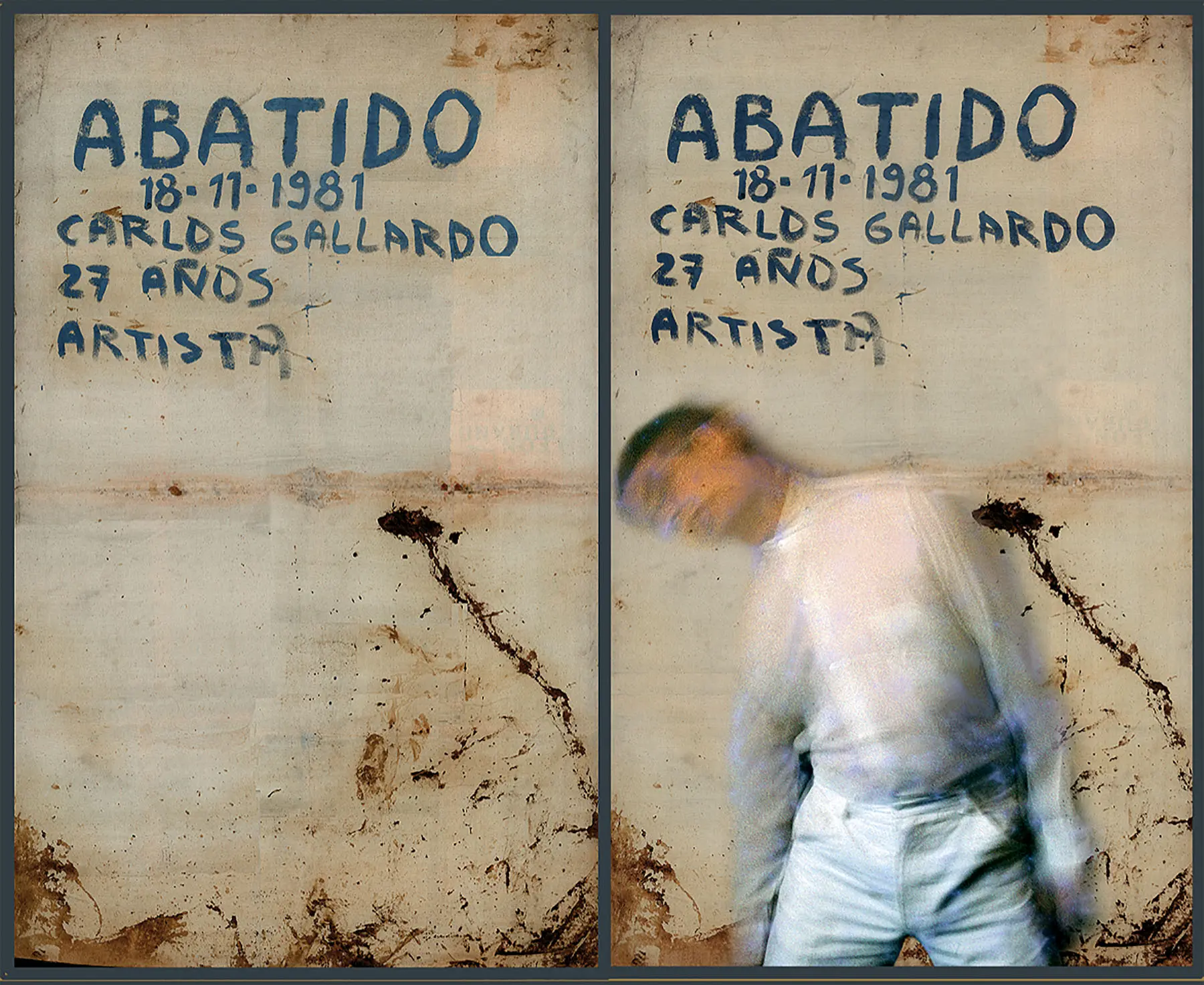
The show displayed photographs of Gallardo’s actions at the slaughterhouse and two correlated works. His diptych Abatido (Shot Down), from 1981, introduces several transferences (9). On the one hand, the blood and fluids of a dead animal are imprinted on canvas, along with a handwritten text in Spanish that reads: “Shot Down / 11.18.1981 / Carlos Gallardo / 27 years old / Artist.” The diptych’s second canvas is a digital print on paper with a double exposure of the “print” and of the artist himself, out of focus and in movement, alluding to the famous photograph by Robert Capa, The Falling Soldier (1936).
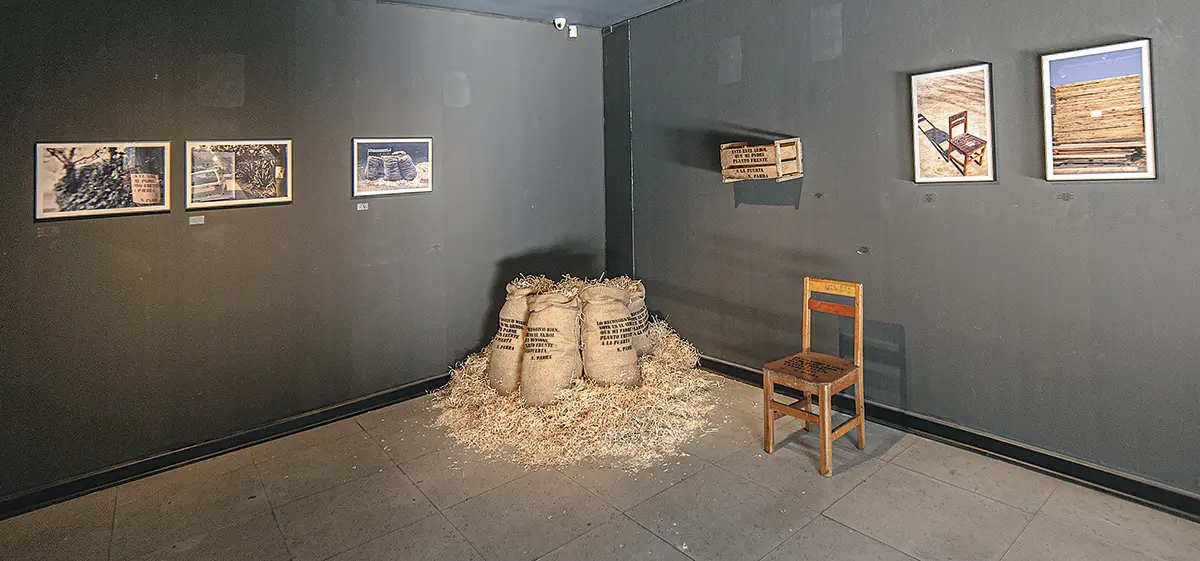
Arturo Duclos, on the other hand, refers to xylography as a working process and a productive chain: from the tree to the procedures that transform it into a raw material for construction or woodwork. This chain’s representative thread was a verse by the poet Nicanor Parra: “I recognize it well: this is the tree that my father planted in front of my door” (1981). Duclos engraved or photocopied the phrase on trees around the city, on chairs, and on sacks filled with shavings, or on pieces of paper placed on stacks of planks for sale. The photograph as processual record served as a repetitive or tautological citation of the displacement of printmaking, just as Gallardo had concluded (see note 7).
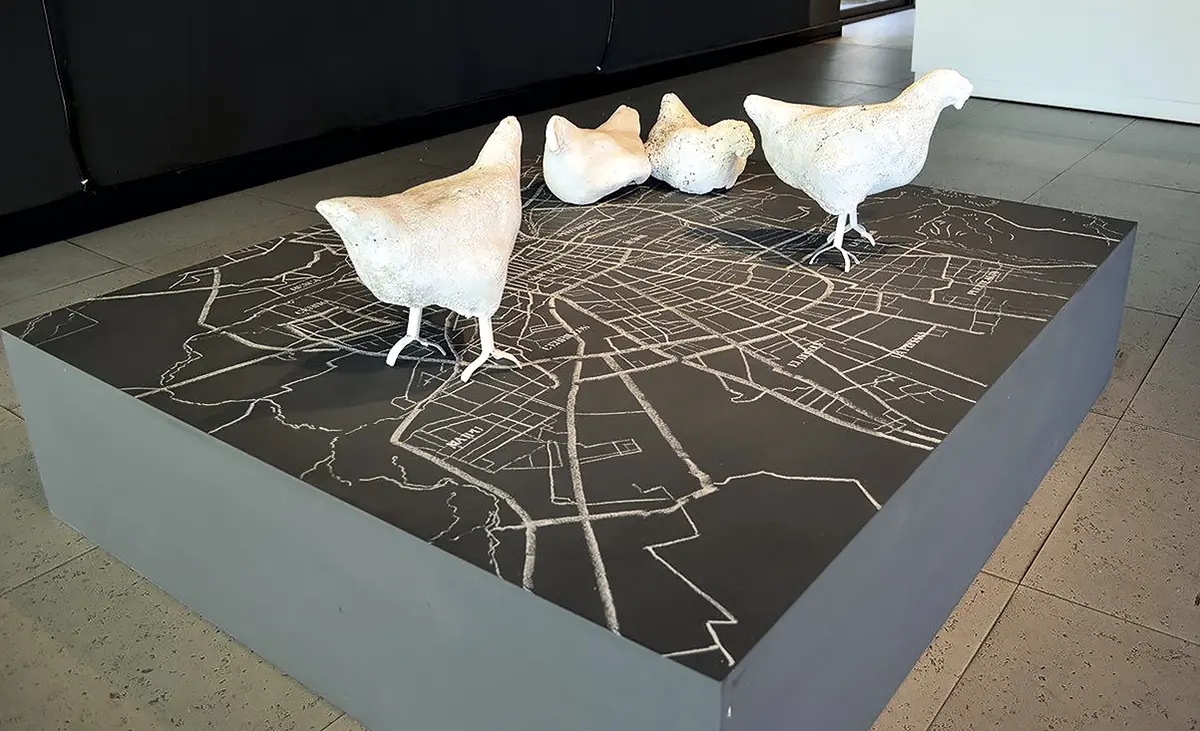
Interventions in the urban landscape had been occurring since the end of the 1970s in Chile. However, the sixty plaster chickens that Alicia Villarreal placed in public spaces in Santiago felt incongruous to passersby, since they went beyond their sculptural condition to follow the notions of matrix, copy, and edition sustained by the group’s experiments. Proyecto Traslado (Relocation Project), winner of the V Valparaíso Art Biennial in 1981, consisted of a map of Santiago, and twenty photographs plus some videos recording the actions. For the recent show, the work was presented in a reconstructed version.
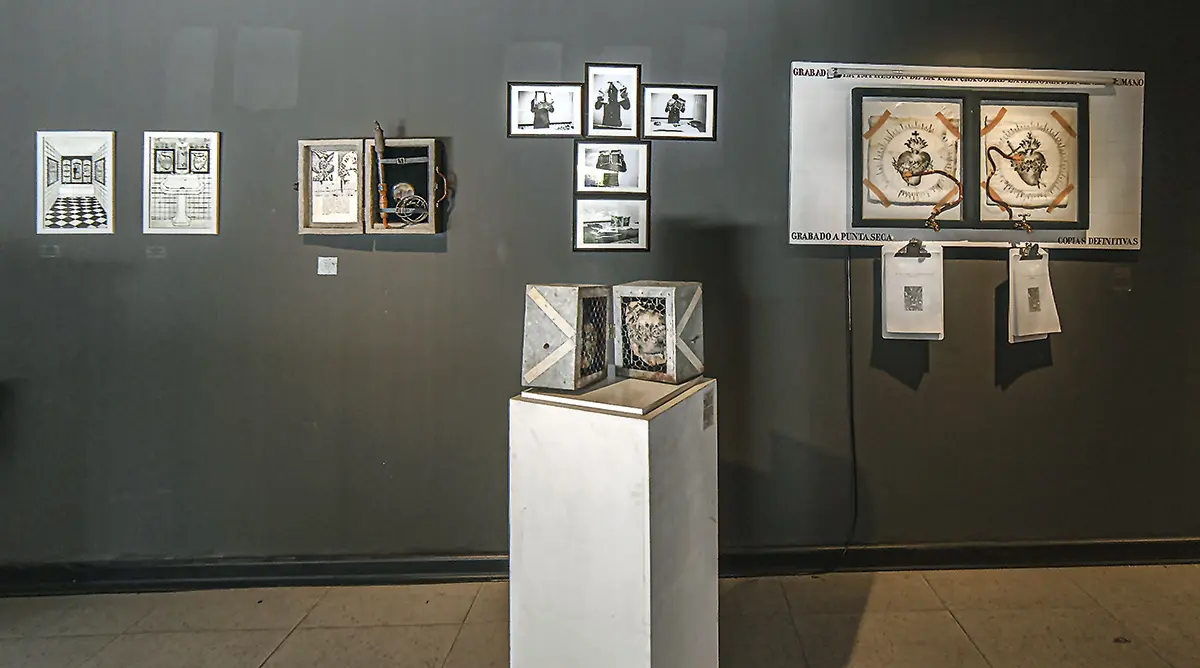
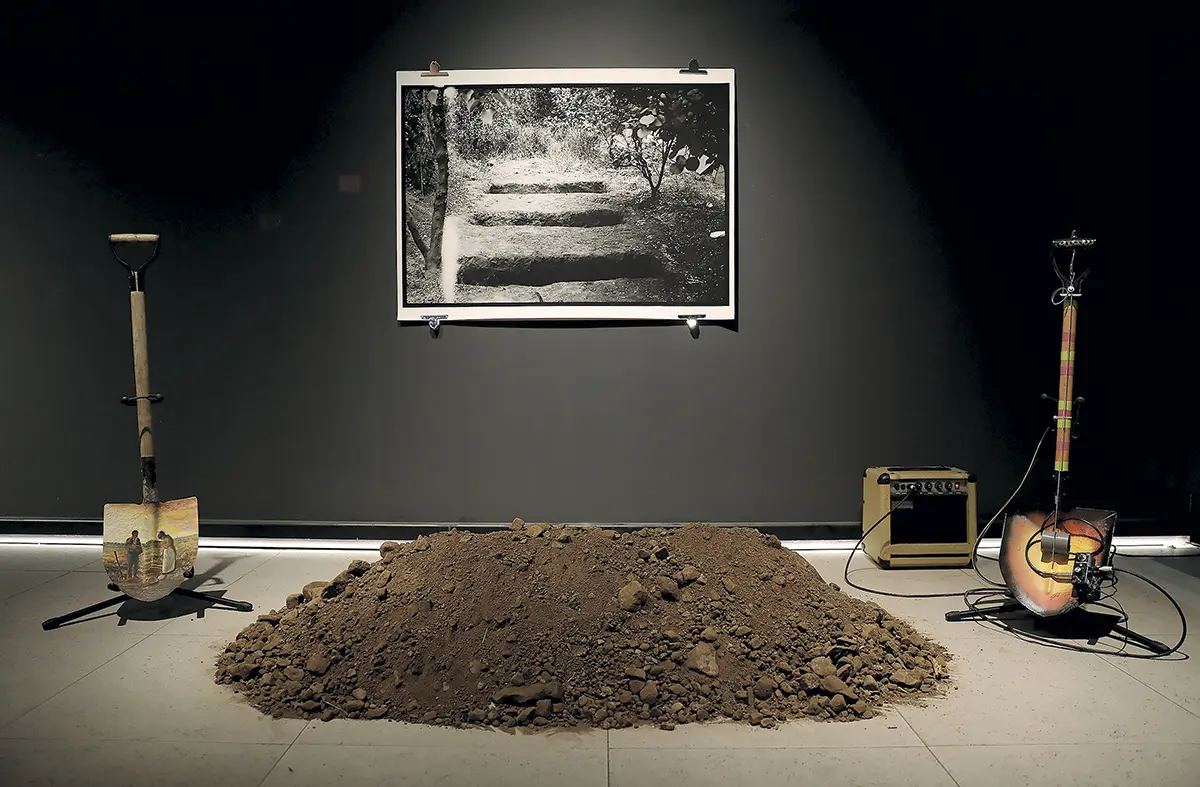
Silvio Paredes, former member of the mythical band Electrodomésticos, based much of his musical journey on the debates and readings that took place in Professor Vilches’s workshop. The photographic record of the paradigmatic hueco-grabado (hollow engraving) technique for his 1981 Tres tumbas (Three Tombs) and Seis fosas (Six Graves)—dug on the Lo Contador campus—remain as a precedent for the expansion of the very concept of “engraving.” This reversion-inversion can be considered a reflective operation on the notions of reproducibility and the social matrices of death and disappearance.
This body of work was represented in “Artistas del desplazamiento” by a mound of earth titled Tomb (1981-2022), and by the installations Angelus Shovel and Electric Shovel (1981-2022). The former points to Millet’s canonical work, The Angelus, with its hidden allusions to death. The latter garden shovel is a bass-sounding instrument connected to an amplifier. Since these reconstructions of the lost originals were presented all together, they seemed to comprise a single installation.
An accompanying panel featured a farming outfit and a photo of Electrodomésticos’ record album ¡Viva Chile! (10). Headphones made it possible to listen to songs taken from vintage radio recordings that created a soundscape. The displacement was a double one: sound reproductions, as well as the band’s production of tapes and records, which fully expanded the concepts of transference and repetition.
Mario Soro offered the most prolific selection of works, perhaps because he is one of the group’s most complex artists and because he has kept some of his original pieces, along with documentation of his performances. 600 Crosses (1981) was a controversial displacement work involving a Catholic symbol (clearly pointing to the university’s faculty). As an exercise for the workshop, Soto reproduced the figure of the cross with a cardboard and lime matrix on Lo Contador campus. The earth was “upholstered” with a repetitive pattern, like a superimposed web, which matched the confirmed number of people killed by the regime up to that point.
Undoubtedly, the procedures of photography, and later of silkscreen printing, would be crucial for the expansion towards new methods of offsetting and displacement of the image. Why is it important to question the origins of engraving’s displacement? This enquiry revolves around the genealogy of the artists and works that began to delve into the status of the image during the dictatorship and the dismantling of artistic institutions; and the “authorship” of those who articulated the change of scene from the 1970s to the 1980s, a period that would radically change the artists’ position and production processes. What is at stake, moreover, is to reconsider the thesis put forward by Richard’s Escena de Avanzada (1986)—an undisputed paradigm in Chilean historiography—by enriching it with other parallel stories, such as the displacement of engraving.
Two further questions emerge here: Is the genealogy of the concept relevant? Or is it more important to think about the displacement of engraving as a radical attitude stemming from the dislocation of a country in a state of emergency and on the violent dismantling of the social matrix? The concept of displacement in relation to art is also a way to understand social reality. For this reason, its origins and discourses are still in dispute.
NOTES
1. Mellado, Justo Pastor (1995). La novela chilena del grabado. Santiago: Editorial Economías de Guerra.
2. Sanfuentes, Francisco (2017). Grabado/poéticas y desplazamientos. Santiago: Departamento de Artes Visuales de la Facultad de Artes de la Universidad de Chile.
3. Padilla, Jorge (2022). “Artistas del desplazamiento” in Arte de desplazamientos, Santiago: Galería Artespacio.
4. It is worth noting that the relevance of the works produced at the Taller del Grabado motivated Nelly Richard to invite Gallardo, Duclos, and Soro to the II Paris Biennial in 1982.
5. Camnitzer, Luis (1969). “Texto” in New York Graphic Workshop. Caracas: Museo de Bellas Artes de Caracas. “Texto” compiles the first (1964) and second (1966) manifestos of the New York Graphic Workshop (NYGW).
6. Richard, Nelly, ed. (1987). Arte en Chile desde 1973. Escena de avanzada y sociedad. Santiago: FLACSO No 46, enero. http://www.memoriachilena.gob.cl/archivos2/pdfs/mc0015226.pdf
7. Carlos Gallardo remarks that although the concept of Free Assemblable Nonfunctional Disposable Serial Objects (FANDSO) was inspiring, “the working hypothesis suggested in Camnitzer’s text is structured around the concept of multiple as the axis of assimilation of the various categories in the system of editions; on the other hand, the displacement of engraving deconstructs and relocates the three fundamental concepts of engraving…” p. 13, op. cit.
8. Gallardo defines displacement “as the fissure through which engraving, human bodies, and the body of culture and art filter—from and towards them—syntagms that resignify their material or conceptual constitution... traveling on borrowed mechanics of production that respect the archetypes of traditional engraving, such as the transport material, the matrix, or the support. These criteria extended to art installations and site-specific interventions…”, p. 13, op. cit.
9. This work was included in the paradigmatic exhibition “Latin Americans in Paris” (1982).
10. Electrodomésticos was founded by Silvio Paredes, Carlos Cabezas, and Ernesto Medina.
*Courtesy of Artespacio
DERMIS LEÓN