Guatemala’s Darío Escobar trajectory as a conceptual artist devoted to shining a light on the patterns that weave the vernacular roots of the Americas and the various colonialisms of which they have been victim—if the term fits—or on the basis of which they have undergone their different social, political, and cultural transformations for over half a millennium, makes him into a postmodern paragon, halfway between the warrior and the superhero, in the determinations—as evident as they are uncomfortable—of the overlaps—if we can describe them in that way—between the different impositions that institute the everyday environment of this or any other Latin American metropolis as a landscape. In that way, Las palabras son de plata, el silencio de oro (Words are Silver, Silence is Gold), more than an art exhibition, is an intervention in dialog with the environment it points to and transforms—if you will—in an electric manner, in counterpoint with the various themes of the New Spain paintings on display in the second floor galleries of Mexico City’s Museo Nacional de Arte, in order to emulate on that basis the metallic metaphor of its title, which distinguishes between the qualities of what is said and what isn’t through the literal—or simulated, to a degree—use of those materials.
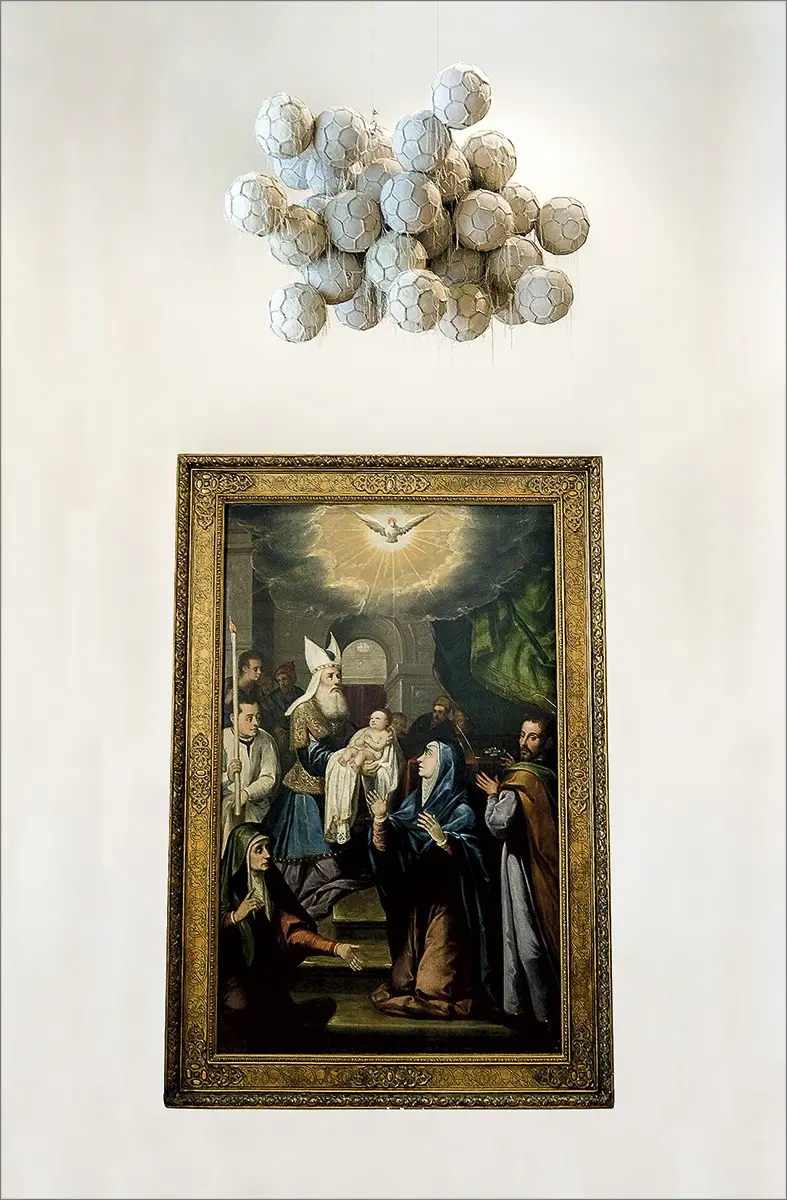
Thus, Escobar’s untitled disposable McDonald’s cup with floral arrangements from 1999 serves as a reference and bastion of syncretisms and counterpoints imposed under the laws of the market, be it colonial or postcolonial, that negotiate and transform the velocities, scarcities and whims of localisms assumed from the non-place of the transnational, confronted with the space of the Museo Nacional de Arte and the art held therein, connecting treasons and traditions that blend into one another, not only over time but in the actual space of the exhibition as such, in a clear allusion to what its title invokes, as filled with dynamism as it is filled with stillness, as full of synergy as it is full of solemnity.
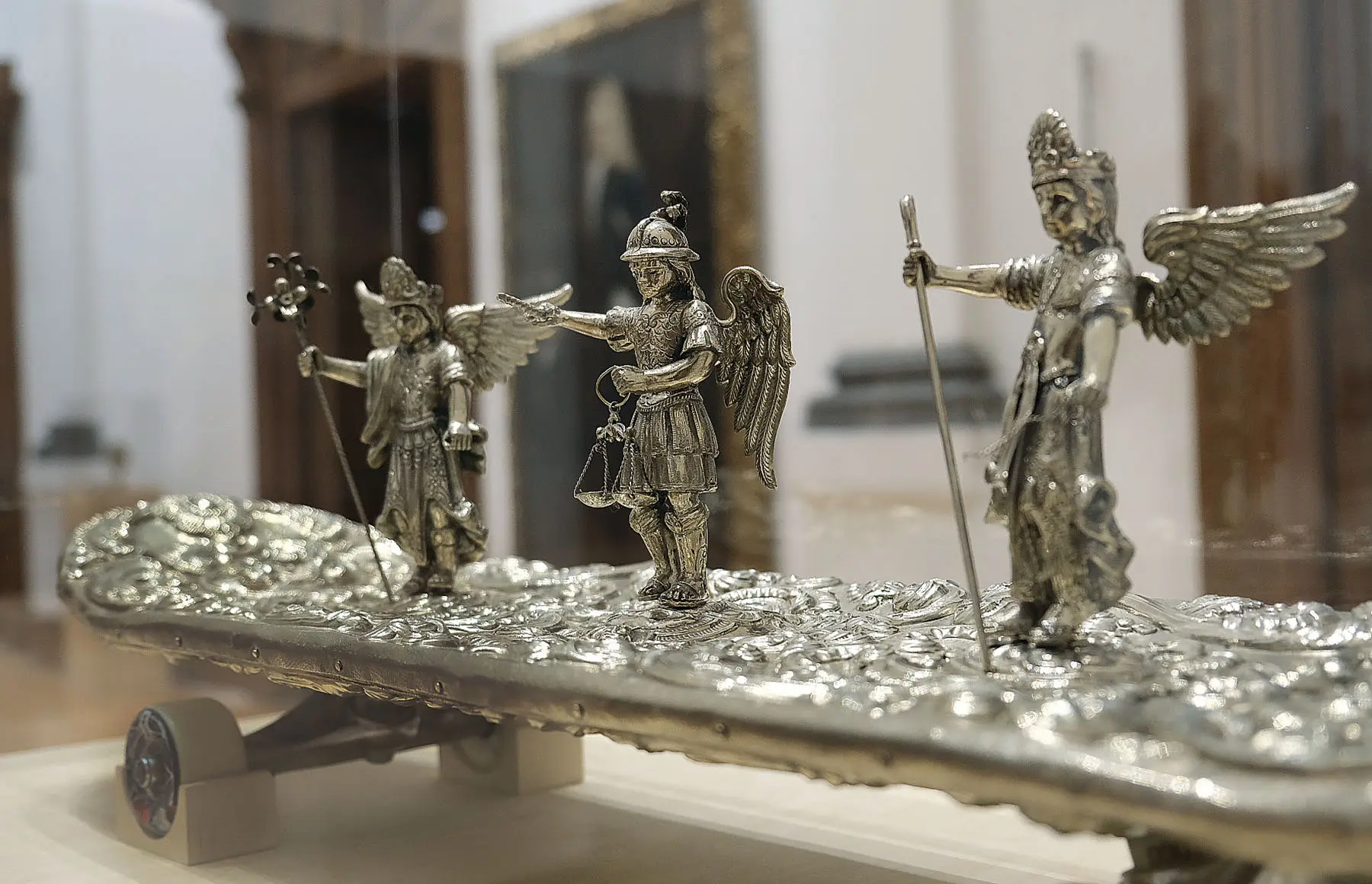
The dialog between Darío Escobar’s work and the museum’s exhibits takes us, in the temporal segment involved in its counterpoint, to the object-based, to the use of art, on one side as well as on the other, as an extension of private statuses and public nationalisms. The historical relevance of those portraits of viceroys and their families, crucifixions, nativities, and so forth, is attenuated by the golden skateboards and silver ping-pong paddles Escobar decorates with images of the sacred heart, archangels, and other religious paraphernalia, which update its pretensions and revise its forms and figures in an always paradoxical present moment, halfway between minimalistic sobriety and sociological flamboyancy. A separate pair of skateboards—otherwise devoid or ornamentation—carry the BMW company logo, which articulates them on the basis of emotions determined by the culture of consumption, in consonance with the golden color of the other boards, in an equivalence—taking into account the religious substratum—of values and prebends. In a space where the visual—and, if you will, moral—weight of these paintings predominates, both because of their size and because of their themes and treatments, Escobar’s intervention flows between provocation, imitating its unreachability by copying the exhibition cases seen in brand-name boutiques, and a formal reflection on passage and permanence—be it of that which is on display, be it of those who come to witness it—on the basis of a superposition of elements in the exhibition galleries, such as chrome plated automobile guards bent once or twice that invoke, by virtue of the context, kneelers or ships, but also ducks or fish. Using bicycle tires as a tropical forest, of soccer balls arranged to form a serpent or a constellation, disarticulating and de-sacralizing fetishes, he reduces and levels them as colonial or postcolonial signs—boxes of corn flakes half painted gold work just as well for the purpose as a soccer goal bent in such a way that it resembles a ball—in order to silence them with gold or enunciate them with silver.
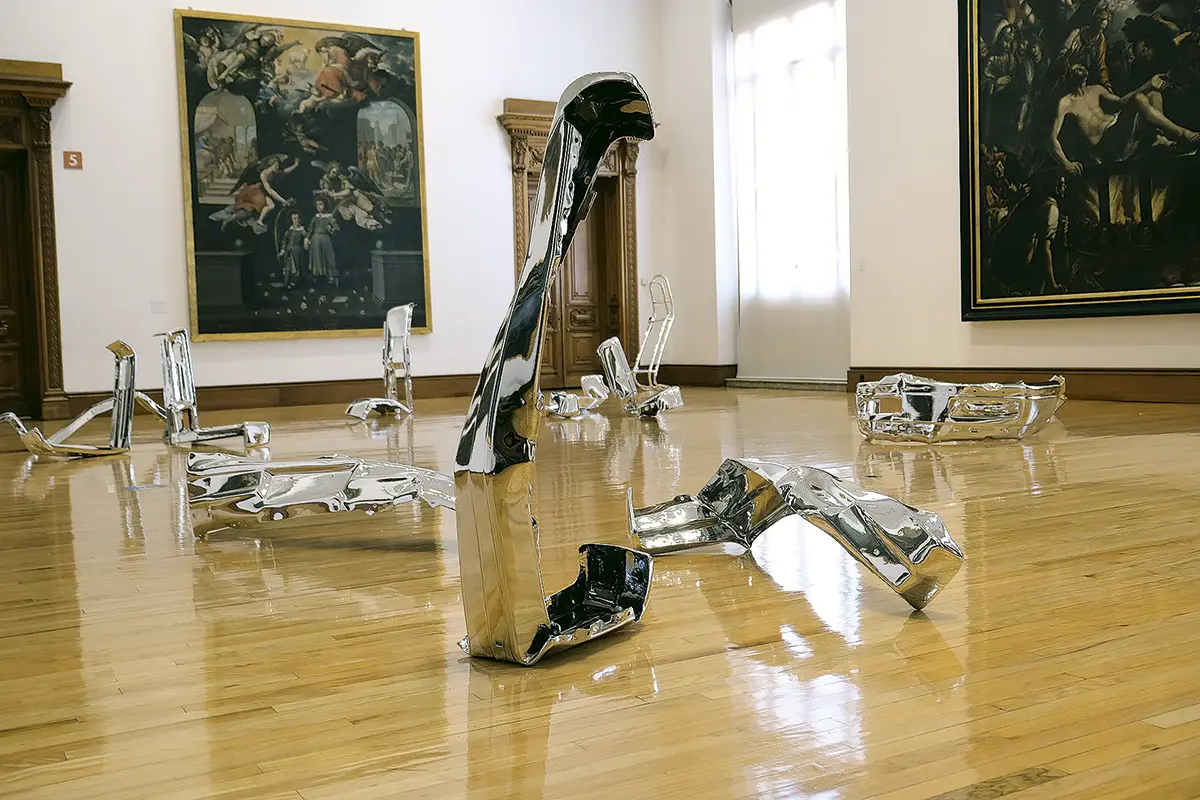
Seen in the illusion or temptation of the white cube—which reveals itself ultimately as an imprint on our perception—by defining, moving, and rendering efficient the space in which they are arranged. This usage or efficiency—similar to that of the collection of New Spain paintings that functions here as their counterpart—is enunciated on the basis of the re-utilization—or, if you will, the recycling—of waste items or elements—be it industrial or cultural waste—to be resignified midpoint—if such a thing were possible—in their struggle—if it can be so described—to say or occupy the space. Their simultaneity—in terms of their physicality and their meaning—is in the end that of a playing card: one or the other. It is in that paradox of simultaneous alternates that we discover the labeled sheets that imply—similarly—a salvage and a transit by the artist in the streets of Guatemala; on one side, we see the labels and their patinas, but on the other—the golden one—what is revealed to, or imposed on, us is the dynamic interplay of a compositional body that hides in its brilliance its ultimate nature.
RICARDO POHLENZ