Daniel Lind-Ramos (Loíza, Puerto Rico, 1953) was on the island when Hurricane María hit Puerto Rico on September 20, 2017, leaving thousands of deaths, floods, and destruction. With the water up to his chest, he went to his studio, and upon arrival, he began to conceive the series that he titled Las Marías (1). He was struck by the fact that a hurricane was named after the Virgin Mary, associated with characteristics such as kindness, love, and solidarity. On the other hand, he thought about the issue of global warming and how warm waters contribute to the strengthening of storms. He also recalled the system for heating food or chemical products known as “Mary’s bath,” a process whose invention is attributed to the Egyptian alchemist Mary of Alexandria. The coincidence seemed fascinating to him, and from there came the name of the first work (2).
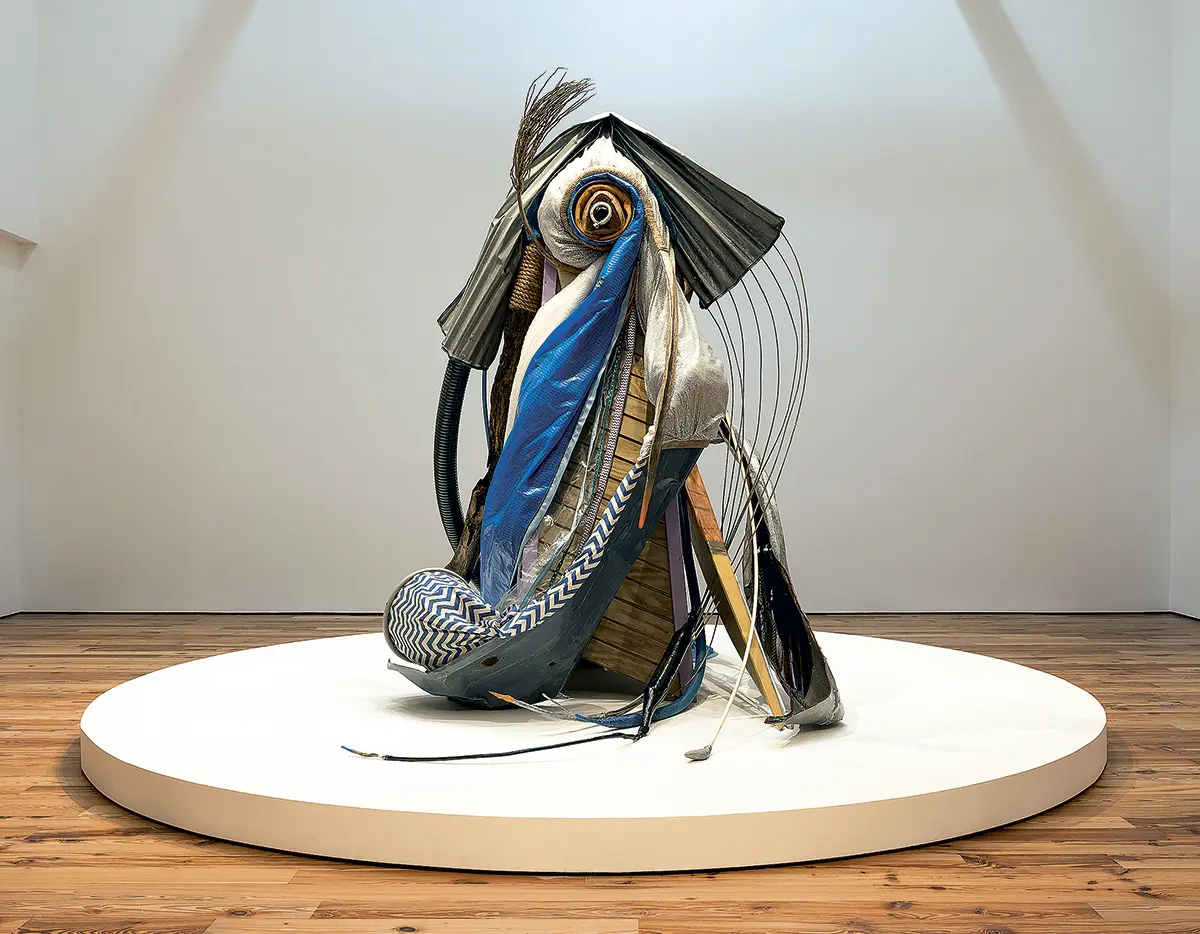
Baño de María (Mary’s Bath) is a monumental piece in which blue, associated with the cloak of the Virgin Mary and with the awnings distributed by FEMA (Federal Emergency Management Agency) to cover the roofs of houses damaged by the hurricane, predominates. Although these awnings are provided as a temporary solution, in many cases, they become permanent as the economic recovery that allows for structural fixes takes months and even years. Additionally, FEMA’s blue canopy is politically charged because of the complex political relationship between the United States and Puerto Rico. The upper part of the work recalls the crown of stars of the Virgin Mary. Each of the trapezoids is decorated with musical instruments and swirling wires that represent the sounds of thunder and the movement of winds from hurricanes in the making. As Lind-Ramos explains, “I really like working with the symbolic, with the poetic. Rhythm as a principle is very important”(3) The ribbons on each side represent lightning, and the shiny material symbolizes the falling water that causes flooding. The jute alludes to the sand on the beach, and the coconuts represent the victims, not only the more than 3,000 dead but also the victims who survived the storm (4).
The second work in the exhibition called María Guabancex,(5) refers to the island’s pre-Hispanic past. The Taínos believed that hurricanes were created by the female spirit or “cemí” called Guabancex, an entity that controlled destructive weather patterns. For the construction of this piece, Lind-Ramos used the wooden walls of a yellow house destroyed by Hurricane Maria that reminded him of the house he lived in as a child. At the top of the piece, the artist creates “the eye of the hurricane” with a series of shiny materials that recall the brightness of water and the movement of the winds in the form of a vortex. Different materials come out of it, mostly debris collected after the passage of Maria, such as palm trees, folded zinc tiles, and wires that the artist connects with memories of his childhood and with the present. Cables and branches collected after the storm surround the piece giving it great dynamism. Under the structure is footwear that symbolizes the victims and a portable bed that refers to refugee centers, common in areas affected by natural disasters.
According to Lind-Ramos, the third assemblage, María de los Sustentos (Mary of the Sustenance), symbolizes the solidarity of Puerto Ricans. Despite living without electricity or drinking water, in some cases for several months, the inhabitants used their ancestral knowledge and carried out basic activities such as fishing and cooking with firewood. For this reason, kitchen implements such as pans, spoons, and other metal objects are part of the work. In the center of the piece, he places a fishing net that refers to the fact that “before FEMA’s aid arrived, in Puerto Rico, we helped each other.” The coconuts located in the lower part of the composition represent the victims. The varnish with which they are covered symbolizes the brightness of the water and refers to the artisan tradition, particularly to the cabinetmaking work carried out by his uncles. In this work and the other two pieces in the exhibition, the objects’ selection and composition have a significant symbolic meaning that conveys the experience of surviving a natural disaster.
Each of the assemblages has a unique appearance and meaning but is bound together by shared memories and experiences. Through them and the other works that make up the Marías series, Lind-Ramos extols Puerto Rico’s capacity for recovery and the resilience of its inhabitants, who, throughout history, have endured colonialism, the eradication of their native culture, and multiple natural catastrophes.
NOTES
1. Daniel Lind-Ramos, conversation with the author, August 19, 2022.
2. Ibid.
3. Ibid.
4. Ibid.
5. The second work of the series, María-María (2019), was presented at the Whitney Biennial in 2019. It is not part of this exhibition.
FRANCINE BIRBRAGHER-ROZENCWAIG, PHD