In the isolation forced by the Covid-19 pandemic, we were all exposed to an experience of time that was radically different from what we had known before. With the blurring of the usual boundaries between work, rest and leisure periods, the passage of the hours escaped its prior parameters: some days seemed truly endless, while others went by dizzyingly fast. On top of this, the generalized uncertainty about the future brought out a new sense of urgency in many people. For many artists, this newfound urgency to produce was the catalyst for experiments with new techniques, as months passed without access to a number of materials, and ideas could only be materialized using what was at hand. Thus, drawing, painting, and small formats became the most viable languages of expression for a large segment of the artistic class.
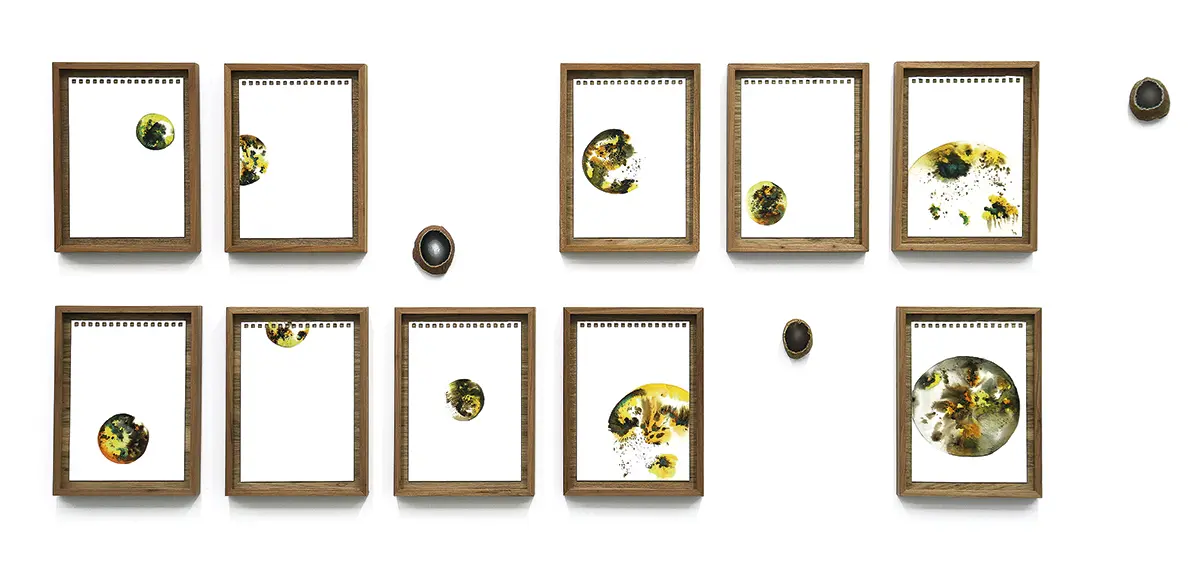
Things were no different for Chiara Banfi. What she had at her disposal was paper, ink, and watercolors. In a way, Banfi seems to have explored the dilution of colors as an operation analogous to the dilution of time that she, like all of us, was experiencing. Therein emerges the title of her solo exhibition, Tempo (Time), which is dominated by memory, rhythm, and inquiries into the natural, even planetary realm. Along with watercolors, in almost all of these works Banfi used potassium permanganate, a disinfectant with medical applications that brings into play, with its blood-like coloration, the tensions between illness and cure, death and life. Except for an intervention on the gallery back wall, Convoluted universe (2022), where sneaking lines coming from all directions converge towards an egg-like agate rock, the works on exhibit have an intimist tone and the organic shapes tend towards circles and ellipses, in consonance with the orbits of celestial bodies. Both these choices point towards a circular conception of time (something alien to Western thought), one where beginnings and ends are seen to alternate and our perception expands with each new cycle, which never exactly repeats a previous one. Moons, planets and orbits undergo transformations in a timeframe that is, compared to our, infinitely more expanded.
The presence of agate segments brings the cosmos back to Earth. A material formed in the innards of our planet, agate replicates the mixtures of blotches explored by the artist in the circles that punctuate the surface of her works, floating against white grounds. Clara Banfi’s inclusion of mineral materials in her art is nothing new; she has used tourmaline, obsidian, and even agate before. Here, however, the rocks retain a degree of autonomy, being situated outside the boundaries of the frame. Arranged in groups of like colors, they dialog and establish connections with the painted spheres, like constellations. There a suggestion of motion in time and space, with some shapes seeming to represent different positions of the same body. This dynamism is reinforced by the titles of the works, such as Calendário de fevereiro de 2020 (February 2020 Calendar, 2020-2022), 5 luas de Pluto (5 Moons of Pluto, 2022) or Amarelo da série luas cheias (Yellow of the Full Moon Series, 2022).
Throughout her career, Chiara Banfi’s visual investigation has aligned with music in a broad sense, from the recording industry to instrument-manufacturing techniques, and to sound itself. This aspect of her work reappears more than once in Tempo. Segmenting time is key to the creation of music, as are pauses (or silences); the difference between pausing in music and “pausing” in a pandemic is that the latter resulted from an emergency and was driven by trepidation at the imminent risk of death. Music is an inspired decision, a creation motivated by a life-affirming drive. Banfi’s Elza, Aquarelas do Brasil (Elza, Watercolors of Brazil, 2022) is an installation with vinyl disks made from discarded LP records, colored and melted together, and reshaped in compositions emulating the technique that dominates the entire exhibition. The installation is completed by a rare recording of singer Elza Soares performing an a cappella version of “Aquarela do Brasil”, composer Ary Barroso’s emblematic and controversial song. Ultimately, Banfi’s work functions as a final tribute to the singer, who passed away a day after the series was completed.
SYLVIA WERNECK