The title and the subject of Ani Villanueva’s most recent exhibition, presented at El Castillete, a space helmed by the curatorial duo of Verónica Liprandi and Patricia Morales, who operate under the figure of Factotum CCS, is Recuerdos del agua (Remembrances of Water). The site’s architecture and lighting played a leading role not only with regard to how the works on display were to be visualized, but also as a stage for the artist’s opening performance.
The central axis on which the show turned was water and the various ways to express it. As is known, nature and organic forms are ever-present in Ani Villanueva’s oeuvre. On earlier occasions, she has suggested air, wind, even sighs, as well as animals, for instance with her jellyfishes and spiders, among other species. All of this developed in a variety of expressive media, assemblage in particular. Villanueva’s ecological concerns were at the forefront in all those artworks, and the exhibition under review is no exception.
The ecological issue becomes doubly acute in the specific case of water—and Villanueva is intent on making it so—due to its dire scarcity in Venezuela, where the majority of the population lacks proper access to this resource, and due also to the danger posed by extensive contamination. Among the causes of the latter is the misuse of plastics. Villanueva, in fact, reuses this contaminating material, recycling and assembling it to represent water in various ways. In this, she is successful. One of her virtues is the ability to express the formlessness of water using solid, tangible materials. Through the transparency of the plastic containers, the flexibility and malleability of the equally translucent hoses, and the way in which Villanueva inserts, ties, or aggregates plastic ribbons, water is perceived as a real presence. This is made possible not only by Villanueva’s assemblages or sculptures, but also by her digital photographs, paintings, and videos. She has represented water in “(plastic) containers”, in showers, as bursts, dripping, or falling in droplets. Also, colored in a deep ocean blue. All of this using bathroom or plumbing objects, containers, or photographs encased in transparent plastic. This is, then, object art—because it uses objects and industrial materials—that formulates, in a very concrete manner, a project that is nevertheless forcefully informalist and conceptual at bottom.
Ani Villanueva’s ecological concerns have been consistent throughout her career. She infuses them in a variety of media. Although she is a painter, sculptor, and digital photographer, on this occasion we must also emphasize her installations and videos, as well as her opening performance, which underscored her experience as one of genre’s most important practitioners in the region. Recuerdos acuáticos (Aquatic Memories) is the title of one of the exhibition’s standout—and central—installations. It comprises 67 plastic-covered photographs denoting the transparency and glimmer of water. As the curators point out in their catalog essay, “these photographs highlight the fact of water as the dominant element in our planet, with an agency more powerful than our will.”
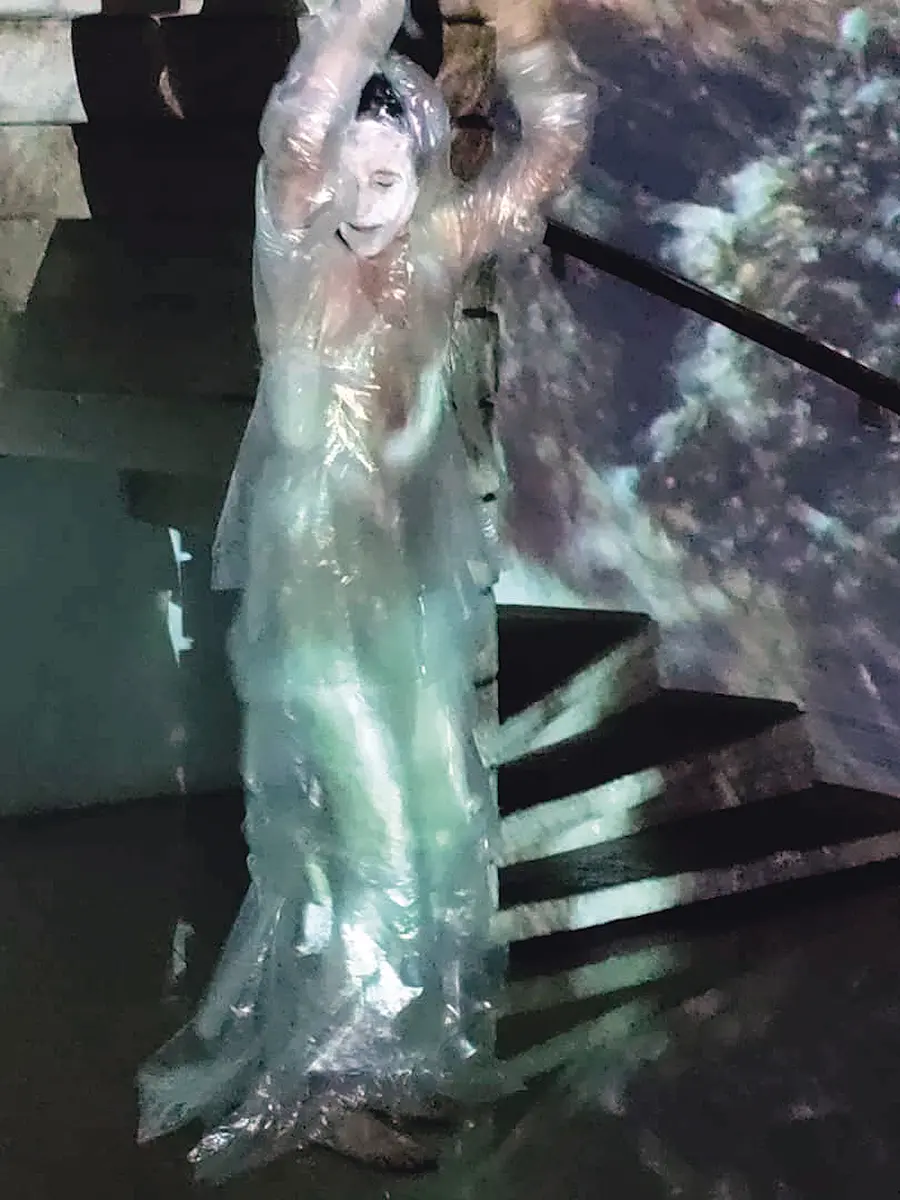
The videos Orilla (Shore) and Río (River), presented during the performance (which was titled, like the exhibition, Recuerdos del agua), must also be considered. In the execution of this performance there was an interesting integration of body in motion, space, light, and the architectural form, along with a projection of sound-backed images of water in a continuous flow. Ani Villanueva descended—and ascended—a concrete spiral staircase, her body, wrapped in a white plastic garment, swaying as the water moved. In that moment, she was water.
Seeing the performance in that context and in consonance with the exhibition’s conceptual axis, puts one in mind not only of the subtle and luminous way in which Villanueva expresses the elusive character of water, but also how this specific performance reflects nature’s ever-shifting condition. Several elements were at play: the helicoidal shape of the staircase; Villanueva’s sinuous bodily motions in her ascent and descent; the images of water and light projected in the video, coupled as a unit. We know that the body is the essence of any performance, but in this case, its motion and transformation activate more intensely water’s formless condition, at once powerful and fragile. This is, in short, a deeply human, sensible and encouraging proposal about what awaits our planet if the contamination of water, our carelessness, and our misguided policies continue without abatement.
SUSANA BENKO