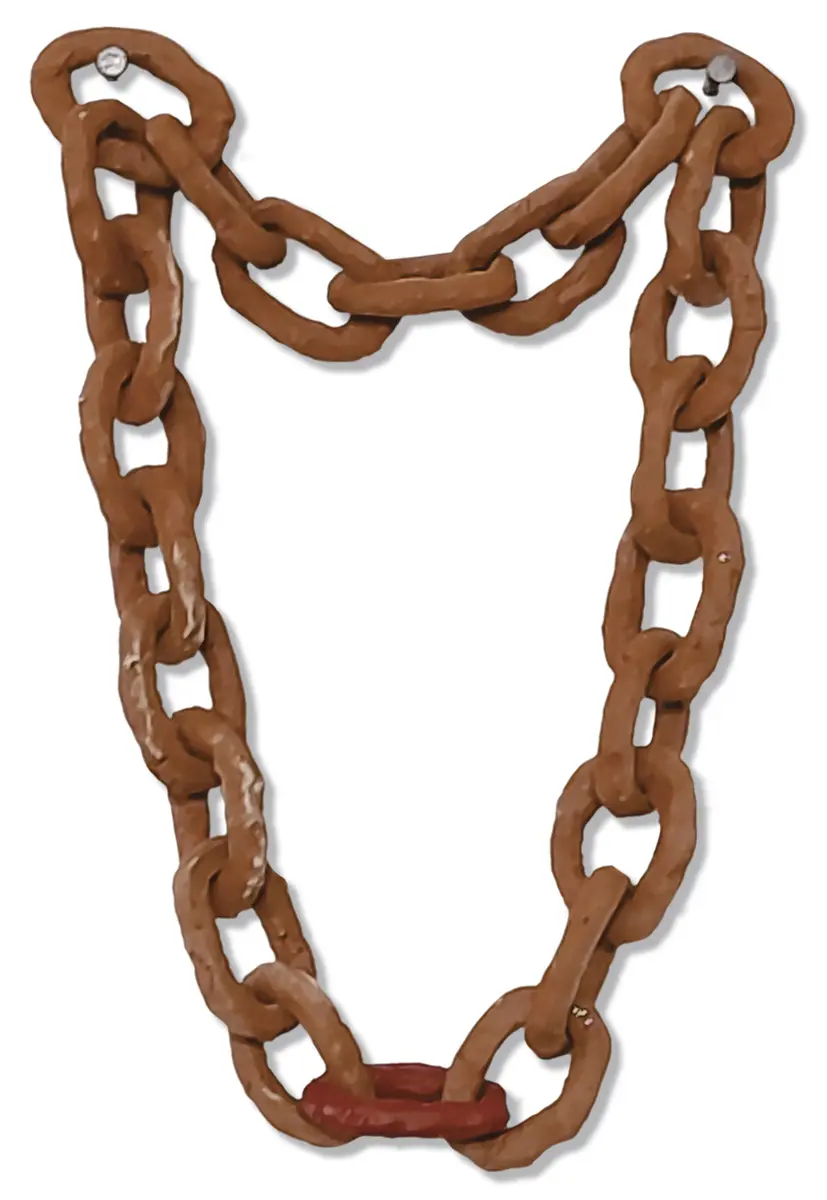
Tekoa is the place of the Guarani way of being (tekó), understood as a set of precepts for life. It derives from the cosmological rules inherited by the ancient Guarani, an indigenous nation that inhabits areas of present-day Brazil, Paraguay, Bolivia, and Argentina. Surprising to many, today in Brazil, around 51,000 Guarani are living in seven states, making them the country’s most numerous indigenous nation. Andrey Gûaîaná Zignnatto is an artist, teacher and activist. He is a descendant on his mother’s side of the Guarani Mby’a people, and on his father’s side, of the Tupinaky’ia Gûaîaná, an indigenous ethnic group whose ancestral universe has been completely wiped out and who once inhabited the territories currently known as São Paulo. Zignnatto lives in an indigenous community in São Paolo with the Guarani who have been guiding him on a personal journey to reclaim his identity as a Native Brazilian aba (man) through art and understanding. Tekoa is the link that inspires his work, represented in Tekoa (Red as Ember), 2022, a terracotta chain created from the clay of the indigenous community Tekoa Itakupé, São Paulo, Brazil. The chain is both strong and fragile as is his inheritance and the future of his community. The ring used to close this circle is painted with urucum mixed with earth. The diversity of his media, ranging from works on paper to objects woven with the industrial materials familiar to him from working with his grandfather laying bricks when he was a teenager. His use of other ordinary materials, such as cement bags, focuses on a facility for working with his hands to construct large installations and other projects that serve in a process of reconstruction and reclamation.(1)
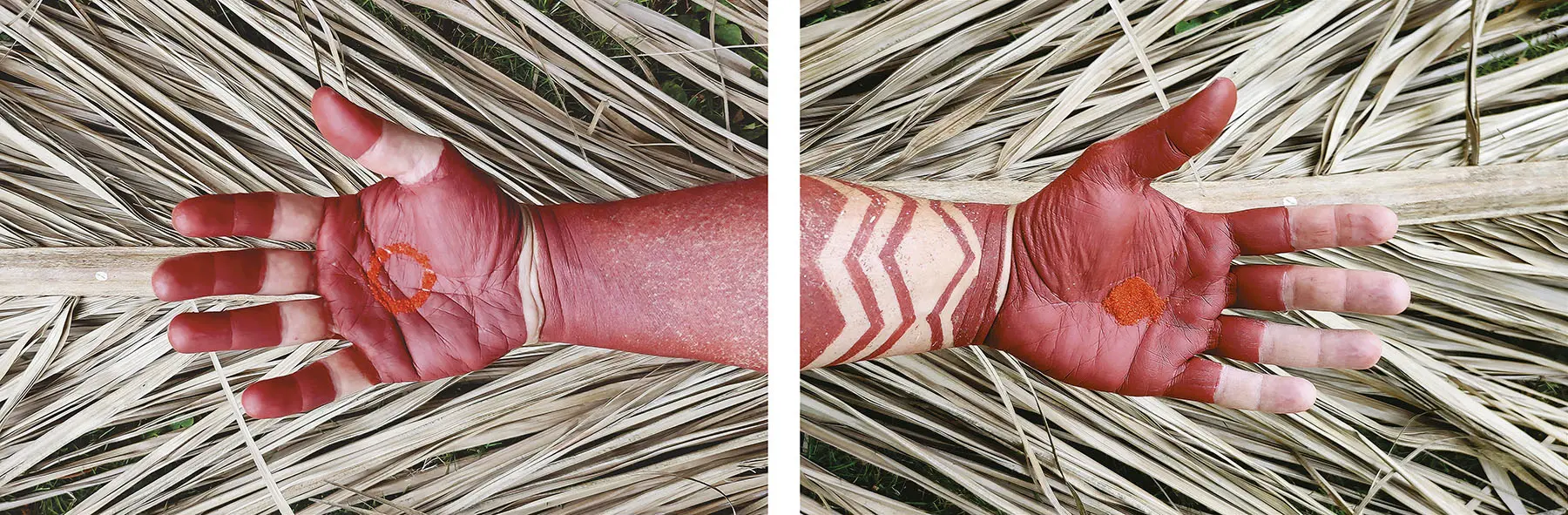
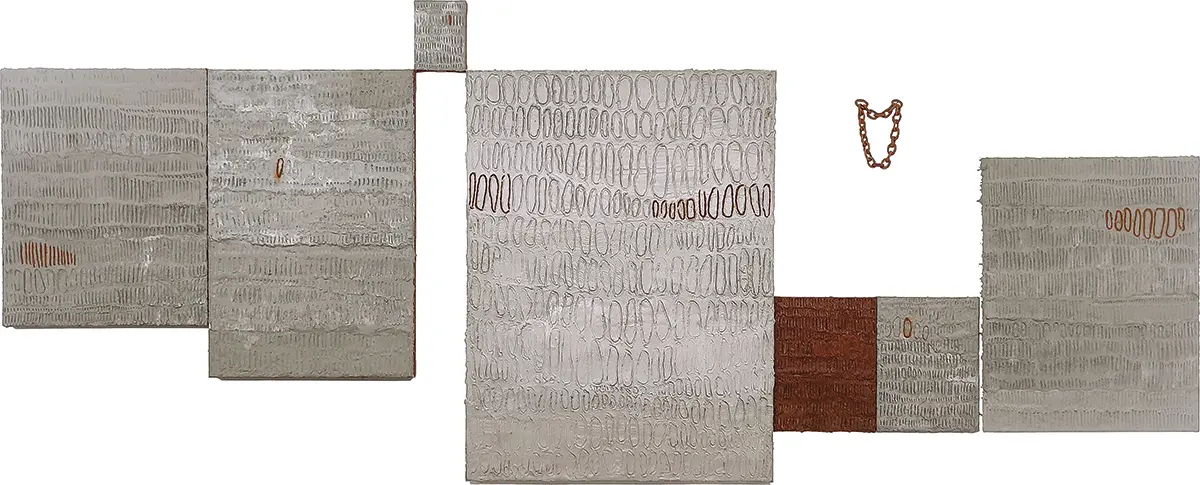
The red urucum color on his arms and in the images of his painted hands marks the gateway to view his work and serves as an embrace, becoming instruments of protection and creativity. In Andejara Tenderovosa, 2022, the hands and arms of the artist are the sources of the creative process, the guardians of the images within. As with all the natural colors and materials made from plants in his work, red – urucum - is from the Bixa Orellana plant. Known by its original Tupi name uruku, urucu, or urucum (red color), the covering of its seeds emits a red dye that is used for body paint. Zignnatto’s work is often monochromatic: browns, greys, and earth tones reflect his dedication to nature. The interruption on many surfaces of red markings further elevates the significance of the dye and the work itself within a ritual context. The presence of the hands on either side of the work To Paint the Sky with Red Urucum #01, 2022, a work in progress of 7 cement panels of varying sizes, protects the installation in a spiritual embrace. The grey surface of cement becomes a canvas to demarcate indigenous territory marked with signs of the body, spirit, and mind. Red urucum markings perform like visual noises of modernity interrupting the quiet of a meditative ritual. He describes this work as “a poetic answer to the questions of the indigenous philosophers David Kopenawa and Ailton Krenak who speak about the process of destruction of indigenous peoples and the erasures of their ancestral universes, resulting in an identity crisis. It is that same identity crisis that has affected my work and at the same time inspired my activism. It is a way to say that we can be stronger when we know who we are, and what is really important to us. Each ‘no painting’ can be a single work, or altogether can also be a single work. I share the decision with the curators, collectors, art institutions, and everybody who will be part of this process. Each canvas is in a vertical position. Together they are a large horizontal.”(2) It can be enlarged and enhanced with new additions and installations that will place all the artworks in the corner between the ground and the wall, matching a human’s size.
In 2021-2022, two exhibitions were held in museums that were built atop the same locations as the Inhampuanbaçu villages of his father’s ancestors, before the founding of the colonial city of São Paulo de Piratininga. Combining the gestures, building methods, and rituals of the indigenous peoples with those of the masons and workers who fabricated the new houses and cities of today, he constructed his own Tekoa as a physical, mental, and spiritual territory and a means of demarcating Native Brazilian land for a unique aesthetic and interactive experience. In the exhibition CO YBY ORE RETAMA, Tupi-Guarani for “This Earth is Our Land,” at the Museum of the City of São Paulo, he brought back the Tibiriça, an indigenous leader, to the original home of his family, his Tekoa. It was also the first project in the history of Brazilian visual arts institutions to present texts translated into an indigenous language.(3) In his search for ancestral memories as the foundation for his work, he continues to create art that is both genuine in essence and contemporary in presentation. Such artistic discourse derived from an Amerindian background is unique among his people. The cultural destruction imposed by colonial and national powers over many years precludes a positive message from the Guarani that this artist addresses with an exclusive and honest perspective, as an insider, not an outsider. Although the definitions and descriptions assigned to his people, and other indigenous groups, are often negated, his people do exist today. They are not extinct or hidden in the jungles of the Amazon. He says his village is built on affective and spiritual bonds, not the social contracts of urban society. The production of his work functions the same way – with spiritual connections informing every material and process. The new approach to reclaiming his identity and ancestry now involves going beyond the merely symbolic to express a sense of belonging in the field of images, narratives, and memories that create a place of life and spirituality.(4)
Most recently, Zignnatto has been at the Fountainhead Residency in Miami, where he was able to experience a new environment, outside of Brazil, and a diverse community of artists in this vibrant city. Although he brought many materials, including earth and pigments, with him in the process of integration with the local surroundings, he was also able to continue and complete a group of projects that were contemplated in Brazil as part of a constant reflection on his role as an indigenous artist – in and away from his homeland. The significance of a residency is that it allows the artist to step back and look beyond his/her immediate situation to a different setting marked with, hopefully, an inspirational type of activity. At the same time, a residency is an opportunity to educate a new and different audience, and the artist plays a unique role, especially in the case of Zignnatto, who is addressing issues often misunderstood about the indigenous peoples and the colonial histories that have wrongly described their very existence. While he creates art to establish connections with his people, he is also using a personal narrative to affect and correct colonial misconceptions, and present-day misconceptions as well. The role of an indigenous artist is complex and when disrupted by socio-political constructs that can be a determining factor in inclusion, must take on new responsibilities to establish identity with true spiritual meaning.
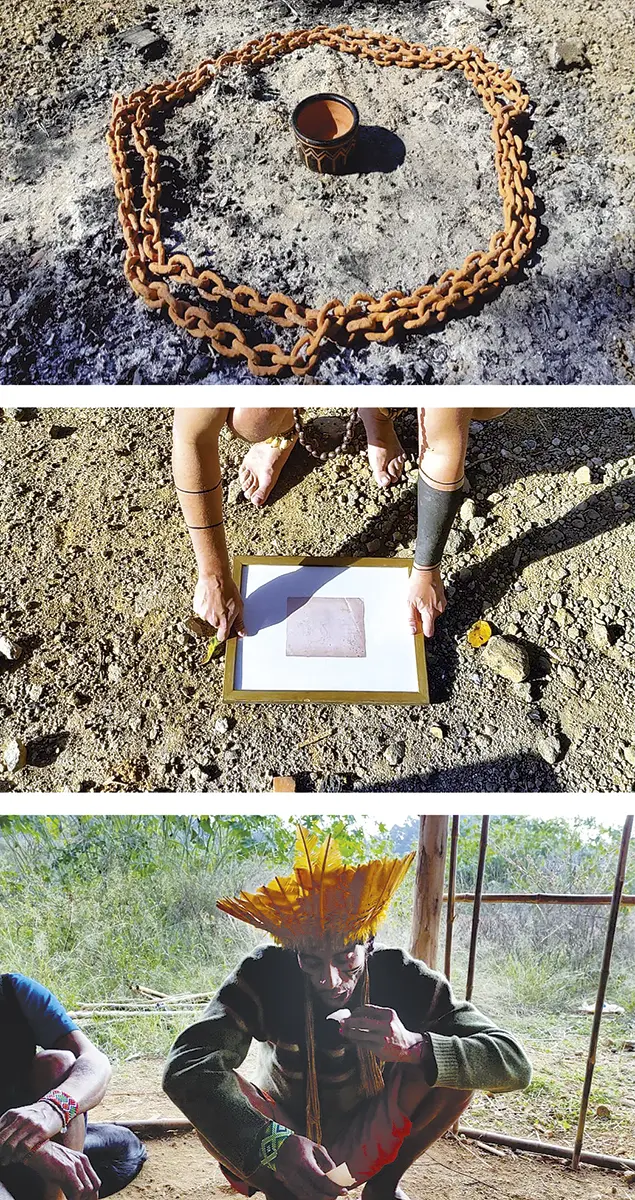
Astutely aware of how the ideas of Brazilian modernity were constructed, through a process of kidnapping indigenous cultures, while leaving them out of the narrative, he cites the famous Anthropophagi Movement developed by the writer Oswald de Andrade and the painter Tarsila do Amaral in the 1920s(5) and illustrated with a drawing by Tarsila do Amaral of a naked figure with an enormous foot, cactus, and sun, identical to that of her painting Abaporu, 1928. She found the source of her title in a dictionary of the Tupi-Guarani language: Aba meaning man, poru, who eats. Zignnatto questions the legitimacy of the Manifesto and the artists who claim to create a new version of Modernity as uniquely Brazilian, without indigenous participation. In his series, Abaporu, 2020, he challenges the fame of their work, first with an artistic ritual made in the indigenous community Tekoa Itakupé of the ethnic group Guarani M’bya by eating an original drawing made by Tarsila do Amaral and a page from an original edition of Revista de Antropofagia by Oswald de Andrade. With its remains, he made handmade paper and painted it with jenipapo(6) juice mixed with coal. This work began a process of reviewing Brazilian visual art history by tearing the pages out of a group of books on Brazilian history, written by the colonizers with misinformation. After removing the pages, he creates his revisionist narrative by turning them into a pulp and dying each with the natural colors of his land: Red (urucum) for the Portuguese book; blue (Mexican clay) for the Latin American book); brown (land of the city where Cortez arrived for the Spanish book); brown (earth from the Seminole territory); Black (coal) for the British book; Black (jenipapo and coal) for the Brazilian book. “In Brazil, indigenous groups never used letters to share information. We have an oral culture and other ways to communicate, like paintings, music, etc. The handmade papers were made with only the pages that talk about the American colonization process. So, this project is my way to talk about our history and take it back.”(7)
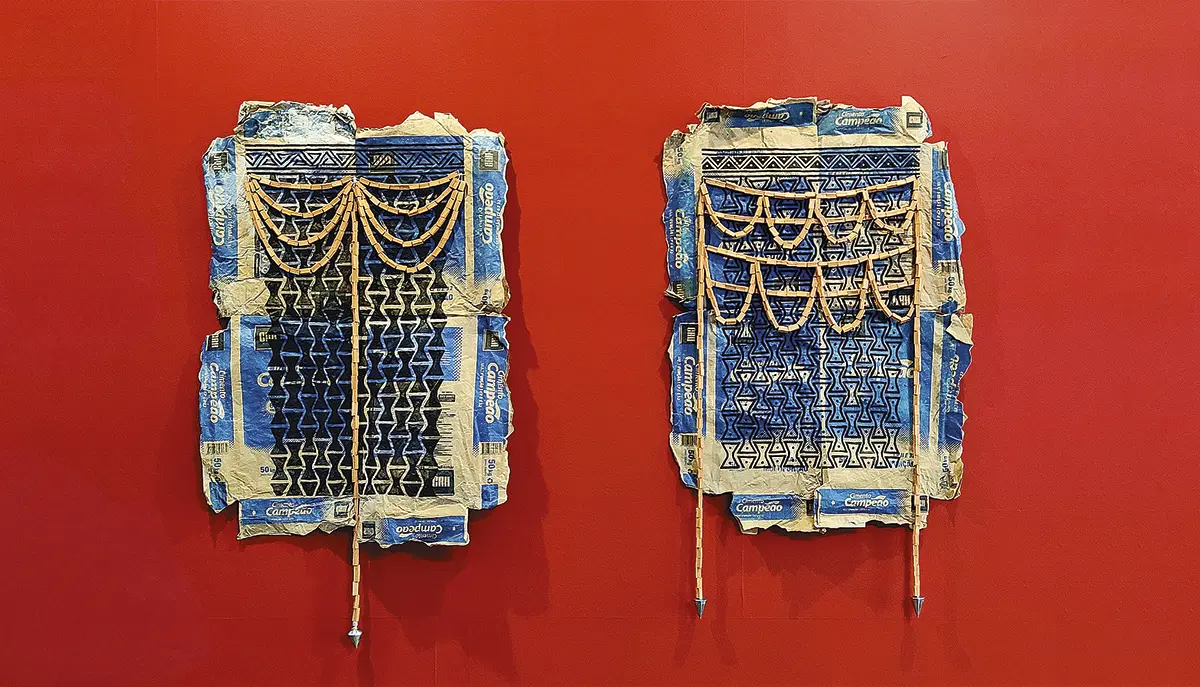
Each work created by Zignnatto is informed by, or a part of, a ritual that elevates his processes above the merely technical virtuosity they immediately present. Although everything began with bricks and construction materials, it soon became evident that a syncretic approach linked the European/Christian with the indigenous, just as his Tekoa Chain is a tangible link to the past and the present. Painted on cement bags, their factory names becoming a significant element in each composition, the works titled Mestiçagem (Mestization), #07 e #08, 2021, and Over the Skin, #1, 2020, combine European and indigenous designs. Hand-made clay objects in the form of carved cement chains dyed with jenipapo and draped like a Baroque necklace are hung with a brass object (fulcrum) used by bricklayers to balance the walls under construction. In describing the works in this series, Zignnatto says: “Mestiçagem is what we call the process of mixing people from different ethnic groups. I lived all my life in a modern city, a western society. I worked as a bricklayer. But at the same time, I am the son of two different indigenous nations. I am a mixing of different people from different places, different universes, cultures… I can´t deny one to the other one. And the arts help me find a way to balance these different universes inside me.”(8)
NOTES
1. Author’s Interview with the artist in Miami, August 25, 2022.
2. Artist’s Interview with Sandra Ara Rete Benites, “Rehabit, Reorder with Possible Resumption” and Curator’s statement, Exhibition: CO YBY ORE RETAMA (Essa Terra e o Nosso Lugar), Museum of the City of Sao Paolo, 2021. https://relievecontemporaneo.com/entre-vista-andrey-guaiana-zignnatto/
3. Author’s Interview with the artist in Miami, August 25, 2022 and Curator’s statement: https://relievecontemporaneo.com/entre-vista-andrey-guaiana-zignnatto/
4. Ibid.
5. Ibid.
The Anthropophagite Manifesto by Oswald de Andrade, 1928, “exhorts us to devour our colonizer…in order to appropriate his virtues and powers and transform the taboo into a totem.” Revista de Antropofagia (Sao Paolo), no.1., May 1928.
6. Jenipapo (Genipa Americana) is a fruit found in large parts of Brazilian territory and is native to the Amazon and Atlantic Forest. Some indigenous people use the fruit to paint their skin, as both fruit and bark contain a substance called genipin, which has a dark purple or blue color and turns black when it comes into contact with air. This is why in Tupi-Guarani jenipapo means “fruit that stains.” Legend has it that warriors paint their skin to win in battle.
7. https://relievecontemporaneo.com/entre-vista-andrey-guaiana-zignnatto. Performance in the indigenous community Tekoa Itakupé, São Paulo, Brazil, 2020. Exhibition: CO YBY ORE RETAMA (Essa Terra e o Nosso Lugar), Museum of the City of Sao Paolo, 2021.
8. Author’s interview with the artist, August 2022.
* Photo: Courtesy of the artist.
CAROL DAMIAN
PH.D. Art Historian