
São Paulo Museum of Art (MASP) presented, from April to July of this year, the exhibition “Volpi: Between the Modern and the Popular,” organized by chief curator Tomás Toledo.
This solo show is part of the museum’s program that focuses on Brazilian modernist artists whose works address the grassroots dimensions of culture. The exhibition featured 96 works centered precisely on Volpi’s interest in popular culture.
Alfredo Volpi was Italian by birth (Lucca, Italy, 1896 – São Paulo, Brazil, 1988). His family, of humble origins, emigrated to Brazil and settled in São Paulo, a city that at the end of the 19th century began to welcome immigrants from different countries, including large numbers of Italians.
Volpi began as a self-taught painter in 1911. Later, he attended the Liceo de Artes e Oficios de São Paulo, a vocational school. With this training, he began to work as a “painter-decorator,” painting friezes and murals for homes of upper-class families. Once his aesthetic drive emerged, the artist began to produce his first canvases: compositions that were still attached to the realistic tradition.
Only after he approached the so-called “second generation of modern artists” that emerged in the 1930s did Volpi become interested in research that sought to construct a modern language. He frequented the Santa Helena Group, created in 1935-1937. With that group he practiced drawing from living models and participated in wanderings through the city’s outskirts to paint landscapes au naturel.
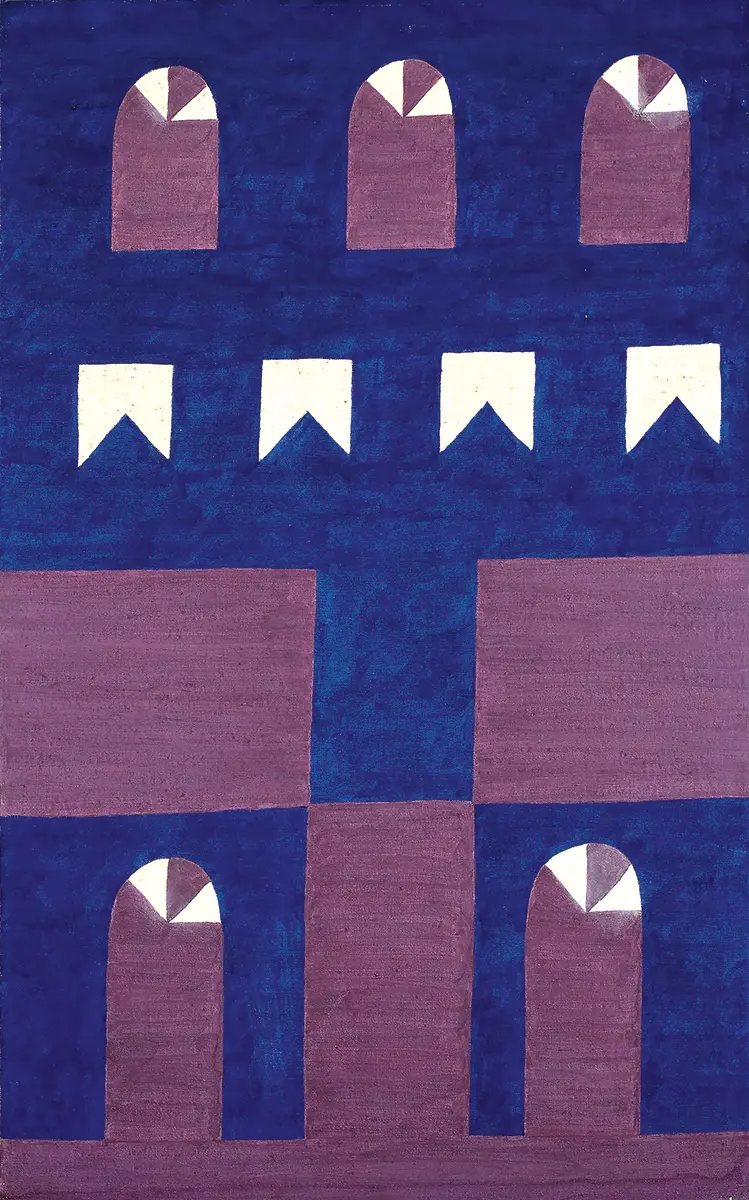
In the 1940s, he began to take interest in popular themes. He went to traditional celebrations such as the June festivities, and worked on religious themes. Later, façades with the famous bandeirinhas (little flags) would emerge. In reality, all of these subjects were pretexts to investigate matters of pictorial form and space. In the history of Latin American art, we can compare these endeavors with Mexican Rufino Tamayo’s still-life compositions with watermelons. The aim was to develop visual thinking focused on pictorial space. Volpi would then establish a dialogue with the concrete artists of São Paulo and create his signature vocabulary of shapes and colors that would identify him within the context of Brazilian art.
The artist intuitively concentrated on the formal aspects of his compositions and on colors that highlighted and gave them musical qualities. He worked with tempera, rescuing the old Renaissance and pre-Renaissance methods, and manipulated pigments to create personal tones that conferred a strong identity to his pictorial work. The poetics of his shapes and colors have always fascinated art critics.
Volpi’s show at the MASP, which allowed visitors to observe all of these exploratory processes, was divided into seven thematic sections: Saints; Portraits; Seascapes; Nautical and Playful Themes; Urban and Rural Scenes; Façades; and Flags and Masts.
According to Tomás Toledo, this artist’s interest in popular themes emerged in his work from the 1940s. He stresses that Volpi had the experience of living in inland cities, such as coastal Itanhaém, where his wife recovered from an illness, and also lived on a farm in Mogi das Cruzes, a town near São Paulo, the state capital. He lived in Mogi for several years, and it was probably there that he made close contact with popular festivities. In Itanhaém, he was moved by the colonial-style façades of homes and churches. Located on the southern coast of the state of São Paulo, this town also inspired him to produce his seascapes.
In the segment focusing on religious subjects, the Madonna-and-Child theme is recurrent. There’s even a black Madonna, which was rare at the time (his wife was black). Saints that inspire popular devotion, such as St. Anthony and St. Francis, are also portrayed here. According to some sources, his treatment of this theme originated as a vow made to the saints in exchange for his wife’s recovery. In these canvases, formal and chromatic simplification are salient features.
In the following decade (1950), Volpi concentrated on compositions with façades, masts, and flags. The curator notes that in Volpi’s work from this period, repetition was an important factor. One could assert that this was his aesthetic way of investigating form and the construction of pictorial space.
Since the 1930s, Alfredo Volpi has been present in the Brazilian modern art circuit. He participated in the first art salons open to the public, such as those of Mayo, the Paulista Artistic Family, and the Union of Visual Artists. Subsequently, he was included in shows of art museums that were emerging in São Paulo and Rio de Janeiro between the end of the 1940s and the beginning of the 1950s. Volpi was also present in some editions of the São Paulo Biennial since its creation in 1951. He received the prize ex aequo with Cavalcanti in the second edition of this biennial, which commemorated the 400th anniversary of São Paulo. He received the Guggenheim Fellowship in 1958, and awards such as the one given by the Brazilian Association of Art Critics. His work was featured in exhibitions in New York and Tokyo, various editions of the Venice Biennale (in 1952, 1954, 1962 and 1964), and group shows on Brazilian art hosted abroad. Retrospectives of his work were held in the 1970s at the São Paulo and Rio de Janeiro Museums of Modern Art, for which important critical essays were published.
The recent show at the MASP allowed us to review fundamental aspects of this painter’s aesthetic journey and to analyze his production in the light of current anti-colonial theories: one of the pillars of the museum’s public program under the artistic direction of Adriano Pedrosa.
LISBETH REBOLLO GONÇALVES