Alfredo Jaar’s exhibition at Galerie Lelong had a most appropriate title, “The Temptation to Exist,’’ for the interesting times we are in right now. It comes from a book by a philosopher that has deeply influenced Jaar’s perspective and practice, “La Tentation d’Exister” is a work by E.M. Cioran, famous for his pessimistic outlook on modern life. This Romanian writer, who wrote most of his works in French, sought renewal through the sting of cynicism, and his works have a deeper significance because of this combination of disenchantment and a cynical viewpoint that can open the mind to awakening from the doldrum of propaganda, publicity and general distractions of technological contemporary life towards more enlightened thinking.
The philosophical outlook of the exhibition is doubly emphasized by its most important work, an installation in the first and largest room in the gallery which consists of a neon sign with a quote from Seneca, the celebrated Stoic philosopher from Ancient Rome:
“What need is there to weep over parts of life? The whole of it calls for tears”
The lighted neon is immersed in a room drenched in red light, suspended on a wall, and its ominous message in this setting recalls the writing on the wall at the biblical King Balthasar’s feast. However, it is in fact a statement for endurance and resistance, which follows in a more detailed fashion in the smaller gallery space where he chose a number of works by artists that he commends for their commitment to changing the societies we live in.
The artist himself called this gallery a “space of resistance, a space of hope” in the press release. He has selected works from 72 artists who have sought to resist and change the world since the 1950s. Amongst the artists chosen for this gallery is Letizia Battaglia, to whom Alfredo Jaar dedicated the exhibition, as she died earlier this year. Her famous photo of Passolini at the Circolo Turati, Milan, is included in the exhibit, a large imposing almost totally black photo that gave Passolini the stature of Cultural Icon he so well deserved. Her photo portrait by Alfredo Jaar, also in black and white, was close by in the exhibit. Frédéric Bruly Bouabré, a celebrated artist from Côte d’Ivoire, Africa who had his first retrospective in the US at MoMa this year is represented with four colorful pencil on board works, the most poignant of which was titled “Collier de Fraternité Humaine,” featuring a necklace similar to those worn by Latin American presidents for their inauguration; it was made up of medallions with men’s faces from different races, an effective commentary on the necessity of racial inclusion. Luis Camnitzer’s piece, “Compass 2021”, was an altered compass that gave the impression of a reversed Magritte painting that had materialized into an object. Vija Celmins had a seascape work on paper, Ocean Surface, 2006 which hung right above two pieces by Glenn Ligon, on which was written in wide black lettering: “I AM A MAN.” The title of this work by Glenn Ligon is Condition Report, and looking at this part of the wall one could not help thinking of the millions of immigrants that have died in the sea trying to escape to a better life, and the struggle of the human condition for survival in our time. Lygia Clark was represented by one of her famous “bichos” and three ping pong balls in a plastic bag, titled Ping Pong, from 1966, which I think is her very unique way of integrating Pop imagery into her otherwise abstract universe. Gino de Dominicis had two photographs, Tentativo di far formare dei quadrati invece che dei cerchi attorno ad un sasso che cade nell’acqua, (Attempt to form squares instead of circles around a stone that falls in the water) from 1969 which shows the figure in silhouette from the back staring at the circles in the water as an ironic reference to the changes that generation dreamt but could be accomplished, while the other photo, Tentativo di volo, (attempted flight) 1969, which actually can pair together with Yves Klein’s photo on the same topic, also on display, titled Saut dans le Vide (Jump into the Void) from 1960. Both pictures show a man in the air, attempting flight in a desperate effort to avoid gravity, a metaphor perhaps for modern man after the war, so much more than ever before engaged in magnifying flying, and to extend it beyond the earth’s orbit with the space programs. Juan Downey’s Yanomami with Camera, 1976 is perhaps his most effective work in contrasting past and present lifestyles in the Amazon habitat that he so loved and tried to protect by documenting. It shows a Yanomami man in costume holding his camera to take a picture. Valie Export, an Austrian woman and avant garde pioneer who should be better known here, and whose work was pivotal in the feminine rights movement, had two photographs that illustrated her aggressive sexual feminism from the ‘60s—a very refreshing antidote to the recent puritanical wave that has been in place here far too long. Alfredo Jaar also had included several of his works in the small gallery “A logo for America” from 1987 and a Selection of three images from Public Interventions are photographs that show his take on both consumerism and criticism of the establishment. There was also a series of four portrait drawings, ink on vellum, of Antonio Francesco Gramsci, obviously a tribute to the founder of the Communist party in Italy, all titled Gramsci, and an excellent likeness as well of Pasolini, in a typical thinkers pose, hand to the chin and wearing his iconic glasses.
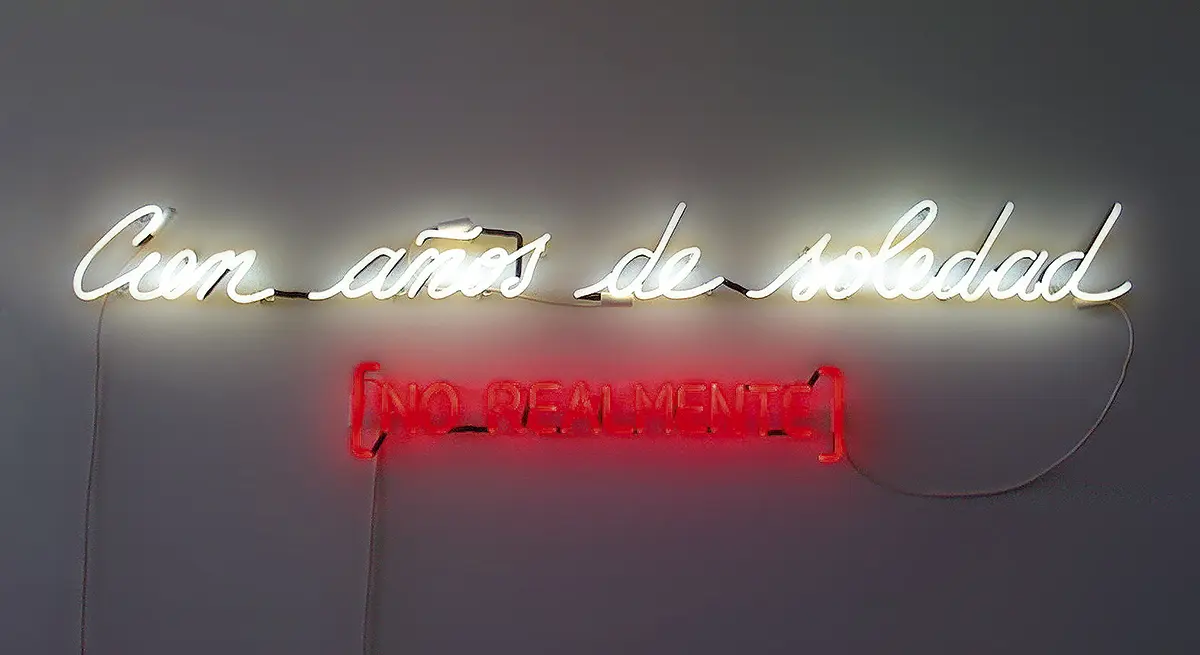
But it was another work in neon that made a most striking impact: “Cien Años de Soledad (No Realmente)” The first line is in white neon while the words in parenthesis appear in bright red, and it’s obviously a commentary on the great novel by Gabriel Garcia Marquez, that achieved international success in the late ‘60s. This legendary masterpiece, depicting the Latin American realities of modern life in a style that seemed derived from Surrealist imagery, but that was nevertheless extremely accurate for illustrating and explaining the social mechanisms of the region and it’s socio political heritage. Undoubtedly this novel was one of the great achievements of modern Latin American literature and the foundation of a great body of work by the author that followed, which eventually made the him a Nobel laureate. The reference made by the Not Really in red points to the fact that the region has always been present, through thousands of years of history, yet ignored by the first world in its selective scale of cultural importance that is still today in place, and is largely derived from obsolete Colonial/Euro Centric perceptions. “Perhaps it is also obsolete to try to differentiate tyrannical regimes,” as George Orwell accurately predicted in his masterpiece “1984.” It has also become obsolete to differentiate between tyrannical regimes that exploit and enslave the very people they advertise to help: the plight of the Cuban masses in the last few months is very similar to the excellent work Jaar presented at the Whitney Biennale in reference to the protests about Black Lives Matter.
Another Jaar neon work that was just as impressive was written in white lights M’ILLUMINO D’IMMENSO, the quintessential modern poem in Italian literature by Giuseppe Ungaretti, the translation of which is roughly “I glow with the great immensity.” It is perhaps the difficulty in translating its esoteric context encompassing the universe and divinity that has kept it from being as well known in English. This light in the neon, coming from the darkness with such graceful calligraphy was a glowing message of hope, very much needed and appreciated in these very challenging times.