Alexis Iglesias began his studies at San Alejandro, one of Havana’s two topmost Academies, on the trail of the Cuban art boom in the 1980s and a few decades after the establishment of the Revolution’s educational plan. It was an environment filled with considerations of the “New [Man] Artist” and the like, based on an elaborate methodology and a map of avant-gardes also charged with such strategies, among them the Volumen I group to which one of his professors belonged, the legendary Juan Francisco Elso. After devoting himself to Land Art as an exercise in structural sculpture, Iglesias took classes with one of the key players in the educational reform, Osvaldo Sánchez. In the 1990s, a massive exodus of artists deserting the system helped bring into the spotlight a new generation of art school graduates. What is known as the “Cuban Art Renaissance” took shape as this generation was able to break the ideological barriers between Eastern Europe and the art of hegemonic centers, and found itself besieged by collectors eager for political art after the fall of the Berlin Wall. Alexis Iglesias’ hybrid work made its debut during that period in Estructuras del existir (Structures of Existence), his first solo show. That a series of paintings, which the artist himself described as “metaphysical”, already evinced what we see today in Las trampas de la fe (The Traps of Faith), a review of Iglesias’ thirty-year career: a desire to adhere to “the density of metaphor.”
Iglesias’ first grand outing in Brazil—where he resettled in 1993— came after those large-format paintings, with A Promessa (The Promise), a solo exhibition at Espaço Henfil de Cultura in São Bernardo do Campo, featuring a series of sculptures inspired in pre-Columbian art. Set in an entirely different scene, more closely connected to the ontology of Concrete Art, it foregrounds his renunciation of the ballast of an origin demarcated by clichés. Threading his work with millenarian versus Western teachings (which was also Elso’s subject), Iglesias opted for focusing on a synthesis of creative processes. Processes that have comprised the only baggage and the only background to his career, from its beginnings to the present day. Different in one way and similar in another, Brazil offered him a new horizon. It was along the Río-São Paulo axis, it should be noted, that Tropicalismo (1968) and its ongoing stocktaking after five decades gained relevance. The result is the body of work now on exhibit, which appears as a challenge to the constructive, experimental scheme through which Iglesias connects with his predecessors in both hemispheres.
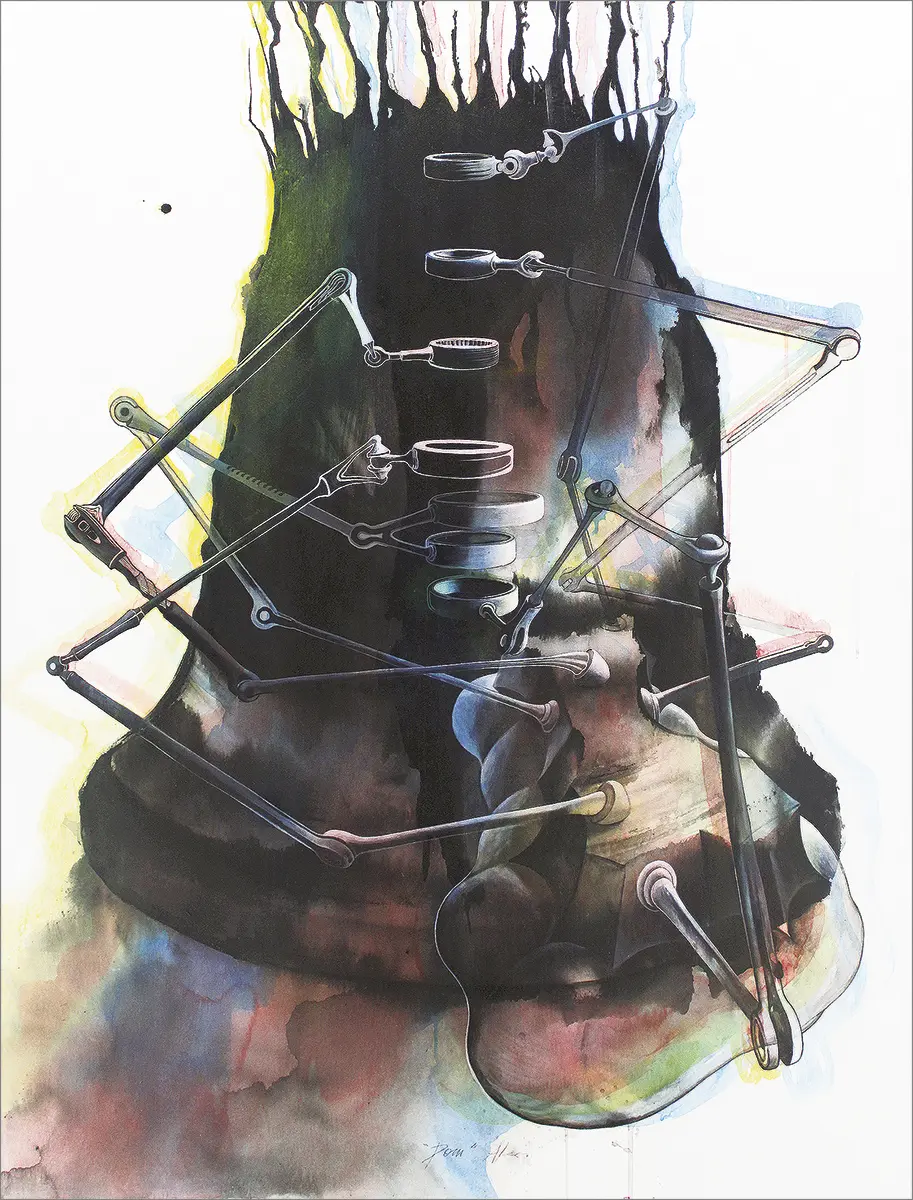
In Las trampas de la fe, beyond the mirages of the private, inward-looking metaphor, Iglesias proposes an incursion into the oeuvre of the Great Masters of European culture. El malestar del deseo (The Discontent of Desire) invokes one such summit work, Velasquez’s Las meninas, as a reconsideration of societies where monarchical excess ignites a spark of doubt in the artist. This Baroque paraphrase comes to modulate a conception of History (note the upper case) that sees it moving in the uncertain present, and in the desire to activate the matrix (be it painting, drawing, or paraphernalia) as a kind of Trojan horse concealing the always problematic matter of the genius artist. In dialog with those other strategies, dressed up in classical garment, Iglesias presents (après Leonardo) his version of La última cena (The Last Supper). It is an example of the return to Mannerism that Umberto Eco spoke of. But whereas in Da Vinci everything flows towards the ecumenical piece of bread that is offered, the leitmotiv in Iglesias’ version is water, or, rather, the “liquidity of processes,” which he mentions with a wink towards Zygmunt Bauman’s key notion. The same confrontation with the artistic “I” permeates other works in the exhibition, such as Accidente de la materia (Accident of Matter), which discusses, first and foremost, which subject is being represented, thus justifying the androgynous character of the figure installed on a pedestal. With its absence of color, this work where Man is penned in by mechanical arms that are nothing but amplified loupes, looks back on the “age of uncertainty,” when tensions emerge from the interior of the structure and of materiality, rather than from outside.
Eager to represent something to hold on to, the artist closes with a move towards the landscape, where he once again pays homage to water. The sea of an island-born artist, expanded and wrung out abroad. The mechanical arms strain the border and its inflexible constraints. The landscape appears as closure. The unceasing maritime unconscious. It wavers between a poetic beach and a complex archipelago. A landscape that permeates the discourse of artists and poets who, errant or otherwise, become emigrants.
In sum, Iglesias’ philosophical discoveries are what guides subsequent pathways and trajectories. A walk through this exhibition clarifies why the installation Ironía del deseo (Irony of Desire) was placed in the foyer. In it, many weaving threads connect to a drawing set directly on the wall, and a bundle of tensions derive into a traditional Doric column.
XENIA BERGMAN