Madrid’s 2 de Mayo Art Center presents Postura y geometría en la Era de la Autocracia Tropical. Alexander Apóstol (Posture and Geometry in the Era of Tropical Autocracy), a mid-career exhibition by the noted Venezuelan artist Alexander Apóstol (Barquisimeto, 1969), who rethinks an important selection of nine of his most representative series and stand-alone works of the last two decades, a solid body of work now regrouped and installed with extraordinary precision over nearly 1,000 square meters of exhibition space. This is Apóstol’s first show in an institution in Madrid, where he has lived for two decades. Manuel Segade was the curator in charge.
Apóstol’s argument begins with the 1950s. History has confirmed that the success was never guaranteed for the construction of a modern utopia on the terrain of a tropical country with an effervescent fossil-fuel economy. The brutalist soundstage and related accoutrements built by the Pérez Jiménez military dictatorship under its “New National ideal” are now all decrepit and dilapidated, the run-down trophies of a failed, jarring, ramshackle modernity. The show opens, significantly, with Los cuatro jinetes (The Four Horsemen, 2005-2007), a video installation documenting the technological contrivance of Villa Planchart, an automated Caracas home designed by Gio Ponti in the 1950s. At the turn of a knob, the hunting trophies on display hide away and are replaced by abstract artworks; the architect has achieved a “solution” to satisfy the homeowners’ contrary demands. How to de-localize the modern project and “square” it with a tropical context is one of the issues that Alexander Apóstol’s emphasizes in his discourse.
Video and photography are foundational elements in the materialization as light of the many-layered critical grammar that Alexander Apóstol has been developing for two decades. With the great sensibility and deep ethical commitment that characterizes his exploration, he insists on bringing us closer—from a multiplicity of sharp, penetrating angles—to the essence of a country long in need, in order to define itself, of new readings of its own political, military and sensorial history.
In that sense, Apóstol’s contributions are indispensable in any approach to the construction of a complex aesthetic paraphernalia at the service of the Venezuelan political apparatus. I prefer to understand this proposal as a meditation on the visual entreaties of kinetic and op art and their relationship to political propaganda in Venezuela. A “hypnotism” capable of having us perceive, unexpectedly, a red hue based of the alternating flicker of a white and a green light (green/white being the distinctive colors of Venezuela’s opposition parties in the democratic era, vs. the red of the current government), as is in evidence in a section of the video installation Contrato colectivo cromosaturado (Chromosaturated Social Contract, 2012). Along those same lines, Color Is My Business (2012-1017) is a large-format, poetic photo installation featuring a gradient of colored and filtered lights, in dialog with Apóstol’s color-field abstractions and in correspondence with the electoral ballots used during Venezuela’s democratic era (1958-1998), which disappeared under the current regime.
Such hypnotism/artifice is also present in Documental (Documentary, 2005), a video depicting a family in a working-class home presided over by a large TV, which broadcasts, in the voice of Renny Ottolina, a true infomercial promoting Venezuelan modernity.
In the first exhibition gallery we find another rhetorical metaphor in the contrast between two photographic series, which signals two different methods of persuasion and breaks apart manipulation in the military realm: in Ensayando la postura nacional (Rehearsing the National Posture, 2010), a set of impeccably executed photographs recreate the poses of the ample bodies of three different races depicted by Centeno Vallenilla, the official painter of the Pérez Jiménez regime, as sensuous archetypes of the nation. Meanwhile, Partidos políticos desaparecidos (Vanished Political Parties, 2018) records photographically the systematic disappearance of opposition parties under the current regime. Apóstol insists on emphasizing the idea of political suggestion and visual communication as part of the agenda of all governments. In approximately twenty photographs, he documents replicas of the visually striking, polished logos of no longer extant political parties, painted in acrylic on wood, photographed and then destroyed. The logos’ visual appeal was a strategy intended to capture the attention of illiterate citizens.
This exhibition also allows us to track Alexander Apóstol’s observations and comments about the rhetoric of art and the implantation of gender and racial canons. The artist seeks to illuminate, in a dramatically aesthetic manner, the existence of non-binary genders. This can be seen in the uncomfortable solemnity of the Ensayando la postura nacional series, already mentioned, and in the video Av. Libertador (Libertador Avenue, 2006), where Caracas’ transvestites are rechristened with the names of the country’s most salient visual artists. The video Yamaikaleter (2009) depicts the extreme alienation of “marginal” political activists who look ridiculous as they attempt to read Simon Bolívar’s famous “Letter from Jamaica,” written originally in flawless English in 1815.
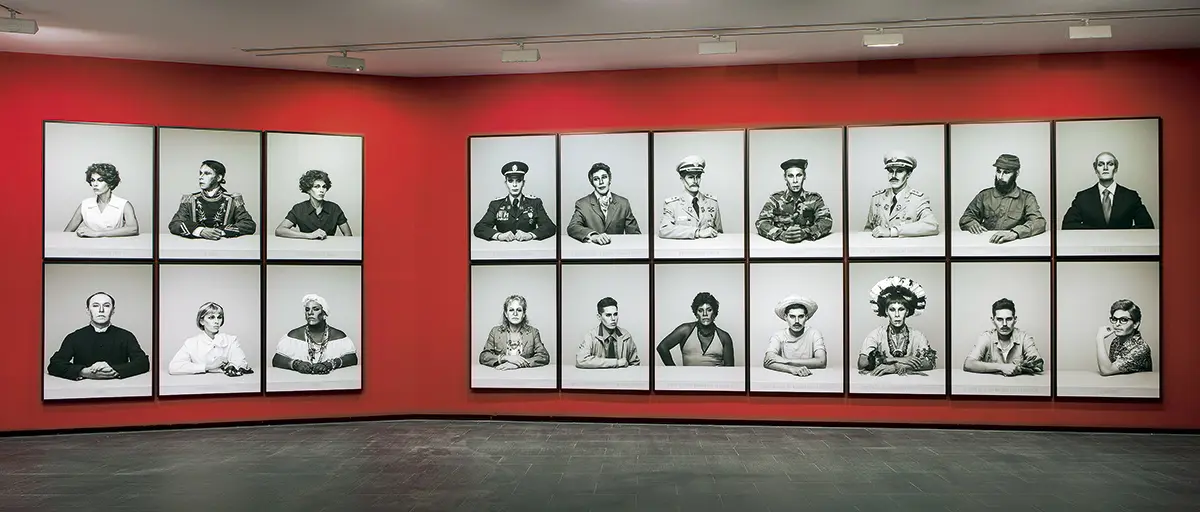
Alexander Apóstol responds creatively to constructions orchestrated to make the “national ideal” cohere and to impose an aesthetics that politicizes the body, turning it into its instrument, as has been the case under Venezuela’s military dictatorships. On the one hand, the Pérez Jiménez regime (1952-1958) allegorized and eroticized the “national body”; on the other, the current regime has been contorting, suffocating and erasing the country’s dissident body since 1998. Apóstol also underscores how groups at risk of social exclusion are ignored in Venezuela. Between those two autocracies, four decades of exercises in democratic alternation seem to vanish. The artist invites us to accompany him in an extended, penetrating tour of their respective reflections and to meet the archetypal Venezuelan characters he has detected in that time, who give shape to a marvelous glossary. As the curatorial essay points out, Alexander Apóstol detects and develops in his proposals “an erotization of politics and a politicization of the body.” The latter indeed defines his imposing installation Régimen: Dramatis Personae (2018), produced as the anti-regime protests of 2017 raged while the artist visited Caracas. Apóstol contacted NGOs working on LGTBI+ rights and asked them to interpret for his camera a variety of political characters he has conceived. The photographic series (made against the clock and under siege by the regime) was presented at the 12th Shanghai Biennial and has become an emblematic fixture in international contemporary art.
Propaganda and censorship, posture and artifice, impositions and absences are all key parameters for this artist when it comes to assess the modes of representation and imposition of his native country’s visual and political culture. The exhibition will be accompanied by a book featuring essays by Manuel Segade and Cuauhtémoc Medina, published by Turner.
ELISA RODRÍGUEZ