The foundation on which Adriana Varejão’s art rests are the paradoxes that give shape to the grandeur of her work. Adriana Varejão: Suturas, fissuras, ruínas (Adriana Varejão: Sutures, Fissures, Ruins), her recent exhibition at the Pinacoteca de São Paulo, brings this into full view. Curated by Jochen Volz and featuring more than sixty artworks created between 1985 and 2022, the show offered the first-ever panoramic approach to the artist’s oeuvre. Varejão’s labyrinthine yet coherent trajectory identifies her as an artist who changes constantly but remains ever faithful to herself. In this operation, her poetics reaches expressive maturity as a complex, spiraling language, whose basic questions return time and again to compose the essence of her project.
The exhibition was organized in seven spaces, each focusing on a specific aspect of Varejão’s oeuvre. The selection of works brought to the fore the impressive complexity of this body of work. Figurative and gestural, highly representative of the 1980s generation in Rio de Janeiro, Varejão’s early paintings seem to already suggest the terrain she was to tread in the immediate future, for example in canvases like A praia (The Beach), O fundo do mar (The Bottom of the Sea) and O Universo (The Universe), all from 1985 and all included in this show. A profusion of colors, figures, textures and impastos characterizes her work of this period, when Varejão was a student at the Parque Lage Visual Arts School. Works from later in the decade, such as Altar amarelo (Yellow Altarpiece, 1987), Anjos (Angels, 1988) and Azulejos (Tiles, 1988), break through the boundaries of that pictorial style and ally themselves with the themes of the Baroque, a mark of the artist’s many travels to the historic cities of Minas Gerais.
Angels, saints, arabesques, flowers, and architectural elements occupy almost the entirety of the canvas and comprise an important part of the allegory that Varejão was beginning to forge around her neo-baroque poetics. Meanwhile, her impastos confirm an impulse to extrapolate two-dimensional space, another obsession she will retain over the course of her career, like the recourse to crackle effects she used in allusion to China’s traditional Song-dynasty ceramics (Varejão spent three months in China in the early 1990s.) In one of the periods highlighted in the exhibition, between 1992 and 1997, Varejão’s historical fictions comprise a series of figurative paintings created on the basis of ancient iconographies, like those from China and colonial South America. She gives new visual meanings to maps, landscapes, traditional tiles, and interior spaces from the colonial past. Among her references are Theodor de Bry’s engravings in the book America, based on narratives and drawings by Hans Staden. Cuts, cracks, incisions, and splits become recurring elements in Varejão’s art starting in this period.
Varejão’s work began to feature an abundance of reference, which enriched her artistic vocabulary in a continuous superposition of allusions that blur the borders between fiction and reality: these are parodies, pastiches, allegories related to different periods and languages in the history of Brazilian art, such as the Baroque, the images of the Dutch period in the 1600s, works by travelers, the French Artistic Mission, and the Academy in the 1800s. Iconic in this respect is Mapa de Lopo Homem (Lopo Homem’s Map, 1992-2004), based on Portuguese cartographer Lopo Homem’s planisphere with fictions between China and Brazil, and with the America’s christened as “Mundus Novus”. One highlight among Varejão’s works from the 1990s is the painting Autorretratos coloniais (Colonial Self-Portraits,1993), where the artist appropriates the typologies of representation used in “caste paintings” across Spain’s American colonies in order to engage with issues of gender and racial violence. This work reproduces ethnic stereotypes in reference to portraits by Moritz Rugendas, a German painter who as, a member of Baron Georg Heinrich von Langsdorff’s expedition, traveled in Brazil in the Nineteenth Century and depicted scenes of the country in the colonial era. At the center of the image, a gash surrounded by the contours of an impasto application, with a texture and coloration that bring flesh to mind, may represent a vulva, a reference that reappears in Filho Bastardo (Bastard Son, 1992) and Filho Bastardo – Cena de Interior (Bastard Son – Interior Scene, 1997). The cuts are located at the center of images representing colonizers violating women, reinforcing the idea that Brazil was born under the sign of the rape of black and indigenous enslaved women. These works also include allusions to botany sheets, Portuguese family scenes, images of priests, and ethnographic representations of indigenous and black women from J. B. Debret’s Picturesque Voyage (1834-39). By giving the characters new roles and building scenes of sexual violence, Varejão retells the story from the point of view of the defeated; deploying the iconographic work of travelers who defined the country as exotic, she resignifies the idea of cultural appropriation. The image of flesh becomes one of the most markedly recurrent signs in her work, as a metaphor of Baroque voluptuousness and violence.
In order to continue with her operation of permanent resignifications, Varejão also self-portrays, for example in Testemunhas Oculares X, Y e Z (Eyewitness X, Y and Z,1997), which features three oil self-portraits: Varejão in Chinese, indigenous, and Moorish versions. An interesting detail: Varejão commissioned these portraits from an academic painter and perforated one eye in each of the characters. Along with the canvases, this work includes other elements, like the eyes in porcelain and silver commissioned from a jeweler, with three Theodor de Bry micro-scenes engraved in them. In her book Pérola imperfeita: A história e as histórias na obra de Adriana Varejão (Imperfect Pearl: History and Stories in the Work of Adriana Varejão; Cobogó/Companhia das Letras, 2016), Lilia Schwarcz connects the method of these portraits to the Brazilian Modernism’s aesthetics of anthropophagy, and adds: “The white character is absent, and her absence is a revealing presence: the presence of whiteness as that which classifies and organizes the others, or of the shadow that overwhelms with its sheer omnipotence.” (30)
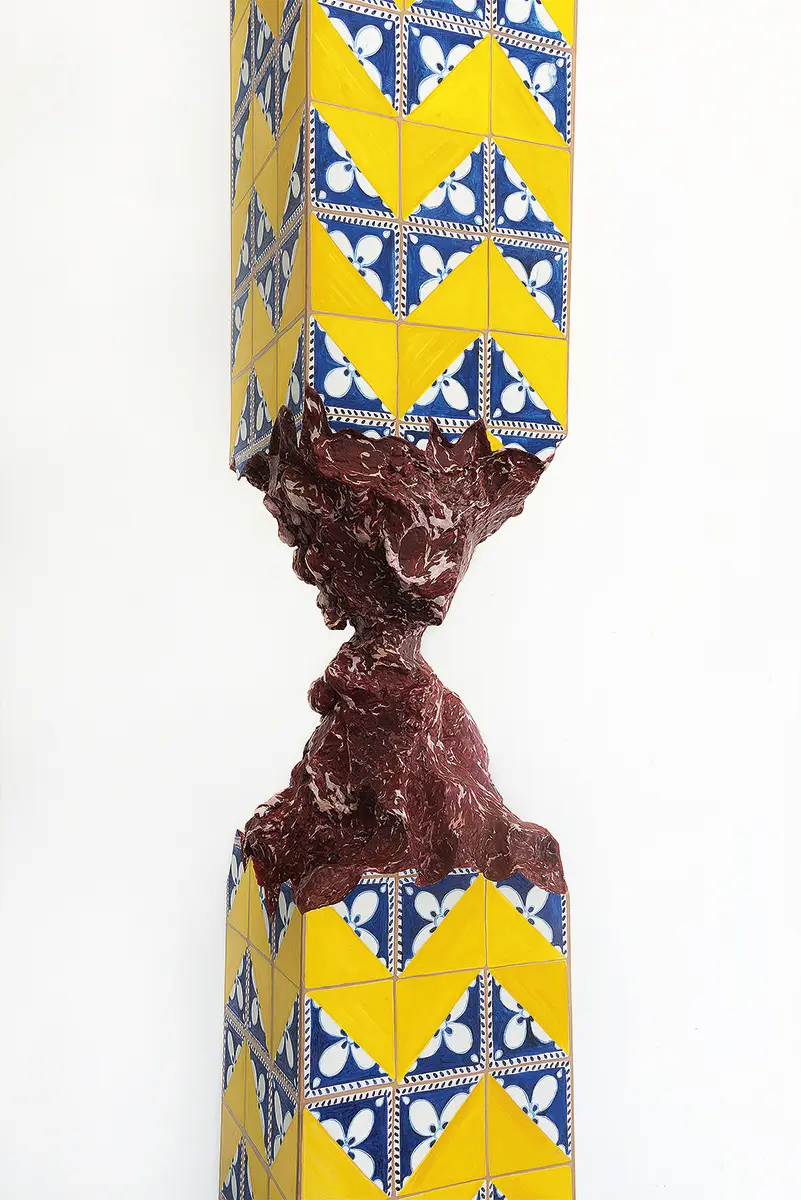
A critique of coloniality became the main reference in Adriana Varejão’s work. In her series Polvo (Dust, 2013-2014), she produced, in association with the Águia factory, a set of colors, with 33 colors identified as skin tones by Brazil’s Geographic and Statistical Institute in 1975. The artist chose the most exotic labels used in that survey, such as “coffee and milk” and “fleeing donkey,” and applies the paint to portraits of herself commissioned from other painters to reveal new analogies between color skin, and miscegenation. Even when Varejão appears to be opening an abyss in the middle of her oeuvre (the Saunas series from the early 2000s, with paintings that depicted scenes of traditional tile decorations in vast, empty interiors, some monochrome), she is only appearing to pause in order to circle back to the iconic tiles as symbols of coloniality, as seen in many earlier works. The metaphor reemerges with particular expressive force in the recent, large-format three-dimensional paintings of the series Ruínas de charque (Dry Meat in Ruins). These tiles, wrapped in meat, viscera, and blood, also reappear in the series Grandes Línguas, from 1998, and are present in this exhibition next to the paintings Comida (Food, 1992), Azulejaria de cozinha com caças variadas (Kitchen Tiles with Various Kills, 1995) and Azulejaria de cozinha com peixes (Kitchen Tiles with Fish, 1995). Such temporal somersaults encouraged by the exhibition demonstrate the coherent complexity of Varejão’s work. Those tiles are among her grand metaphors of the colonial project: they bring violence to the fore by means of the meat, and impose their coldness upon the erotic heat of the viscera. Paced among the ruins and the decomposition are the confused mixtures of Varejão’s characters, who signify the discontinuity of a country she has always represented through the metaphor of the “imperfect pearl.”
ALESSANDRA SIMOES