“Caudal adentro” (Inflow), the first of the ten exhibitions featured in the 46th National Salon: “Inaudito Magdalena” (Outrageous Magdalena), opened to the public on June 12 at the José Eustasio Rivera Cultural Center in Neiva, 1,600 meters from the Magdalena River embankment.
The Magdalena River was not only the great site surrounding the exhibitions and activities. The curatorial premise also positioned the river as a subject and agent where opposing dynamics between humans and nature can be traced. Bodies of water are primarily generators of life and sustenance for multiple species, including humans; the river is the agent allowing us to verify the interconnections between biological and cultural ecosystems, as well as key aspects of our history’s economic and social developments. But also, much like the communities that live on its banks, the river has been the witness and victim of the armed conflict and of multiple forms of extractions caused by the false illusion of progress. According to Jaime Cerón, artistic director of this edition of the salon, inaudito (unheard of, outrageous) alludes to this ambivalence. “We are interested in the concept of inaudito for both its negative and positive connotations. It may point to what is unspoken, but also to what we want to silence, or rather what the powers that be will not allow to be uttered.” (Pérez, 2022).
The central curatorship of “Inaudito Magdalena” incorporated the six regional curatorial projects that received the 2021 Art and Nature Grants, and fifteen artists who won similar awards. The 46th National Artists Salon (NAS), organized by the curatorial team of “Inaudito Magdalena”—Yolanda Chois, Ximena Gama, José Sanín, and Jaime Cerón as artistic director—had the following exhibition scheme: “Caudal adentro” (Inflow) in Neiva, “Caminar contracorriente” (Walking Upstream) in Barranquilla, and “Tierra en tránsito” (Land in Transit) in Ibagué.
These exhibitions were presented along with the ones selected by grants: “Black Line” represented the Caribbean and was curated by Jaider Orsini in Barrancabermeja; “Asymmetry” represented the Eastern region and was curated by Alberto Borja in Mompox; “National Caravan: The River Rumbles When It Carries Stones” was curated by Federico Daza in Ibagué; “Vibrational Epistemology” represented the Southwest and was curated by Éricka Flórez in Barranquilla; “Geopoetics of Water” represented the Midwest and was curated by Santiago Vélez in Honda; and “Rainforests, Myths, and Canoes: A Journey Through the Art of the Earth” represented the Orinoco-Amazon region and was curated by María Camila Montalvo in Bogotá, almost simultaneously with the show commissioned to researcher Melissa Aguilar, “All Is Dead, All Is Alive: Thresholds of Resistance.”
In addition to the laboratories (many of them proposed by regional artists) that were active in seventeen cities other than Bogotá and which included local actors in all aspects of production, this strategy of exchange between regions should become an opportunity to evaluate other ways of establishing interregional dialogues and to reassess the relationship between centers and peripheries in terms of decentralization policies.
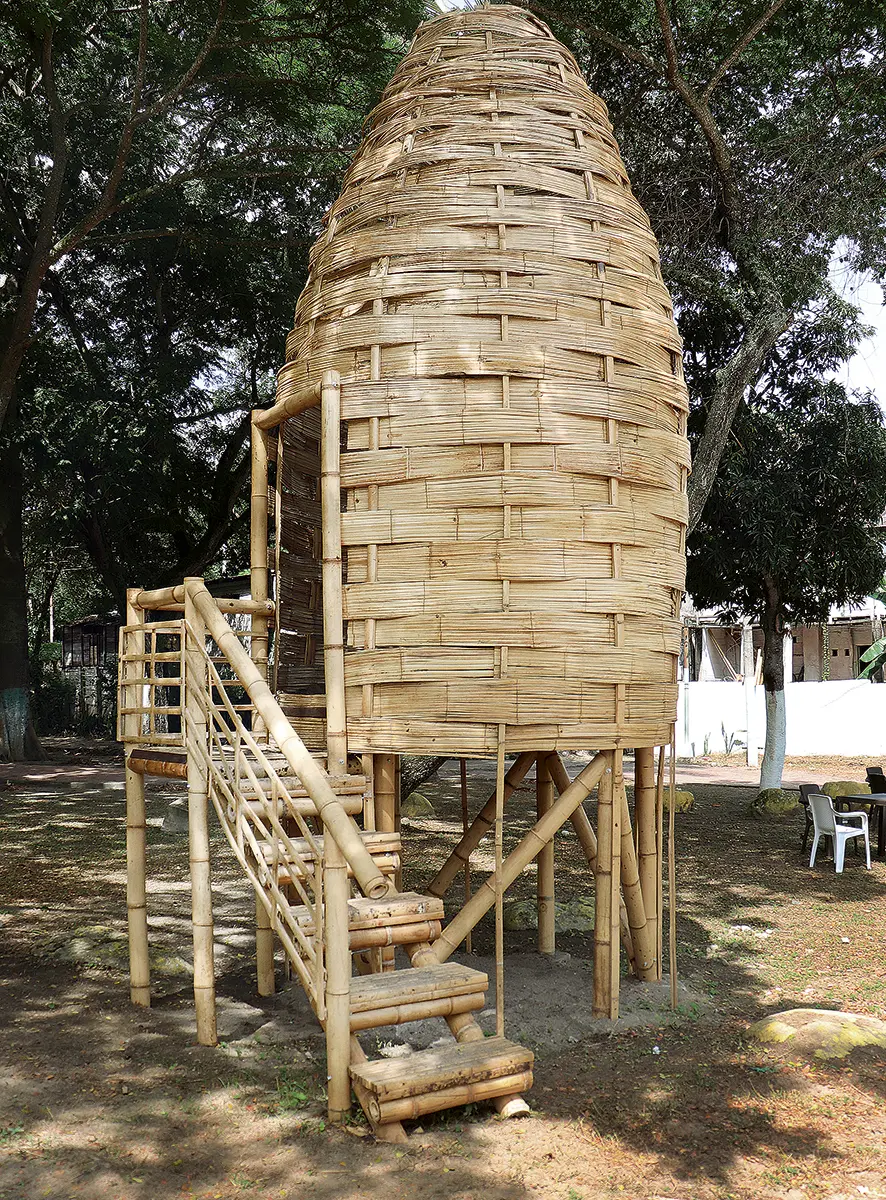
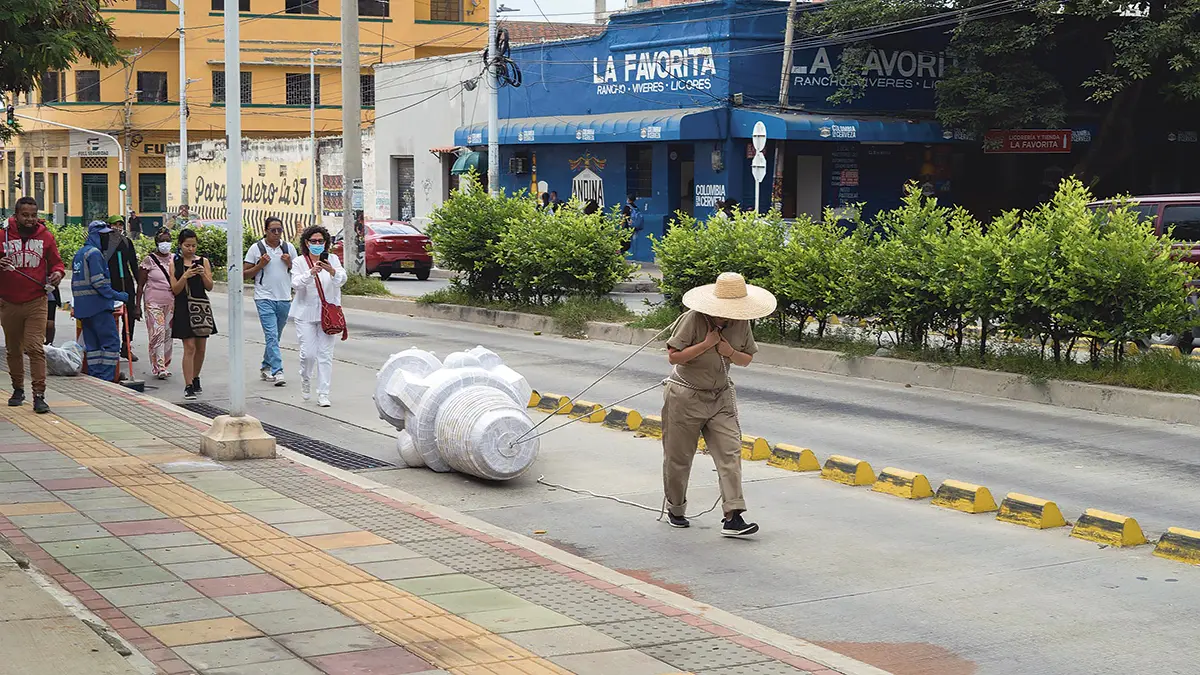
“Inaudito Magdalena” also included works commissioned to engage with the sites and which were divided into “Port Stations” and “Interventions in Public Space.” Some were located on the banks of the river or in community spaces. I will name a few. Mountain Range, by Mario Opazo, was a walkable bamboo tunnel erected next to the José Eustasio Rivera Convention Center in Neiva. For his assemblage Afloat, Ecuadorian Adrián Balseca borrowed a salvage capsule from the Ecopetrol Museum and perched it on a pair of fishing canoes, which in turn rested on a pile of earth located at the entrance of the Pipatón Hotel, a few meters from the Port of Barrancabermeja. Hippos In Gravitas, Calderón & Piñero’s video about the environmental conflict caused by the exponential reproduction of hippos brought to the area by Pablo Escobar, was projected inside an old house in Mompox, which is now a trade school. Radio Manigua broadcast live several activities organized by the salon and by local communities in the Momposina Depression.
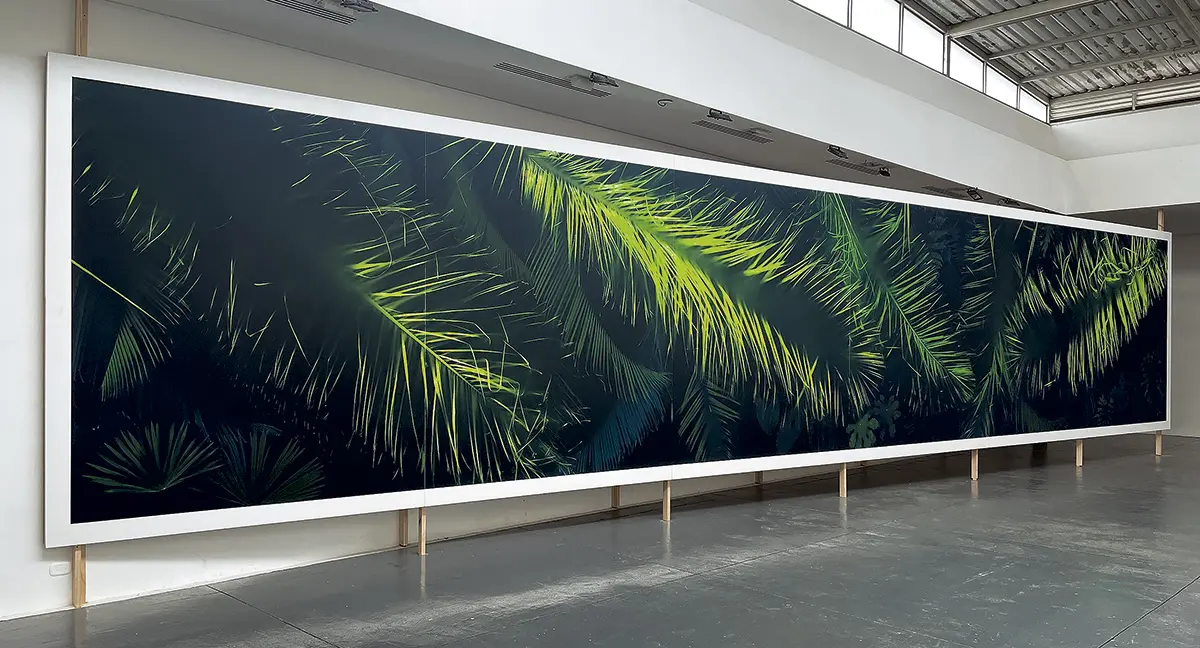
For Amphibious Concert, the Werebere collective invited visitors to listen to the internal currents of the Magdalena River on a plank previously intervened by artist Liliana Andrade and local artisans in Mompox. On Barranquilla’s waterfront, Fernando García & Emma Hanna built It’s Boiling Hot: a wall of large blocks of ice made with water from the Magdalena River. On the waterfront in Honda, facing the Magdalena River, artist Vanessa Sandoval built her Seed: a receptacle to meditate while contemplating a native endemic tree. A few meters ahead, the collectives La Tropa Guaduera and Isla en Vela made Atarraya, a casting net in bamboo to encourage encounters and the contemplation of the river. Nocturne, by Brazilian artist Marlon de Azambuja, was a large ephemeral mural made with layers of powdered pigment and aerosol on different species of local palms, which was exhibited in the main hall of the Museo de Arte del Tolima.
Rethinking the dichotomous dynamics posed by the notion of inaudito—that which lies between what is and what is not allowed to be heard in relation to the river—I have singled out some “ports” of the Magdalena to try to give an account of what this journey on the river, beside the river, and from the river was like.
The curatorial laboratory En-Mingate to Advance and Create to Heal, by the collective Minga for Decolonial Practices, took place in 2021 and was one of the first actions of the 46th NAS. Starting from the source of the Magdalena in Las Papas Tundra (at the border between Cauca and Huila) and ending in San Agustín, in Huila, Minga carried out practices of spiritual harmony with the river; offerings to land, water, and ancestors; and conversations with the elders: guardians of the mountains and the river. These listening-and-healing rituals exposed the will to establish a different place of enunciation in this new version of the NAS. The ritual actions concluded in June 2022, during the opening of the exhibition “Walking Upstream,” for which Minga performed a ritual walk to Bocas de Ceniza, in the Caribbean region, where fresh water emanating from the womb of the Yuma River mixes with the waters of the Magdalena and the sea.
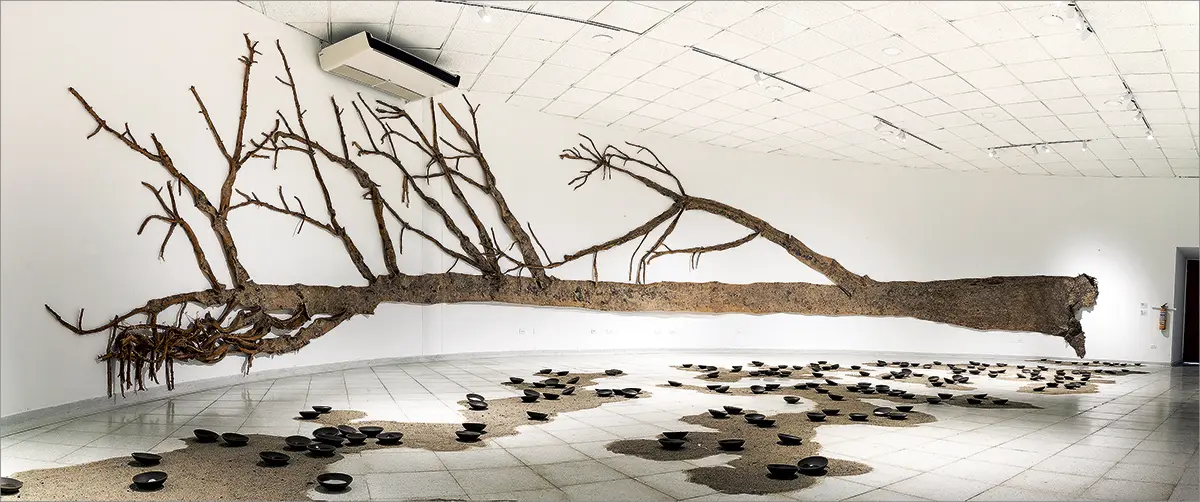
The exhibition “Inflow,” hosted by the Museo de Arte Contemporáneo del Huila, 158 kilometers from the Magdalena Lagoon, displayed the work Encounters and Missed Encounters: rectangular glass containers with water samples that artist Diana González extracted from different points along the Magdalena River. In that same room, The Voice Adrift, a video by Donna Conlon and Jonathan Harker, invited the viewer to travel, along with a plastic bottle, through the water ducts and canals of a city. In the next room, Alberto Baraya’s Rubber Tree—with the still-penetrating smell of latex—was placed horizontally on a curved wall to lead us to his video River, a close-up of a gun firing over and over again into an Amazonian River. On the floor of that room, the installation Moonshine, created by Luis Roldán with river sand and clay bowls, brought us closer to ancestral ways of observing the stars and lunar calendars. Part of the curatorial purpose of “Inaudito Magdalena” for this particular exhibition was to gather different stories about the river and other bodies of water.
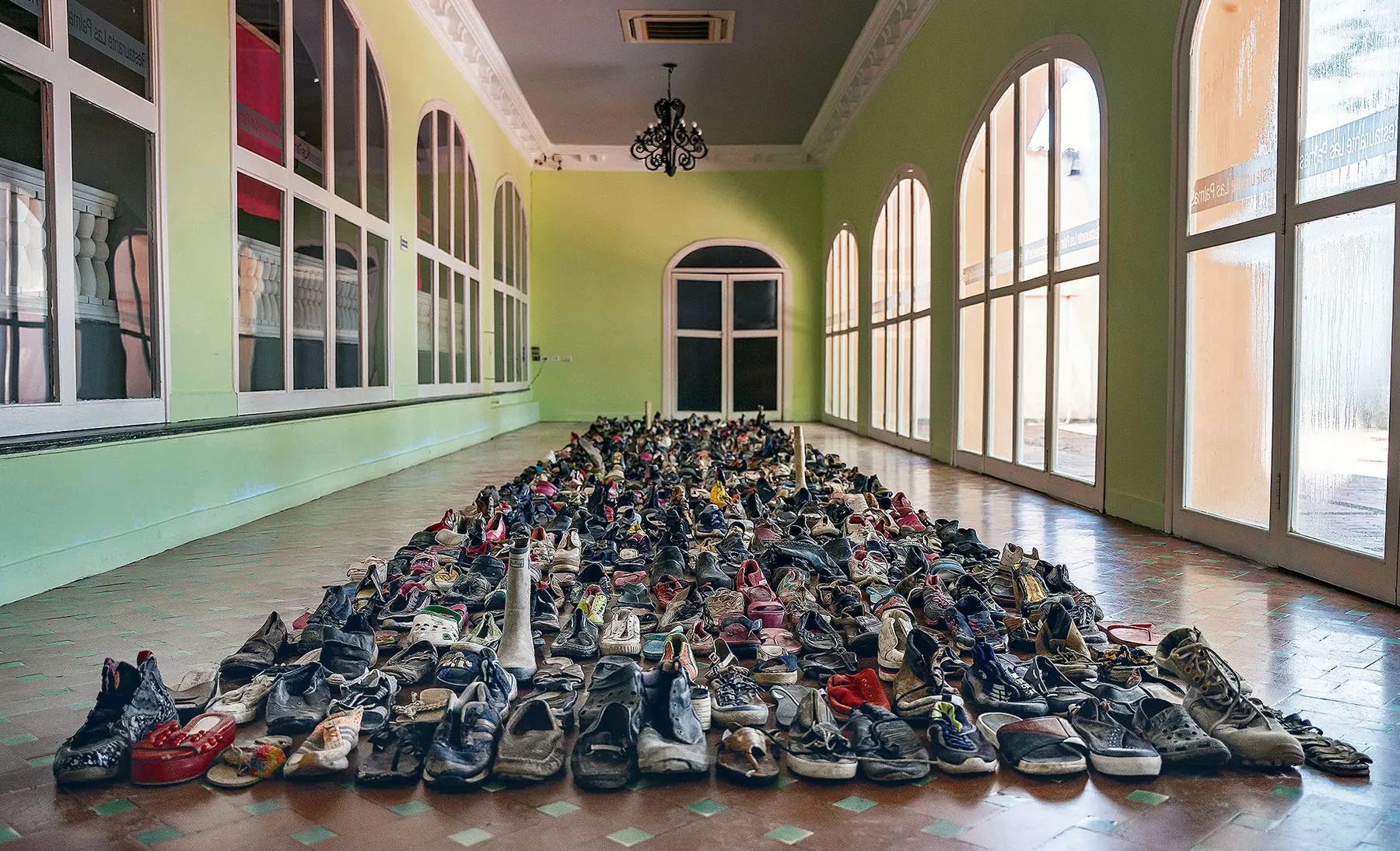
Afterwards, 606 kilometers to the north, in Barrancabermeja, the old lobby of the Hotel Pipatón presented Naboba, by Yosokwi, an indigenous audiovisual production company from the Sierra Nevada de Santa Marta; the video narrates the journey of a young indigenous man who goes against the current, from the Large Marsh of Santa Marta to the source of one of its rivers, in the mountain peaks, while he shares the wisdom of his elders. Next to it, Trampled, by Eduardo Butrón, showed evidences of the conflict in the river through an installation made with shoes that he collected from the Magdalena. Leaving the room, one encountered the quilts of the Weavers of Mampuján, a women’s collective. These quilts illustrate, through colorful embroideries, how the armed conflict in our country has impacted all kinds of lives, including the river.
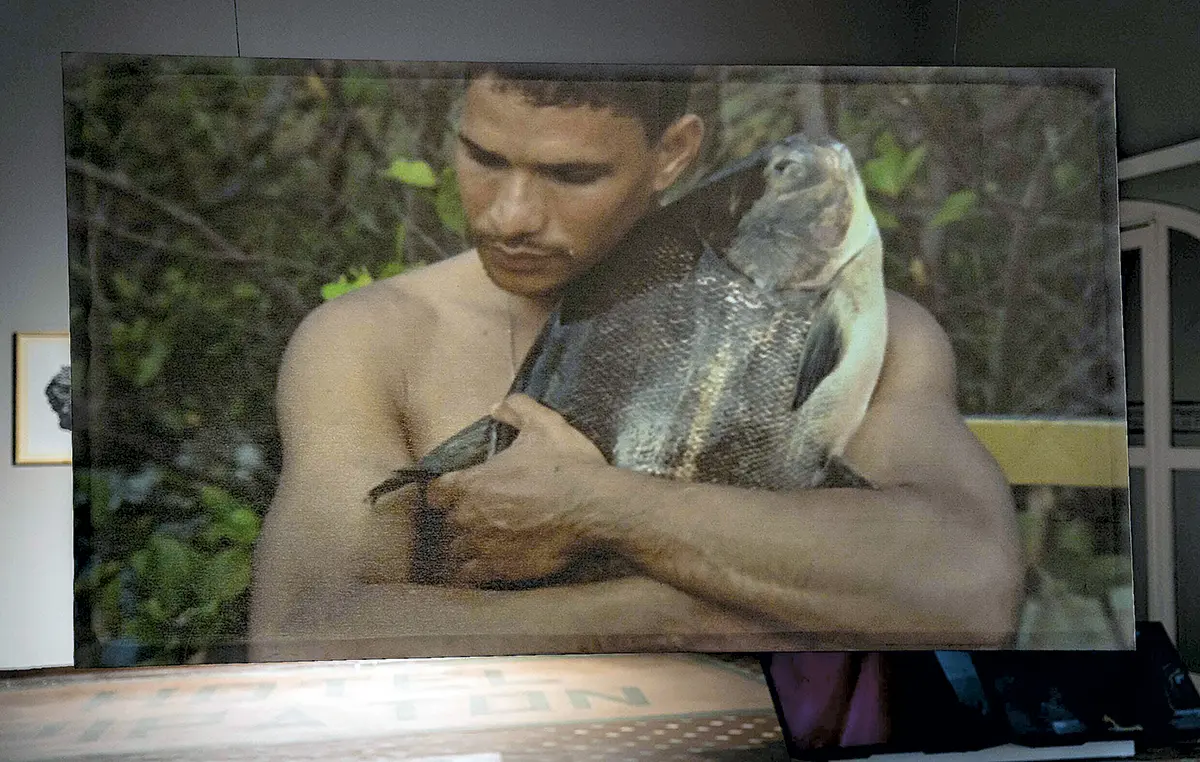
Projected next to the textiles, the video entitled The Fish, by Jonathas de Andrade, an artist from northeastern Brazil, presents the ritual of farewell to life and encounter with death practiced by some fishing communities in Brazil. The images show how a fisherman embraces and caresses a recently caught fish. Displayed behind the video, at the back of the room, was the series called “Fishing:” pencil drawings that the Barranquilla artist Luis Mendoza made as a result of living with communities that fish in the tributaries of the Magdalena River. These works were part of curator Jaider Orsini’s show entitled “The Black Line: An Interstice between Art, Resistance, and Life in the Colombian Caribbean.” The “black line” points to the special biological and cultural territory that the state must protect in favor of the peoples of the Sierra Nevada. Orsini extends this notion to an interconnected territorial dynamic that has repercussions beyond official borders and expands to Colombia’s entire Caribbean region.
Returning 419 kilometers to the center-south of the country, the exhibition “Land in Transit” at the Museo de Arte del Tolima brought together works that complicate the notion of landscape, questioning value systems that dictate what is natural and what is cultural. In the main hall, next to Azambuja’s Nocturne, María Ángela Aponte’s Immaterial Geology consisted of fictional rocks, made by folding and crumpling photographs of landscapes, arranged on a table in the manner of a scientific collection. On display at one end of the room, Pedro Peña’s Between Mountains is a sequence of forty-two small-format images made on a scale of grays in asphalt paint, presenting bodies of water located in the Colombian mountains and resembling crude oil wells. In the next room, Eres un princeso (You are Male Princess), a multi-channel video by Chilean artist Patricia Domínguez depicting the eternal parading of a horse and its rider, evokes the affective interactions between beings of different species. In the next room, the three-channel video performance by Nadia Granados and Simon(e) Paetau employs the legend of La Mojana (Mother of Water) as a metaphor to confront us with the way power names bodies and dictates what is natural, when in fact it is not.
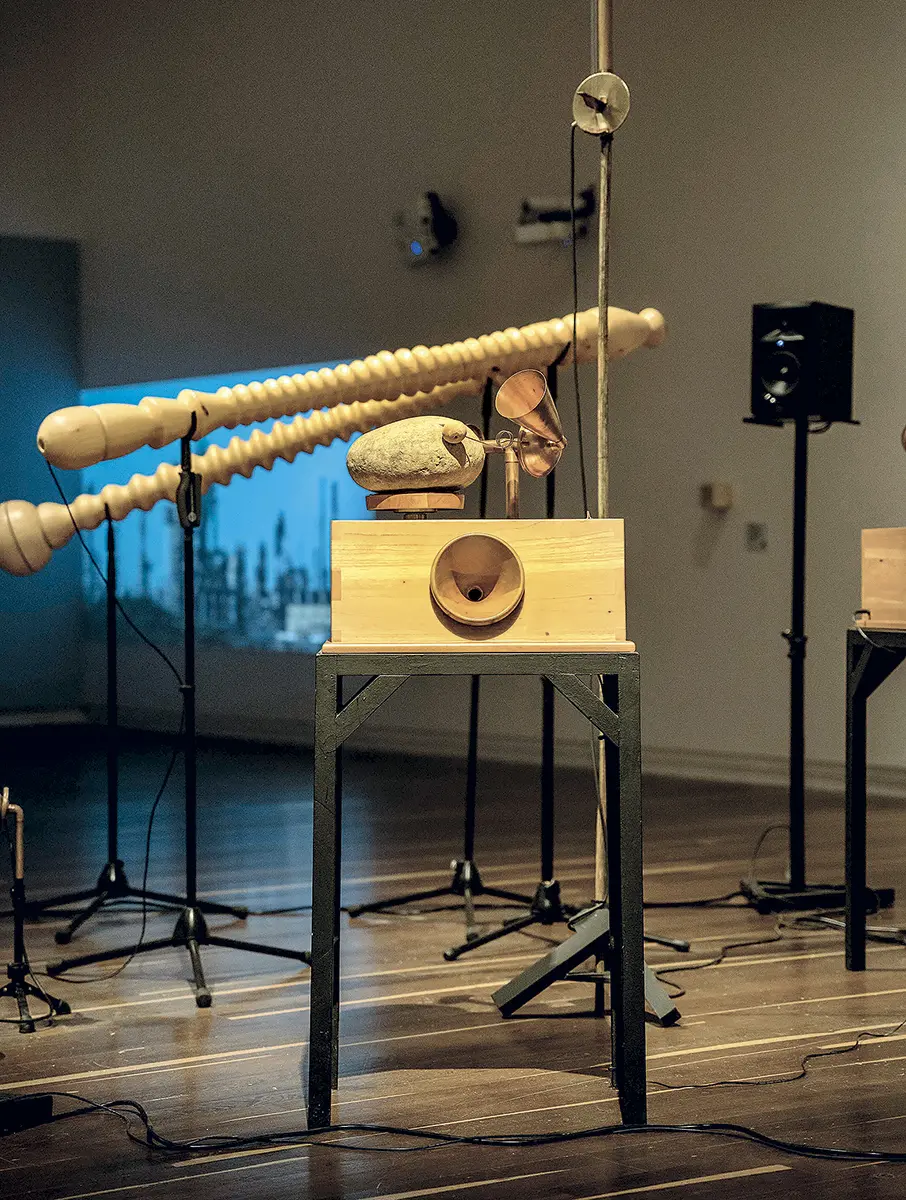
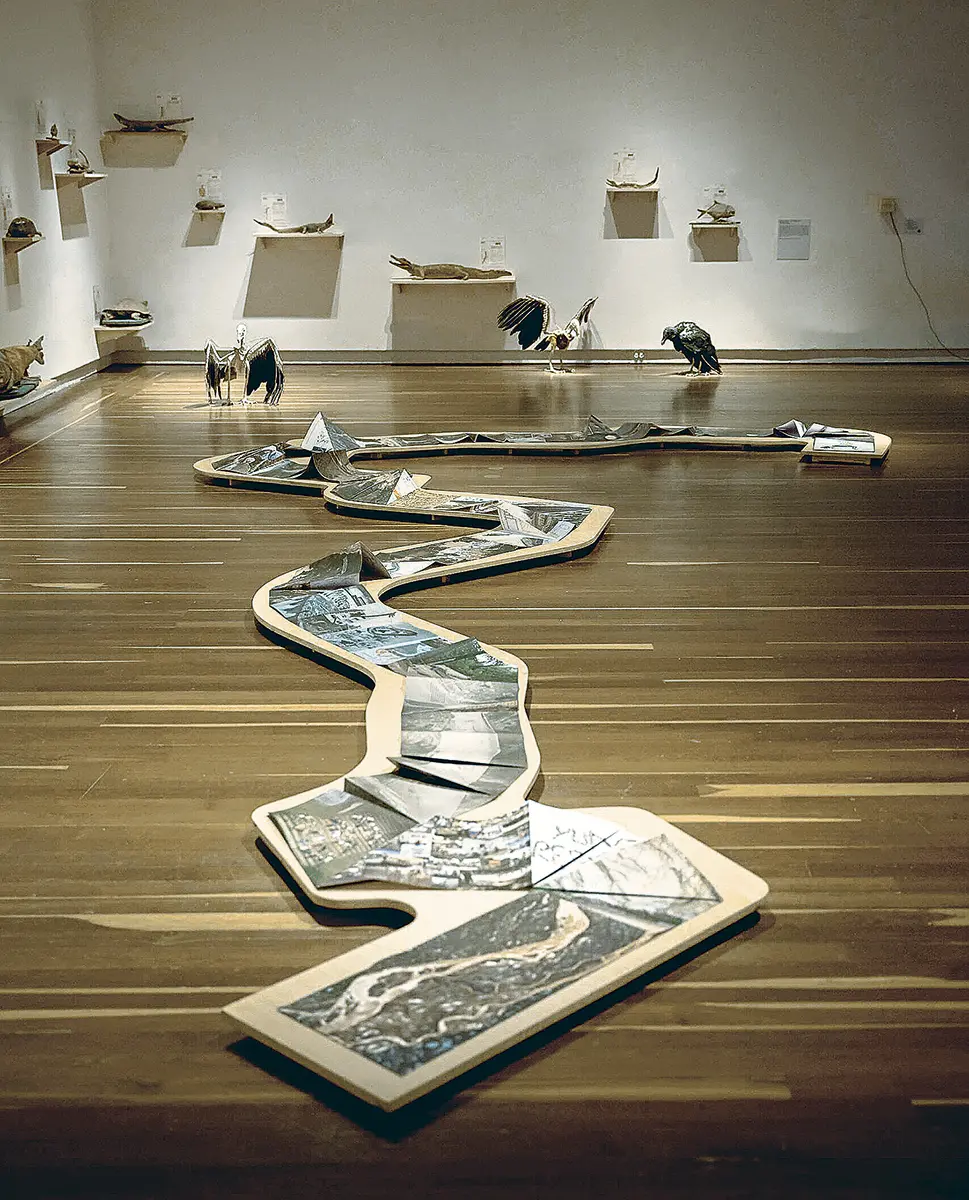
Some shows, especially those in Barranquilla, stood on a wavering border between the exhibition of artworks and the display of registers, resonances, and objects that were the result of actions, workshops, and collective or community work, executed in parallel or before the exhibitions themselves. At 991 kilometers from our previous station, “Walking Upstream,” by the curatorial team of “Inaudito Magdalena,” exhibited the results of cartographies, journeys, and walks undertaken by various artists and collectives along the Magdalena, such as Mónica Restrepo, Comunarte, Minga de Prácticas Decoloniales, and Estudio Nuboso. Along these lines, “Vibrating Epistemology,” curated by Ericka Flórez, was shown in a small space at the old Customs building. One of its axes dealt with the concepts of resonance and vibration connected to the sounds of the river. The participating artists were Leonel Vásquez, Eider Yangana, the master of percussion Freddy Colorado, the storyteller Cándida García, and the Corporación del Macizo Colombiano, among others.
The Salon “Inaudito Magdalena” seemed to be overflowing— even more so than the Caribbean’s 42nd and Bogotá’s 45th National Artists Salons—due to the complex logistics involved in managing the resources, transportation, venues, activities, and communications, in order to navigate the river’s currents and work in the different regional ports; but also, because its intention surpassed the traditional notion of “salon”— focused in exhibition rooms— to promote a rarely-seen practice from the center, which was subsequently deployed in the various exhibitions, at the eighteen community laboratories, and through mediation processes in the towns bordering the Magdalena River (1): San Sebastián (Cauca); San Agustín, Garzón, La Jagua, and Neiva (Huila); Ibagué, Honda, and Mariquita (Tolima); Bogotá and Girardot (Cundinamarca); Puerto Boyacá (Boyacá); La Dorada (Caldas), Puerto Berrío (Antioquia); Gamarra (Cesar); Barrancabermeja and Puerto Wilches (Santander); Mompox (Bolívar); and Barranquilla (Atlantic). These processes were also timidly applied, almost at the end of the event, to the museography of the exhibitions in Ibagué, Honda, and Bogotá, through an additional component called “Social Memory.”
NOTE
1. It should be noted that the organization must give greater recognition to the work of those art educators in charge of the mediation processes, an issue that caused much controversy during the course of this salon.
REFERENCES
Mincultura (2022). 46 Salón Nacional: Inaudito Magdalena. https://artesvisuales.mincultura.gov.co/NAS46/
Pérez, A. (2022). “Un intercambio con Jaime Cerón, director artístico del 46 NAS, sobre una edición que fluye por un caudal”. Revista Semana, July 15. https://www.semana.com/cultura/articulo/un-intercambio-con-jaime-ceron-director-artistico-del-46-NAS-sobre-una-edicion-que-fluye-por-un-caudal/202252/
ANA BERNAL CORTÉS